
The half of your champion audience you can't see.
Deactivated user IDs and frontline calendar invites are the most underused stakeholder signals in modern B2B. Here's what happens when you turn them on — and what the wider research says about why this problem is getting worse, not better.
Every B2B revenue leader has a version of the same story. A deal you spent nine months building dies in a quarter because the champion left. A new logo that should have been a layup goes to a competitor because the buyer you trained two years ago at her last company never got a call from you at her new one. A QBR happens, three new stakeholders show up, and none of them ever make it into Salesforce.
We call this whole category of work different things depending on which team is talking. Sales calls it champion monitoring. Customer success calls it stakeholder tracking. Marketing calls it new-hire tracking or change-agent campaigns. RevOps calls it pouncing on new opportunities, or previous-stakeholder reactivation. The label doesn't matter. What matters is that almost every company we talk to is doing some version of it, and almost every company we talk to is doing it on roughly half the data they actually have.
This is a piece about the other half — and about why the problem is measurably larger today than it was even three or four years ago. For the full operational walkthrough, our team put together a companion resource on how champion identification drives B2B success; this piece focuses on the signals underneath it and the research that backs them up.
What champion monitoring actually is
At its simplest, champion monitoring is the discipline of maintaining a live, validated relationship graph between your company and every individual who has ever bought from you, evaluated you, been credentialed into your product, attended a meeting about your product, or vouched for you internally — and then tracking those individuals as they move through their careers.
The standard playbook most teams run looks something like this:
Pull job-change signals. From LinkedIn or a vendor like UserGems, ZoomInfo, or Apollo.
Cross-reference against CRM. Match against closed-won and closed-lost contacts in Salesforce.
Route into a campaign. Hand off matches to nurture or to an AE for outbound.
That playbook works. But it operates on a fundamentally incomplete view of who your champions are, and the room it's trying to track has gotten a lot more crowded.
A playbook built to track one or two named contacts per account was never going to keep pace with a committee that size. It misses two of the richest data sources you already own.
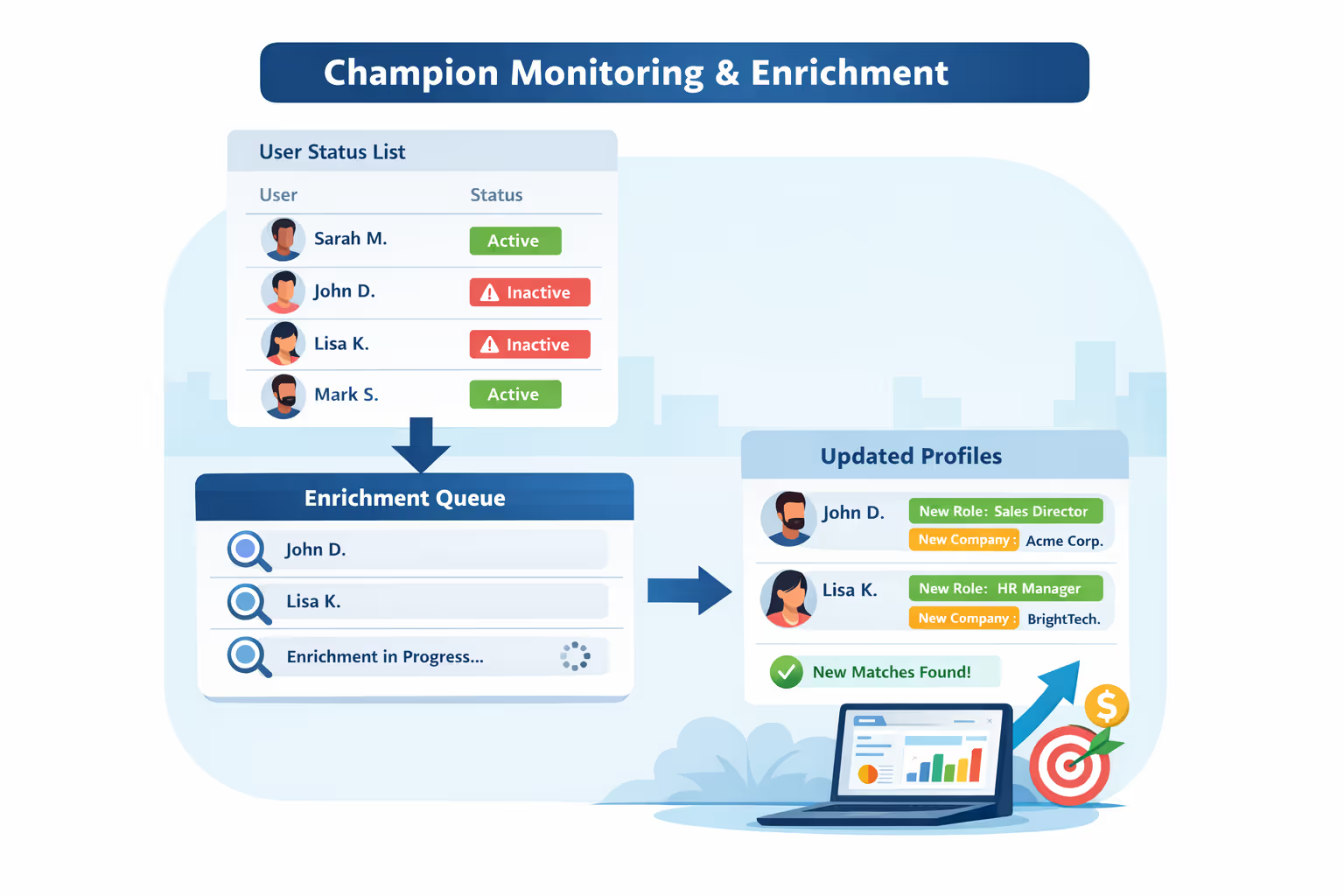
Deactivated user IDs from your installed base
If you sell a credentialed SaaS product — anything where individual users log in with their own username — you are sitting on a real-time departure feed that almost nobody uses as a sales signal.
Every time a customer's admin deactivates a user in your product, three things are almost always true. That person no longer works at that company. That person used your product, often as a daily-active user. And that person is, right now, either between jobs or actively starting a new one somewhere else.
This matters more than it used to, because people move faster than they did a decade ago. Median U.S. job tenure has fallen to roughly 3.9–4.1 years — the lowest level since 2002 — and in technology specifically, tenure is shorter still, often cited in the 2-to-3-year range. A meaningful slice of your entire installed base changes jobs every single year, whether or not you're watching for it.
A user-deactivation event is the cleanest, earliest, most accurate job-change signal a SaaS company can possibly receive. It arrives before LinkedIn updates, before email bounces, before the new-employer announcement. And almost no SaaS company routes it into a champion campaign.
Productboard is a clean example of the pattern. When a product manager who has been a power user inside a Productboard customer suddenly gets deactivated, that's not noise — that's a champion in motion. The trigger should be automatic: deactivation event, add to monitored list, validate placement at new employer, route to the appropriate AE the day the new role is confirmed.
The same logic applies to any SaaS where users are credentialed in: dev tools, analytics, sales engagement, HR software, security tooling, design platforms. If your product has named user seats, your deprovisioning log is a champion-tracking gold mine.
The calendars of your customer-facing team
The second source quietly causes the most friction between sales, customer success, RevOps, and whichever team owns CRM hygiene. It is also the single largest source of missing stakeholders we have ever measured.
Here's what we did at LeadGenius. We took every account executive, CSM, project manager, and customer-facing executive who runs QBRs, and pulled the full attendee history out of their Google Calendars (invited, accepted, attended). Then we compared that list against every stakeholder we had captured in Salesforce, across both customer accounts and open evaluation cycles.
We started with roughly 8,000 identified champions across the install base and pipeline. After the audit, we ended with over 17,000.
More than half of the humans who had actually been in a room with us — people who had been invited to, accepted, and attended live working sessions about our product — were invisible to every campaign we ran. Doubling our champion population didn't require new data sources. It required looking at the ones we already owned.
They were not missing for any one reason. They were missing for ten small reasons that compound: outreach that didn't sync, an invite logged five minutes before the call and never revisited, a forwarded invite that brought in an attendee never on the original thread, a new VP looped in over Slack three weeks into the cycle, an exec sponsor who attended as a +1 and was never a named contact. Each one is a rounding error. In aggregate, they are half your audience.
Why job-change feeds aren't enough
The dominant champion-monitoring tools (UserGems, ZoomInfo, Apollo, and the various LinkedIn-scraping point solutions) are all built on the same underlying signal: a public LinkedIn job-title update. That signal is useful, but it has three structural weaknesses — and each one is worse than it looks in isolation.
- It's late. People update LinkedIn weeks or months after they actually start a new role. Some never update it at all.
- It's unverified. A title change on LinkedIn doesn't come with a working email at the new company. By the time you reach out, the email you have on file bounces.
- It's one-dimensional. It captures only the people who maintain a public LinkedIn presence and update it promptly — systematically under-counting senior, technical, and international stakeholders.
Gartner moved off that stack for exactly this reason. Where UserGems, ZoomInfo, and Apollo were each surfacing a partial slice of the change-agent population, LeadGenius runs continuous monitoring across the full stakeholder graph — deactivation signals, calendar-derived contacts, public job changes, and traditional CRM history — with bounce-tested email verification and human-in-the-loop validation on top.
The net result, measured against the combined output of the three job-change tools they previously used: a roughly 30% increase in champion coverage. Not just identified. Contactable on day one of their new role.
Why this keeps getting harder, not easier
It's worth stepping back from any one company's numbers and looking at what the broader market research says, because it all points the same direction: the signal is decaying faster than most GTM stacks are built to handle, and the cost of missing it is growing.
Layer in that median U.S. job tenure has dropped to its lowest point since 2002, and that the buying committee itself has nearly doubled in size since 2015 (see the chart in Section 01), and the picture is clear: more people are moving, more people are in the room to begin with, and the cost of losing track of any one of them keeps climbing. None of these figures are proprietary to any single vendor — they're the market backdrop that makes champion monitoring worth doing at all. Our companion guide, How Champion Identification Drives B2B Success, walks through how that shows up in an actual pipeline, deal by deal.
Speed compounds all of it. None of this works if the signal sits in a queue. Response-time research — most famously the InsideSales.com study on lead follow-up — found that contacts reached within five minutes convert up to eight times more often than those reached even a few hours later. A job-change or deactivation signal has the same shape: it's most valuable the day it fires and loses value every day after that.
What this looks like in practice
A working champion-monitoring program built on the full signal set has three layers running in parallel.
Continuous capture. Every customer-facing calendar, every CRM stakeholder record, every product deactivation event, and every public job change feeds into one unified champion population. Capture is automated — humans don't have to remember to log anyone.
Continuous validation. Every contact is re-verified on a cadence: email deliverability, current employer, current title, current location. This is the step LinkedIn-only tools skip. At roughly 2% monthly decay, a quarterly-only cleaning cycle already leaves a meaningful share of "active" records wrong at any given moment.
Continuous routing. When any champion changes companies, a verified record routes to the right owner immediately — prospect, existing customer, or competitor-target play. The value of a job-change signal decays by the week.
"We doubled our identified champion population without buying any new data. We just stopped ignoring the data we already had."
See the full playbook →The numbers, attributed
The Paycor 0.7% to 5% jump is the one that tends to get the most attention, and it shouldn't be surprising. A cold contact converts at cold rates. A contact who already used your product, already liked it, and just walked into a new company that needs your product converts at warm-introduction rates. Champion monitoring is, in effect, the operational practice of turning the second group from invisible into reachable — the same 5-to-10x warm-versus-cold gap that shows up across the industry benchmarks in Section 05.
The Gartner coverage number is the one that matters most to a CRO. Coverage is the upstream input to every downstream metric: conversion, velocity, ACV, retention. A 30% coverage lift over the best-in-class stack of point tools means a third more buyers in motion are visible to the revenue org on any given week — against a backdrop where the buying committee itself has grown by roughly 2x over the past decade.
The LeadGenius internal number is the proof of concept. We doubled our identified champion population without buying any new data. We just stopped ignoring the data we already had.
How to start, in five moves
Audit your deprovisioning log. If you sell credentialed SaaS, your product has a list of every user deactivated by every customer admin in the last 24 months. Get that list.
Pull six months of customer-facing calendars. Every AE, CSM, PM, and customer-facing executive. Export the attendee data.
Reconcile against Salesforce. Expect to find that 30–60% of attendees were never captured as contacts.
Enrich, verify, and bounce-test. Every missing contact gets a current employer, current title, and validated email before anything else happens.
Monitor on a cadence. Re-verify every 30–90 days. Route job changes automatically, and treat the first 48 hours after any departure signal as the highest-value window you'll get.
This is the work. It isn't glamorous, it doesn't require new AI, and it doesn't require ripping out your existing data stack. It requires acknowledging that the signals you already own are worth more than the signals you currently pay for — and that the market environment is making that gap wider every year, not smaller.
The other half is sitting right there
The companies winning at champion monitoring in 2026 are not the ones with the biggest contact databases. They are the ones who treat every customer-facing interaction — every login, every logout, every calendar invite, every QBR — as a data event. They have stopped relying on individual reps to remember to log people, and stopped relying on LinkedIn to tell them who moved.
Your other half of champions is sitting in your product's admin logs and on your team's calendars right now. The question is whether you go find them before your competitor does.
How champion identification drives B2B success
The full guide walks through the operating model end to end — capture, validation, routing, and how teams put a dollar figure on the champions they were missing.
Read the full guide →.avif)