
This conversation used to feel theoretical.
It doesn’t anymore.
The last few years have made something clear: privacy exposure is not a niche legal issue - it is now an operational reality for the data industry.
Major data vendors have faced mounting scrutiny, including public lawsuits alleging improper sourcing, insufficient consent frameworks, or inadequate transparency around how records were collected and processed.
Large providers such as Cognism and ZoomInfo have both been named in multiple privacy-related legal challenges across jurisdictions - a signal that vendor scale does not eliminate sourcing scrutiny. In fact, it often increases it.
At the same time, companies like Apollo and Seamless have experienced platform enforcement actions - including LinkedIn company page suspensions - tied to how data collection practices intersect with platform policies.
These events matter less as isolated incidents and more as indicators of a broader shift:
Compliance enforcement is becoming infrastructure-level.
The web of privacy law is expanding across:
- Country legislation
- Regulator guidance
- Platform rules
- Registry requirements
- Enforcement precedent
- Cross-border interpretation
In other words, compliance complexity is compounding.
And static answers age quickly in a compounding system.
What the Country Mapping Makes Visible
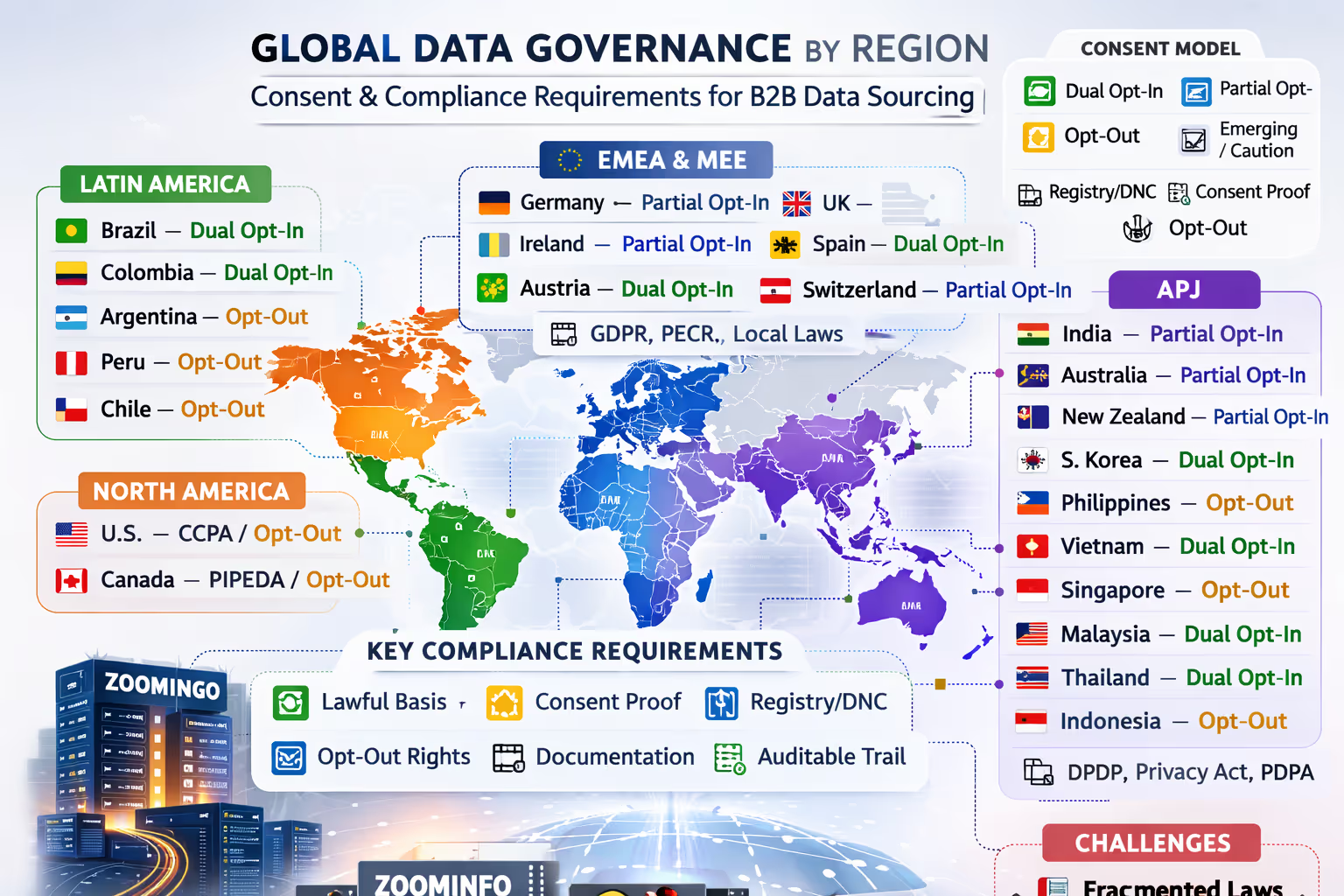
Your country mapping framework illustrates why this shift is structural, not temporary.
Even a single region (for example Latin America) already spans multiple regulatory models.
From the document:
- Brazil falls into a dual / explicit consent environment, where vendors must demonstrate documented lawful basis and consent pathways under the Brazilian Data Protection Law.
- Argentina, Peru, and Chile operate primarily under transparency + opt-out frameworks, where notice, suppression workflows, and registry integration become critical.
- Colombia introduces additional expectations around how vendors collect and document sourcing under national law and guidance.
These are not subtle differences.
They change:
- How records can be sourced
- What documentation must exist
- Which registries must be checked
- What proof must be retained
- How quickly workflows must adapt
A vendor claiming global coverage is implicitly claiming the ability to operationalize all of these differences simultaneously.
That is a much higher bar than “GDPR compliant.”
Why Lawsuits and Enforcement Signal an Architectural Problem
When enforcement actions happen, the narrative often focuses on legal exposure.
But the deeper signal is architectural.
Most traditional providers were built around accumulation:
Collect data → store it → refresh it periodically.
Compliance, however, behaves like a workflow problem:
Evaluate lawful basis → incorporate country rules → check registries → retain provenance → update when guidance changes.
Those are different systems.
And when the compliance environment becomes more intricate (which it is) the mismatch becomes visible.
Lawsuits, platform suspensions, and regulator inquiries are often symptoms of that mismatch.
Not necessarily wrongdoing.
But structural friction between static data models and dynamic regulatory expectations.
The Expanding Compliance Surface Area
The important shift revenue leaders should recognize is this:
Compliance risk no longer lives only in regulation.
It now exists across multiple layers simultaneously:
- Regulatory law (GDPR, LGPD, national DP laws)
- Country guidance from data protection authorities
- Registry ecosystems (DNC, suppression frameworks)
- Platform policies (LinkedIn, advertising ecosystems, enrichment tooling)
- Precedent created by enforcement and litigation
- Campaign context (intent, channel, geography, audience type)
Each layer evolves on its own timeline.
This is why the compliance landscape feels more intricate every year - because it literally is.
And complexity compounds faster than refresh cycles.
What This Means for Vendor Evaluation
The presence of lawsuits or enforcement actions across the industry does not automatically disqualify vendors.
But it does change what responsible evaluation looks like.
It means revenue leaders should move from asking:
“Are you compliant?”
To asking:
“Show me how compliance operates.”
Using your mapping framework, that becomes tangible:
- How does sourcing differ between Brazil (explicit consent) and Argentina (opt-out transparency)?
- How are registry checks incorporated before delivery?
- What documentation exists at the record level?
- How does the vendor update workflows when country guidance changes?
- What proof can be produced if sourcing is questioned?
Those questions reflect the real environment not the marketing narrative.
The Direction the Market Is Moving
The industry is moving toward provenance transparency whether vendors are ready or not.
Because regulators are asking for it.
Platforms are enforcing it.
Customers are demanding it.
And global expansion makes it unavoidable.
The result is a quiet but important shift:
Compliance maturity is becoming a competitive differentiator.
Not because buyers suddenly care about legal nuance but because compliance clarity directly affects:
- Campaign speed
- Geographic expansion
- Platform stability
- Legal confidence
- Pipeline durability
In a world where the compliance web grows more intricate by the day, documentation is no longer defensive.
It is enabling infrastructure.
And vendor answers (especially specific ones) are now signals of whether that infrastructure actually exists.
.avif)