Germany GTM Playbook: Turn GDPR Compliance into Your Competitive Edge
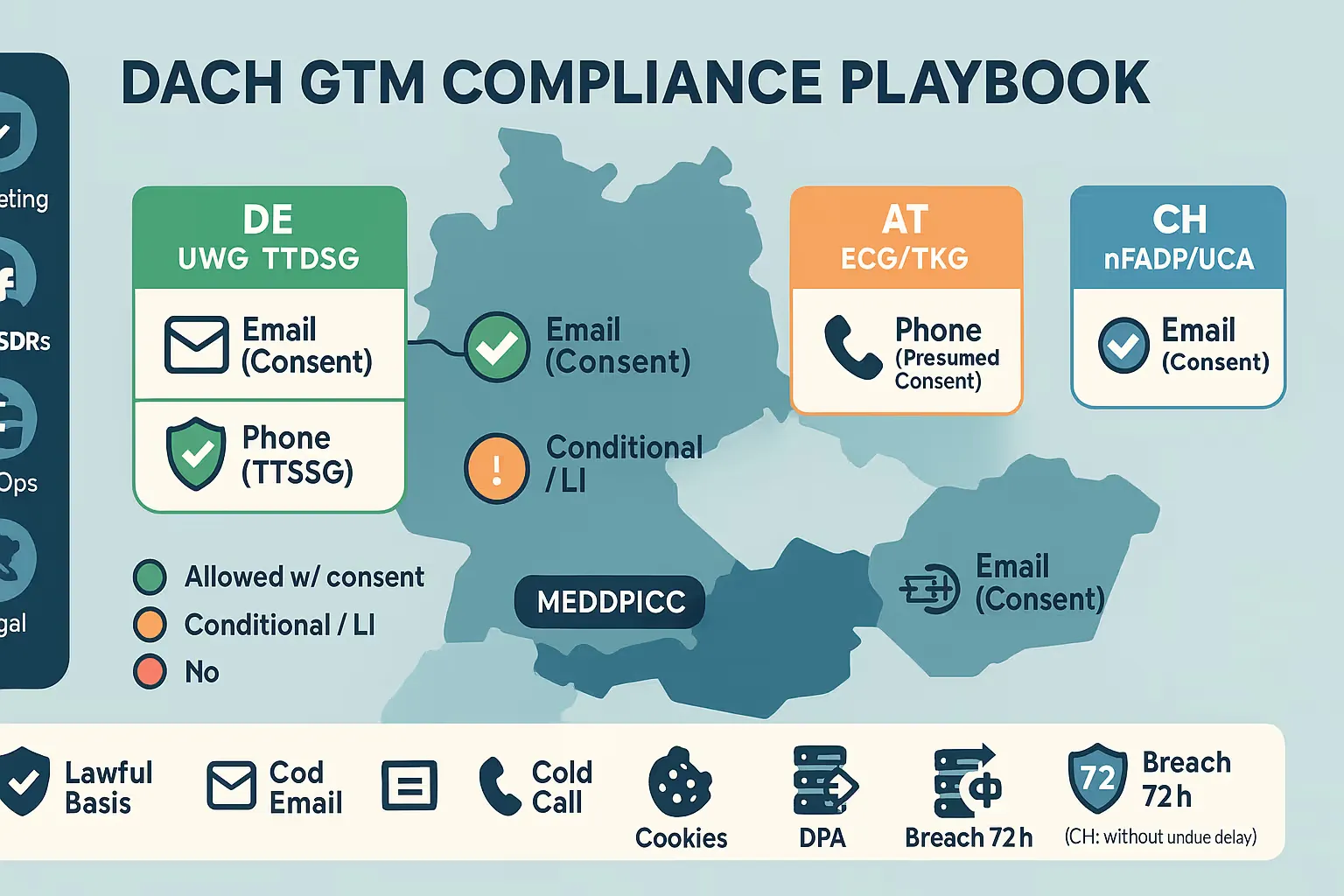
The DACH GTM Compliance Playbook visualizes data privacy expectations across Germany (DE), Austria (AT), and Switzerland (CH), clarifying where consent or legitimate interest applies for outreach and cookies. It helps GTM teams quickly understand what’s allowed—showing at a glance that email marketing requires consent everywhere, while B2B calling remains conditional under German and Austrian law.
Guide
Executive summary (for CRO/GC)
Why it matters (Germany): GDPR is the global benchmark. Its seven principles—lawfulness/fairness/transparency; accuracy; purpose limitation; data minimization; storage limitation; integrity & confidentiality; accountability—shape how you build lists, track consent, and run campaigns. Expect 72-hour breach notification, clear controller/processor obligations, and fines up to €20M or 4% of global revenue.
What you get today: a Germany-specific playbook covering lawful bases for B2B outreach, cold email/call rules under the German UWG, cookie/ePrivacy expectations (TTDSG), breach windows, transfer posture (EU-US DPF), supervisory authority routing, and AE/SDR talk-tracks + logging.
How to win: Treat compliance as a GTM system. Bake lawful basis + consent provenance into CRM picklists and MAP/CMP sync. Use privacy-first targeting (account signals + Legitimate Interest only where valid), and opt-in activation where consent is required. That’s how LeadGenius outperforms static lakes (ZoomInfo/Apollo): custom compliance + custom insight, delivered in real time.
Pro tip (Revenue leaders): Compliance + account signals is the winning combo. Signals don’t replace consent for email in DE—but they increase relevance (opt-in conversions) and justify “presumed consent” for targeted B2B calling when documented.
Consent-first email:
“We only email contacts who’ve opted-in or are existing customers for closely related services. If you’d like specifics or to update your preferences, here’s the link.”
Signal-justified call:
“I’m calling because your team just [signal: e.g., posted a DE RFP for X]. Given your role, this seemed relevant—happy to keep it brief, and I’ll note your preference if phone isn’t ideal.”
Operational playbooks (drop straight into SOPs)
For AEs & SDRs (front-line sellers in Germany)
When LI might work (phone only):
Call only relevant roles at companies that show fresh, concrete buying signals (your “presumed consent” basis).
In your notes, log: signal, date, source, why this role, and why phone is appropriate. Meyen Trademark Law
When consent is required (email / most cases):
Use permission pathways: content syndication (with proof of consent), webinar registrations (explicit marketing consent box), or double opt-in.
If invoking §7(3) UWG (existing customers): confirm “similar goods/services,” show prior collection, and include one-click opt-out—every time. Schürmann Rosenthal Dreyer Rechtsanwälte
Bespoke > prebuilt. We turn living country rules into fields, validations, and automations—and we fuse them with account signals to drive lawful, high-propensity outreach. That’s a play static databases can’t run.
Share
Related Resources
Guide
Best B2B Data Provider for Germany: GDPR, UWG, and How to Stay Out of Court
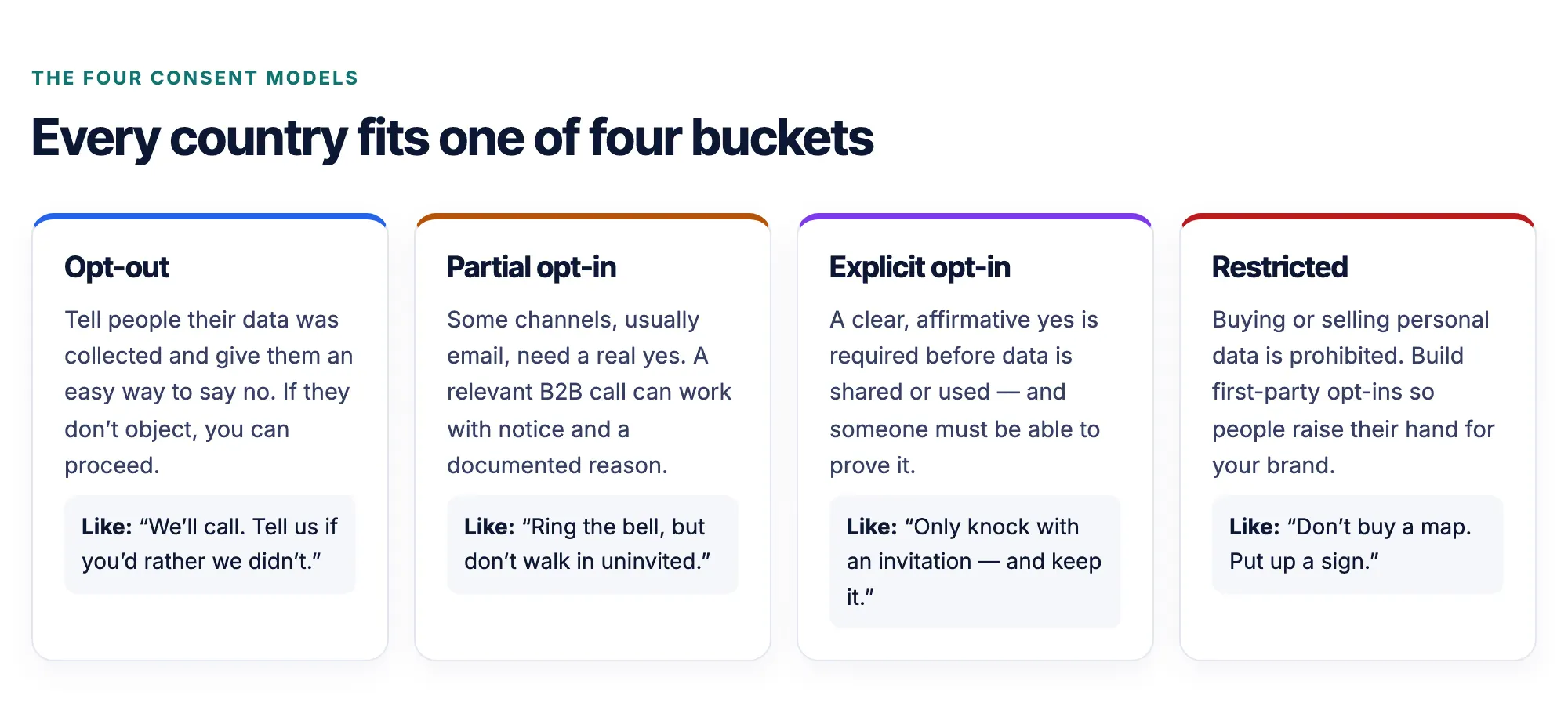
Before choosing a B2B data provider for Germany, every revenue and compliance leader should be able to answer five questions: what law applies, who enforces it, what the maximum penalty is, what consent model the country requires, and what DNC or suppression registries must be honoured. Here's the snapshot for Germany.
Best B2B Data Providers for DACH and Germany: Why Regional Coverage Beats Generic Global Databases
Germany is not just another country filter in your database. DACH is not just "Europe, but German-speaking." Learn what to look for in a regional B2B data provider, and why hierarchy mapping, contact verification, and compliance handling matter more than total record count.