
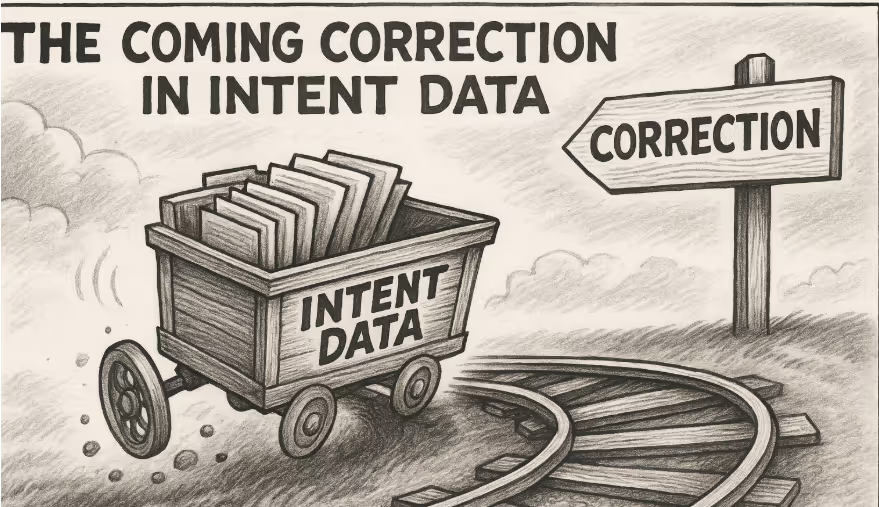
For nearly a decade, intent data has enjoyed a strange kind of reverence in B2B. The idea that you could know which companies were preparing to buy, before they ever spoke to you, delivered the promise technology always offers at its most seductive: foresight. If data could reveal the future, the pipeline would fill itself. Sales would stop guessing. Marketing would stop wasting time. Alignment would finally happen not through meetings and models, but through mathematics.
But when fiction meets procurement review, belief loses its power.
I’ve spoken with six senior revenue leaders in recent weeks. Six different organizations. Six different budget structures. Not one saw a material improvement in meeting conversion from high-intent account outreach. Not one renewed their contract with the major intent providers. The silent churn rate is an indictment far more powerful than any report.
This is not about disappointment. It is about realization.
Why the market is turning
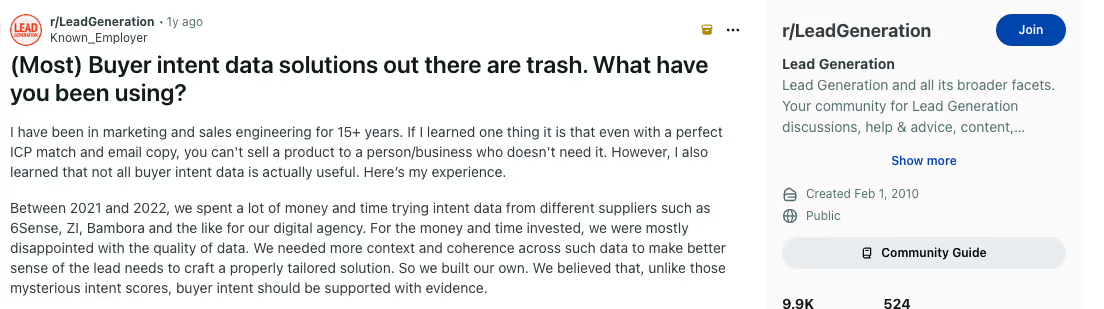
The problem isn’t simply that Bombora and 6Sense couldn’t fulfill the promise. It’s that the promise itself was always built on inference, not certainty.
Intent vendors sell the idea that digital behavior equals commercial readiness. That reading patterns, search activity, or topic consumption at scale indicates a pending purchase. Yet none of these behaviors necessarily connect to buying behavior. They connect to curiosity.
Someone researching Kubernetes may be comparison shopping. Or they may be studying for a certification. Or drafting a blog. Or onboarding into a role. The data exhaust is identical. The commercial implication is not.
Which leads to four core reasons revenue teams are beginning to distrust the model.
Reasons for skepticism
False positives are common. A surge in research often reflects job requirements, competitor benchmarking, or general interest rather than imminent purchase behavior. The sales motion built on that assumption burns cycles and morale.
Lack of specificity compounds the problem. When signals are aggregated across domains or triggered by ambiguous keywords, the output becomes less predictive and more probabilistic. Without context, a spike is only a spike.
There is a growing conversation about what some call data laundering. The concern is simple. Some intent signals may simply be re-packaged first-party engagement or low-quality third-party data, presented as proprietary insight. A recycled signal masquerading as revelation.
And reliance on intent alone leads organizations to ignore the ninety-five percent of buyers who are not actively researching solutions today but are developing a need, slowly, structurally, beneath the surface. These are the buyers who fuel next-quarter revenue, not this-quarter urgency. A model optimized for surges misses the market before it forms.
The structural flaw remains the core weakness
Even if intent data were perfect, sales would still struggle. Because outbound requires person-level clarity, and intent lives upstream at the account level. An account reading about a topic tells you nothing about who read it, who cares about it, who owns budget, or who will champion change.
Sales does not sell to accounts. It sells to individuals acting on behalf of an account.
That gap between account inference and contact precision is where quota misses happen.
Where intent can be valuable
The answer is not to discard intent. The answer is to re-position it.
Intent becomes useful only when it is contextualized, validated, and combined with other signals that strengthen its meaning rather than assume it.
The most effective teams are blending intent with first-party evidence such as site visits, content consumption, product trials, event attendance, and outbound engagement response patterns. Intent becomes hypothesis, not conclusion.
Account-level shifts still matter. When an entire organization demonstrates increased interest around a category, particularly when layered with hiring spikes, budget allocation indicators, or new leadership appointments, the predictive weight increases materially. Collective behavior is direction, not noise.
Providers must be vetted with the scrutiny we reserve for financial auditors. Transparent methodologies, ethical data sourcing, clarity around keyword classification, and the ability to identify both the power and limits of the dataset should be a non-negotiable requirement.
And intent should be one signal among many, never the operating system. When treated as a primary decision engine, it misleads. When treated as a lens, it informs.
The future is insight over inference
Intent data succeeded because it told a story we wanted to hear. Knowledge before contact. Pipeline before outreach. A world where revenue was discoverable through browsing behavior alone. But outcomes have exposed a misalignment between the idea and the workflow it was meant to power.
The next era will not belong to platforms that infer interest, but to systems that reveal change. Actual signals. Actual movement. Actual evidence. Not who is reading, but who is reorganizing. Not who is curious, but who is investing. Not what is searched, but what is built.
The reckoning for intent will not be a collapse. It will be a correction. The market is not rejecting the technology. It is rejecting the illusion that inference equals inevitability.
And in that correction lies the opportunity.
.avif)