Most GTM teams don’t actually have a TAM problem.
They have a reachable market problem — and they don’t notice it until the quarter gets weird.
If you’ve ever looked at your ICP list, opened LinkedIn, and thought “we can definitely reach these people,” you’re not alone. LinkedIn is the default source of truth for prospecting, targeting, ABM audience building, and even market sizing. It feels like the map.
But here’s the quiet truth that shows up in customer calls over and over:
LinkedIn coverage ≠ reachability.
Coverage is: “People exist.”
Reachability is: “We can reliably identify, match, and activate them — by industry, persona, and tier — at the level our GTM motion needs.”
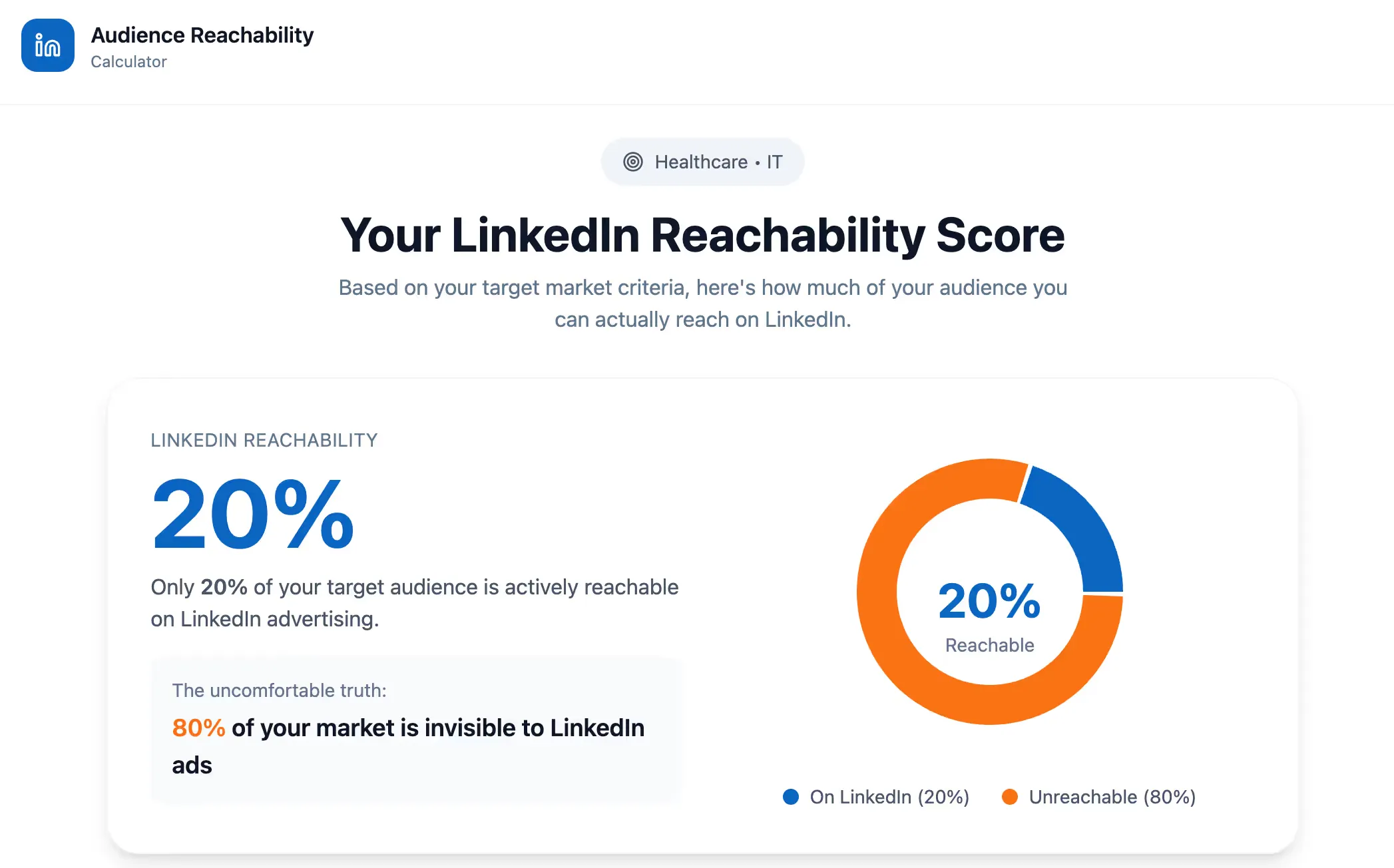
That gap is exactly why I built the LinkedIn Reachability Calculator.
It’s a simple tool that helps teams quantify what they usually hand-wave:
- How much of your TAM is actually reachable on LinkedIn?
- How much of your ICP becomes unreachable once you segment by industry, persona, and market tier?
- How much pipeline are you leaving on the cutting room floor because your “coverage assumptions” are wrong?
And if you’re building pipeline goals, territories, rep books, ABM programs, or expansion plays — this isn’t a philosophical exercise. It’s math.
The problem: we keep confusing market size with matchable market
Most revenue leaders are operating with a stack of assumptions that sound reasonable:
- “LinkedIn has everyone.”
- “If we can’t find them on LinkedIn, they probably don’t matter.”
- “We can use LinkedIn audience building as a proxy for market access.”
- “If our match rate is low, the fix is better ads / better messaging / more touches.”
Sometimes those assumptions hold.
But in customer testimonial calls (and in real-world experience), a consistent pattern shows up:
LinkedIn reachability collapses in specific pockets of the market.
Not randomly — predictably.
Where it falls short most often
- Certain industries look fine at a macro level… then break when you zoom into sub-verticals.
- Certain personas exist, but are hard to match to the right company, location, role scope, or buying group.
- Certain market tiers (SMB, long tail, multi-location, international) create a coverage cliff where “finding” turns into “guessing.”
That’s not a LinkedIn problem. It’s an inputs problem.
If your GTM model assumes you can reach your market through LinkedIn, but your actual matchable universe is smaller than you think, everything downstream gets distorted:
- forecasting
- territory design
- ABM audience sizing
- outbound productivity expectations
- CAC math
- pipeline coverage requirements
Why the calculator matters: it gives you a reality check before you scale
The calculator is designed to do one job:
Make your reachability explicit.
It gives you a fast way to quantify “market access” instead of relying on gut feel.
Because once you can measure reachability, you can make better decisions about:
- whether LinkedIn-only targeting is enough
- where you need supplemental data
- which segments require a different sourcing strategy
- whether pipeline goals are realistic given your reachable ICP
This is especially important if you’re selling into markets where signals and identification are harder than generic B2B:
- niche vertical SaaS categories
- regulated industries
- international expansions
- field-heavy workforces
- multi-location and franchise models
- SMB-heavy TAMs
- partner ecosystems and VAR channels
Those are the markets where generic lists and “prebuilt databases” tend to look great in a demo… and underperform in production.
What the calculator does (in plain English)
I built the experience as a short four-step survey that helps you estimate:
- Your true TAM (what exists in the real world)
- Your ICP slice (who you actually want)
- Your LinkedIn-reachable subset (who you can consistently match and activate)
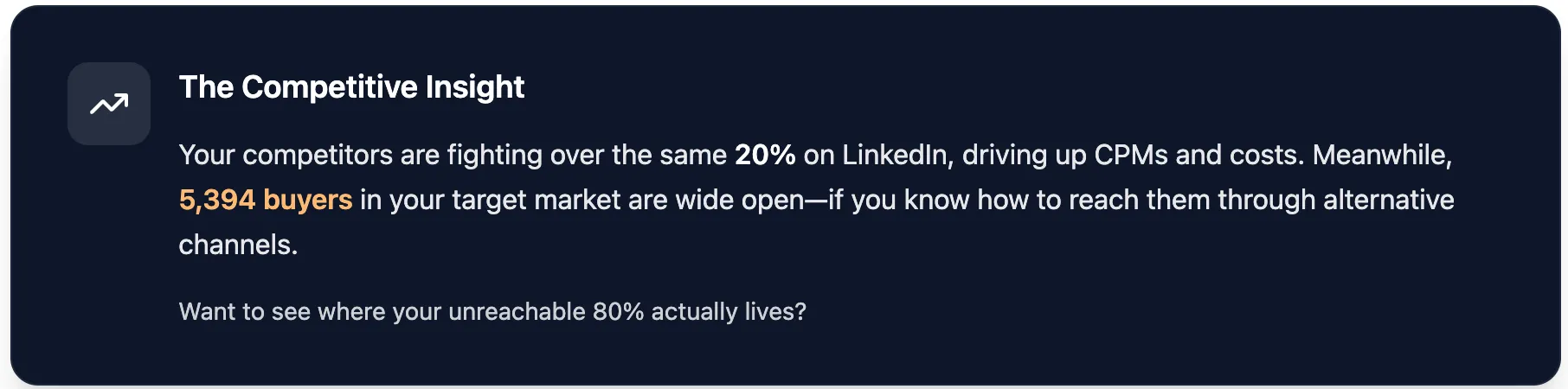
- Your “left behind” segment (the portion you’re structurally missing if LinkedIn is your main map)
The output isn’t meant to be academically perfect. It’s meant to be directionally honest — and more honest than the default approach most teams use (which is basically: “LinkedIn seems big enough”).
The real win is the behavior change it creates:
Instead of asking “How do we do more on LinkedIn?”
You start asking “Where does LinkedIn work… and where do we need different inputs?”
That’s the shift.
The downstream impact: better pipeline math, better strategy, fewer surprises
When you don’t measure reachability, you end up blaming the wrong thing.
You blame:
- messaging
- creative
- rep activity
- bid strategy
- sequencing
- SDR quality
When the real limiter is:
you’re not reaching enough of the market to create consistent opportunities.
A few examples of what reachability affects
1) ABM audience sizing
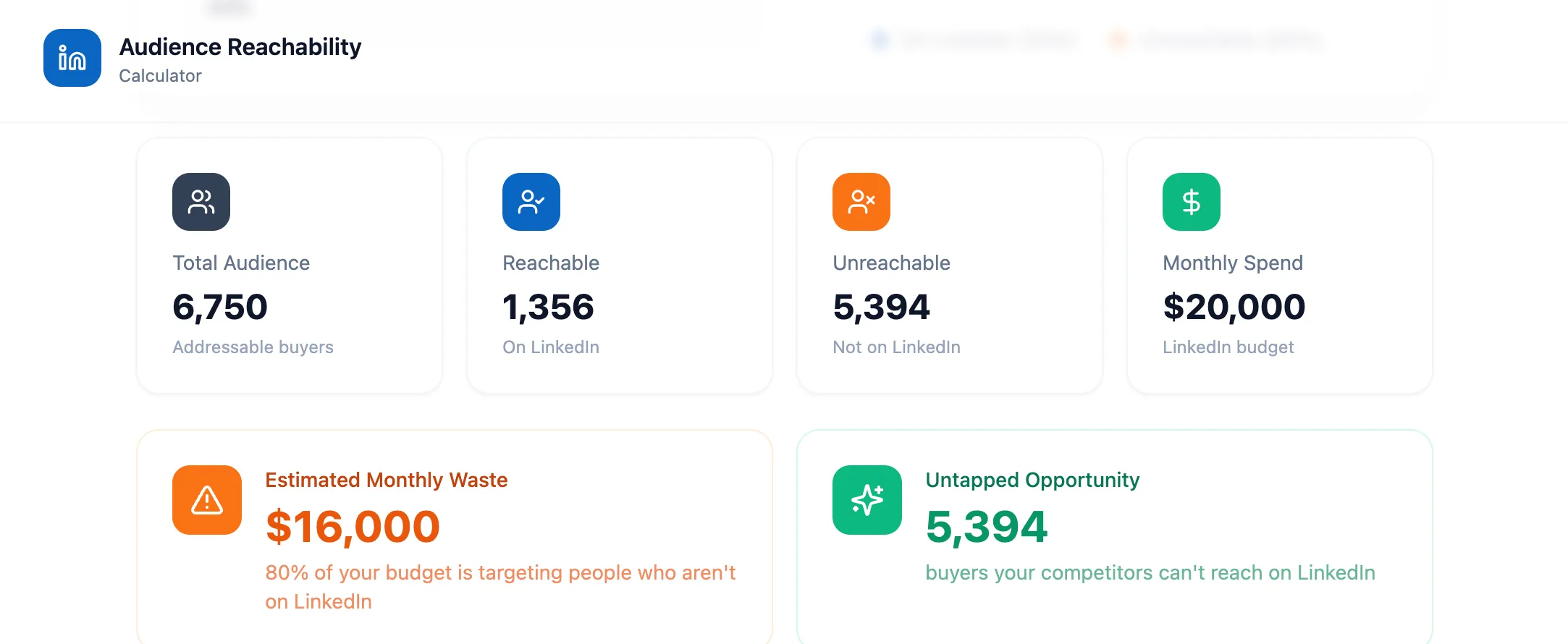
If your ABM program is designed for 20,000 target accounts but your matchable LinkedIn audience is only 6,000, you’re going to see:
- high frequency
- declining performance
- “creative fatigue” that’s actually audience exhaustion
- false conclusions about ICP
2) SDR productivity
If SDRs are expected to hit activity targets based on an assumption of abundant reachable contacts, but the segment is structurally hard to source, you get:
- lower connect rates
- more time wasted
- higher rep frustration
- pipeline variability
…and eventually, a belief that outbound “doesn’t work.”
3) Territory design + coverage
If territory books are built from incomplete reachability, you end up with reps holding:
- dead zones
- under-covered verticals
- missing buying groups
- “account lists” that look legit but are missing the humans who matter
This is why the calculator is important: it pushes you to design around reality.