
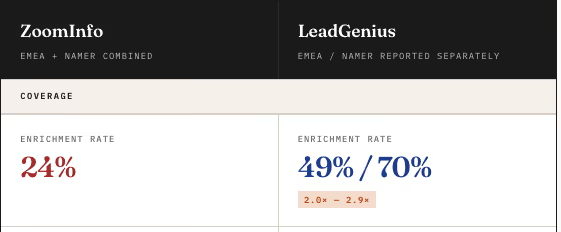
An AWS sales team ran the same enrichment job through LeadGenius and ZoomInfo. LeadGenius returned 3.7× more EMEA contacts, a connect rate 3× higher, and an invalid phone number rate 9× lower. The gap was largest in EMEA — exactly where ZoomInfo's LinkedIn-indexed model has the most structural weakness.
Most data provider comparisons are theoretical. The vendor publishes accuracy claims, the buyer takes them on faith, and nobody runs the actual head-to-head. This one was real. An AWS team responsible for prospecting into SMB and mid-market accounts in EMEA and North America sent the same list of target companies to both LeadGenius and ZoomInfo, asked for the same enrichment job, and measured what came back. We're publishing the numbers because they matter, and because if you're evaluating data providers for an SMB sales motion, you should see what a real test looks like before you sign anything.
One important framing note before the scoreboard: this test was on SMB and mid-market accounts, which is the segment where LeadGenius has its biggest structural advantage. For enterprise prospecting into Fortune 500 contacts, ZoomInfo would post much stronger numbers and would often win. The point of this comparison isn't that ZoomInfo is a bad tool. It's that ZoomInfo is the wrong tool for this specific job — and the gap is bigger than most teams realize until they run the test.
The scoreboard
Same input. Same enrichment job. Both providers running their full data pipelines. Here's what each one returned:
What the numbers actually mean
Coverage: 3.7× more contacts in EMEA
ZoomInfo returned 2,200 contacts across the entire combined EMEA + NAMER list. LeadGenius returned 8,244 in EMEA alone, plus another 1,307 in North America. The combined LeadGenius total of 9,551 is more than 4× the ZoomInfo total — and the EMEA gap alone is where the story is.
This is the structural problem we keep talking about. ZoomInfo's database is built on LinkedIn profiles and US-pattern corporate email structures. European SMBs operate under GDPR constraints, use country-specific domains, and are dramatically less likely to maintain active LinkedIn profiles than their North American counterparts. The result: a 24% combined enrichment rate, with the weight of the miss falling in EMEA.
LeadGenius's AI plus human-in-the-loop sourcing isn't constrained to a pre-built index. Researchers can verify contacts from country-specific sources — chambers of commerce, business registries, regional directories, native-language web pages — that scraped databases don't reach. The 49% EMEA enrichment rate isn't magic. It's just that the architecture matches the segment.
Accuracy: a connect rate 3× higher
Coverage matters, but accuracy is what actually drives pipeline. ZoomInfo's 11-14% connect rate means that out of every 100 dials, 11-14 reach a real person. LeadGenius's 40-42% connect rate means 40-42 do. For an outbound team running 5,000 dials a week, the difference between those two numbers is the difference between a struggling motion and a healthy one.
The invalid phone number rate tells the same story from the other direction. 28% of the phone numbers ZoomInfo returned didn't connect to anyone — they were disconnected, reassigned, or wrong from the start. LeadGenius's invalid rate was 3%. That's the difference between scraping numbers and verifying them.
The math that matters
Vendor pricing is usually compared on dollars per contact. That's the wrong unit. The unit that matters is dollars per booked meeting — and once you run the math with the AWS team's actual connect rates, the cost picture inverts.
ZoomInfo @ 12.5% connect rate → 625 conversations
LeadGenius @ 41% connect rate → 2,050 conversations
Same meeting-to-conversation ratio (say 8%):
ZoomInfo → 50 meetings
LeadGenius → 164 meetings
If LeadGenius costs 2× per record but produces 3.3× the meetings, the cost per meeting is 40% lower. That's the calculation enterprise teams with serious SMB motions tend to make when they sit down with the data — and it's the calculation Apollo and ZoomInfo can't win on segments where their data quality drops below 20% accuracy.
This math works for SMB and mid-market prospecting in segments that don't index well on LinkedIn. For enterprise SaaS prospecting against Fortune 1000 contacts with active LinkedIn profiles, the connect rate gap closes significantly and ZoomInfo's intent data and scale advantages often justify their pricing. The point isn't that one tool is universally better. It's that you need to know which job you're hiring the tool for.
Why the gap is biggest in EMEA
The single largest delta in the test was EMEA enrichment: 49% for LeadGenius vs ZoomInfo's combined 24%. Three reasons:
LinkedIn density is lower. European SMBs — especially in Germany, France, Italy, and Spain — use LinkedIn far less than US counterparts. A US-style database built on LinkedIn scraping inherits this gap by architecture.
GDPR limits aggressive scraping. Legitimate B2B sourcing in the EU requires careful handling of personal data. Databases built primarily for the US market often have shallow or stale European coverage because their sourcing methods don't translate cleanly to GDPR-compliant operations.
Country-specific signals require country-specific research. A French SMB might be sourced from the SIRENE registry. A German one from the Handelsregister. A Brazilian one from the CNPJ database. These aren't fields in a generic database — they're sources that require local research to mine. LeadGenius's model is designed for exactly this; ZoomInfo's isn't.
How to read this if you're evaluating providers
Three takeaways for anyone running a similar evaluation:
Test on your actual ICP, not a generic list. The AWS team's results came from a real target list in their real motion. A vendor demo using cherry-picked accounts is meaningless. Send both providers the same 1,000-row sample from your actual pipeline and compare what comes back. Both LeadGenius and ZoomInfo offer pilot evaluations specifically for this.
Measure connect rate, not just enrichment rate. Enrichment rate tells you what percentage of records the provider could touch. Connect rate tells you how many of those records actually work. The first number is marketing; the second is pipeline. Always measure both.
Separate the test by region. Combined averages hide where the real differences are. The AWS team learned more from the EMEA split (49% vs effectively ~15% on EMEA-only) than from any combined number. If you sell globally, test globally.
The questions buyers actually ask
What does enrichment rate mean in a B2B data comparison?
Enrichment rate is the percentage of input records the data provider can return with usable contact information. If you send a provider 10,000 company records and they return verified contact data for 4,900 of them, the enrichment rate is 49%. It is the single most important measure of provider coverage on a specific ICP.
Why is ZoomInfo's enrichment rate lower in EMEA than in North America?
ZoomInfo's database is heavily indexed against North American LinkedIn profiles and US-pattern corporate email structures. European SMBs are less likely to be on LinkedIn, more likely to use country-specific domains and personal email patterns, and operate under GDPR constraints that limit how aggressively data can be scraped. The combined effect is meaningfully lower coverage on EMEA SMB and micro-SMB segments.
What is a connect rate and why does it matter more than contact volume?
Connect rate is the percentage of dials or outreach attempts that actually reach a real person. A provider can hand you 10,000 phone numbers, but if only 11% of dials connect to a human, you have 1,100 real conversation opportunities. At a 42% connect rate, the same 10,000 numbers produce 4,200 conversations. Connect rate is the number that actually drives pipeline.
Is this AWS comparison representative of typical results?
Results vary by ICP, region, and use case. The AWS team was specifically prospecting into SMB and mid-market accounts in EMEA and North America, which is the segment where LeadGenius's AI plus human-in-the-loop sourcing has the largest structural advantage over LinkedIn-indexed databases. For enterprise SaaS prospecting into LinkedIn-active companies, the gap would be much smaller and ZoomInfo would often win.
How does LeadGenius achieve a 3% invalid phone number rate?
Pure scraping produces high invalid rates because phone numbers go stale fast — small business owners change carriers, sell their businesses, or retire numbers. LeadGenius combines AI-driven sourcing with human researcher verification. Researchers validate numbers before delivery, catching the data decay that automated systems miss. The 3% invalid rate reflects this human verification step.
Run the same test on your data
If you'd like to compare LeadGenius against your current provider on your actual ICP, we run pilot evaluations specifically for that. No commitment, real numbers.
Request a Pilot.avif)