
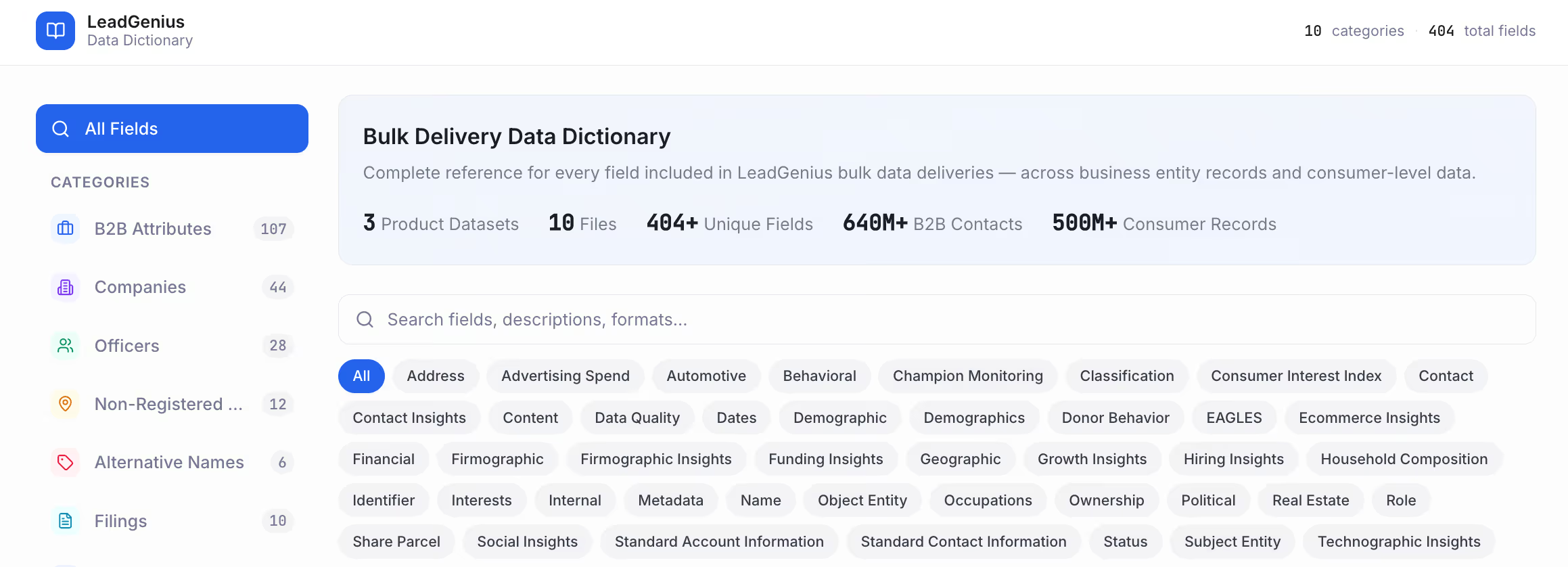
Most B2B databases were built for a simpler era of go-to-market. You needed a company name. A domain. An industry. A revenue range. A contact name. A title. Maybe an email if you were lucky. That was the data model.
Modern GTM teams do not just need more records. They need better ways to understand accounts, contacts, locations, technologies, ecommerce activity, hiring patterns, buying committees, regional coverage, and the real-world signals that tell a rep or marketer why an account is worth pursuing now.
That is why a B2B data dictionary matters.
A data dictionary is not just a list of fields. It is the operating system for your go-to-market strategy. It defines what your company can know about a market, how precisely you can segment it, how confidently you can route it, and how intelligently your sales and marketing teams can act on it.
The future of B2B data is not one giant prebuilt database. The future is custom data built around the specific markets, segments, accounts, contacts, and buying signals that matter to your business.
That matters whether you are building international coverage in DACH, APAC, LATAM, or the UK; identifying SMBs like restaurants, franchises, HVAC companies, medspas, contractors, or law firms; mapping ecommerce sellers across Amazon, Shopify, eBay, Walmart Marketplace, Etsy, and TikTok Shop; or enriching your CRM with buying committees, direct dials, technographics, hiring signals, and account-level growth insights.
This guide breaks down what a modern B2B data dictionary should include, how revenue teams should use it, and why custom data points often outperform static lists from traditional sales intelligence vendors.
What is a B2B data dictionary?
A B2B data dictionary is a structured catalog of account, contact, firmographic, technographic, ecommerce, hiring, social, funding, location, and signal-based fields that a revenue team can use to define, enrich, segment, score, and activate target accounts.
The best B2B data dictionaries go beyond basic company and contact fields. They include custom data points such as active job postings, technologies used, ecommerce platform, Amazon seller rating, Shopify store indicators, new product launches, new location openings, executive changes, funding events, social followers, direct dials, contact status, buying committee roles, and account-level growth signals.
For GTM teams, the point of a data dictionary is not documentation. The point is activation.
Chapter 01 Why standard B2B data fields are no longer enough
The traditional B2B data model was built around standard account and contact information. That usually means company name, website, industry, employee range, revenue range, headquarters address, contact name, title, department, seniority, email, phone, and LinkedIn URL.
Those fields still matter, but they are no longer enough to win. Every major vendor has some version of the same basic fields, and your CRM probably has half of them already, in various states of decay. The problem is that basic fields tell you who exists. They do not tell you who is ready, who fits, who is growing, who is reachable, who is changing, or who should be prioritized.
"Which audience can I target that my competitors are missing?"
"Which fields do we need to route, score, segment, and measure correctly?"
"Who can my reps actually reach, and what should they say?"
"Which accounts should my team focus on this quarter?"
That is where custom data points become the difference between a generic list and a GTM advantage.
Chapter 02 The core categories in a modern B2B data dictionary
A modern B2B data dictionary should organize data into categories that map to real GTM use cases. This helps teams understand which fields are foundational, which fields are useful for segmentation, which fields support contactability, and which fields create proprietary advantage.
Account data
Company name, website, industry, employee range, revenue range, location, phone, LinkedIn URL, and company description.
Contact data
First name, last name, title, department, seniority, email, direct dial, LinkedIn URL, contact status, and location.
Firmographic data
Business type, founded year, years in business, company description, current investors, specialties, and competitor information.
Technographic data
Technologies used, technology type, annual technology spend, first verified date, and last verified date.
Growth signals
Employee growth, department growth, new locations, new product launches, M&A activity, executive changes, and recent news.
Ecommerce data
Amazon seller data, Shopify platform indicators, product count, online store revenue, website visitors, seller ratings, and marketplace URLs.
Social insights
Social handles, follower counts, Google Maps reviews, Facebook likes, Instagram followers, LinkedIn followers, and YouTube subscribers.
Registry & location
Legal name, jurisdiction, company status, branch status, officer data, address verification, latitude, longitude, and postal metadata.
The important thing is not just having these categories. The important thing is being able to combine them into a custom dataset that reflects a specific business problem.
Same data dictionary. Different GTM motion. That is the whole point.
Need a field that does not exist in your current data stack?
LeadGenius builds custom data points to spec, then delivers them to your CRM, warehouse, or ad platform on a schedule that fits your GTM motion.
Chapter 03 Standard account information: the foundation
Standard account information is the base layer of a B2B data dictionary. These are the fields most teams expect from any B2B data provider.
| Field group | Example fields | Primary use case |
|---|---|---|
| Company identity | Company name, website, company phone, LinkedIn URL | CRM matching, deduplication, account identification, routing |
| Company profile | Industry, employee range, number of employees, revenue range | ICP filtering, segmentation, account scoring |
| Location | Street, city, state, zip or postal code, country | Territory planning, direct mail, field sales, regional segmentation |
This is the layer that supports basic segmentation, territory planning, CRM matching, routing, enrichment, and reporting. But on its own, it is not a strategy.
A list of software companies in Germany is not a DACH GTM motion. A list of restaurants in California is not a restaurant acquisition strategy. A list of Shopify stores is not a merchant growth plan.
Standard account data tells you where to start. Custom data tells you where to focus.
Chapter 04 Firmographic insights: moving beyond basic company size
Firmographic data helps GTM teams understand what a company is, how it is structured, and whether it looks like a fit. Common firmographic fields include business type, company description, founded year, years in business, current investors, LinkedIn specialties, list of competitors, and CEO rating.
These fields help revenue teams move beyond generic filters like industry and employee count. A company description can help distinguish between two companies in the same industry that actually serve different markets. LinkedIn specialties can reveal whether a company aligns with a specific product category. Years in business can separate early-stage businesses from established operators. Competitor fields can help build conquest campaigns.
In practice, firmographics help GTM teams build better account lists, refine ICP definitions, prioritize accounts, route territories, and personalize outreach.
Chapter 05 Growth insights: the fields that tell you "why now?"
Growth insights are some of the most valuable fields in a B2B data dictionary because they help answer the timing question. A company might fit your ICP, but that does not mean it is ready to buy.
Growth signals help identify accounts that are changing. Useful growth fields include employee growth, department growth, mergers and acquisitions, new location openings, new product or service launches, recent company news, and executive changes.
- A company opening a new location may need local services, logistics, hiring support, POS systems, security, insurance, payroll, or marketing support.
- A company launching a new product may need partnerships, agencies, data, demand generation, infrastructure, or sales capacity.
- A company experiencing department growth may need tools, services, or vendors tied to that expanding function.
- A company involved in an M&A may need integration support, data cleanup, technology consolidation, HR systems, finance transformation, or account mapping.
That is why these fields matter more than static firmographics. They help your team answer "why now?" before the rep writes the email.
Chapter 06 Funding insights: capital and momentum
Funding data is a classic GTM signal, but it becomes more useful when it is part of a broader data dictionary. Useful funding fields include most recent funding amount, funding event type, most recent funding year, total funding, and current investors.
Funding alone does not guarantee fit. A newly funded company can still be a terrible prospect if it does not match your segment, region, maturity, or use case. But when funding data is combined with hiring trends, employee growth, technology usage, and relevant contacts, it becomes much more useful.
Not "target all funded companies." Target funded companies that match your ICP and show the operational signals that make your offer timely.
Chapter 07 Hiring insights: one of the most underused GTM signals
Hiring data is a strong indicator of company priorities. If a company is hiring engineers, it may be building product. If it is hiring sales reps, it may be expanding revenue capacity. If it is hiring customer success, it may be scaling accounts. If it is hiring security, data, marketing, or finance roles, those functions may be under pressure or investment.
Useful hiring fields include active job postings, number of job openings at the company, executive change in the last six months, executive change in the past year, department growth, department size, and employee growth.
For outbound, hiring signals make messaging more relevant. Instead of saying, "I saw you are a fast-growing company," a rep can say, "I noticed you are hiring across revenue operations and customer success, which usually creates pressure around account coverage, routing, and data quality." That is the difference between personalization and relevance.
Chapter 08 Technographic insights: knowing the stack before you sell
Technographic data helps GTM teams understand what technologies a company uses. Useful technographic fields include technologies used, technology type, annual technology spend, first time verified, and last time verified.
Technographic data is especially valuable for software companies, consulting firms, integration partners, cloud providers, cybersecurity vendors, RevOps teams, and any company selling into a technology ecosystem.
The "last time verified" field matters because technographics decay. A company may install, remove, test, or change software over time. A stale install signal can send reps after accounts that no longer have the relevant technology.
Chapter 09 Ecommerce insights: from seller lists to merchant intelligence
Ecommerce data is one of the clearest examples of why a modern B2B data dictionary needs custom fields. A generic ecommerce list might give you a store name and a website. That is not enough.
Marketplace, logistics, fintech, SaaS, and advertising teams need deeper merchant intelligence. Useful ecommerce fields include Amazon seller name, Amazon seller rating, Amazon seller store URL, Amazon top seller rank, number of Amazon reviews, current ecommerce platform, delivery options available at checkout, domain rank, number of products available, number of unique monthly website visitors, visitor growth, online store revenue, shipping provider, eBay seller rating, Etsy shop URL, Walmart Marketplace seller URL, Walmart Marketplace review score, and currencies used.
This is the data that turns a seller list into a marketplace acquisition strategy.
- A marketplace team may want Amazon sellers in a specific category with strong reviews and cross-border potential.
- A logistics company may want Shopify stores using specific shipping providers or offering certain delivery options.
- A payments company may want ecommerce merchants with meaningful traffic, multiple currencies, and online store revenue indicators.
- A SaaS company may want brands using Shopify or WooCommerce with growing traffic and active social channels.
The long-tail keyword opportunity here is strong because buyers do not just search for "B2B data." They search for specific commercial problems.
Those are not generic SEO terms. They are buying signals.
Chapter 10 Social insights: audience, reputation, and reach
Social insights help GTM teams understand a company's audience, visibility, and digital footprint. Useful social fields include company Facebook URL, Instagram handle, Pinterest page URL, X handle, YouTube channel URL, Crunchbase URL, Glassdoor review score, Google Maps URL, Google Maps review score, Instagram followers, Facebook likes, LinkedIn followers, YouTube subscribers, video views, and other social audience indicators.
For local businesses, social data can help separate active operators from dormant listings. For ecommerce brands, social followers and content activity can indicate maturity, audience strength, and growth potential. For SMB campaigns, Google Maps review score and review volume can help prioritize businesses with strong customer activity. For paid media teams, social handles can support matched audiences, retargeting, competitor research, influencer discovery, or creative analysis.
Chapter 11 Advertising spend insights: companies already investing in growth
Advertising data helps GTM teams understand whether a company is actively investing in customer acquisition. Useful advertising fields include advertising on Facebook or Instagram, advertising on LinkedIn, advertising on TikTok, estimated monthly ad spend range, Facebook monthly ad spend, Google Ads spend, Google or YouTube active video ads, LinkedIn total number of ads, and number of active Facebook or Instagram ads.
This is valuable for agencies, martech vendors, adtech companies, ecommerce platforms, marketplace teams, and any business selling growth-related products or services. A company actively advertising on Meta, Google, LinkedIn, TikTok, or YouTube is already spending to acquire customers. That does not automatically make it a fit, but it tells you the company has a growth motion worth understanding.
Chapter 12 Standard contact information: still critical, still hard
Even the best account intelligence fails if your team cannot reach the right person. Standard contact fields include first name, last name, title, department, seniority, email, direct dials, LinkedIn profile URL, and contact status.
The key field here is contact status. A record is not useful just because it has a name and title. The person needs to still be at the company. They need to match the target persona. Ideally, they need to have a verified email, direct dial, or other reliable contact path.
For Sales leaders, this is where data quality becomes rep productivity. If your reps spend their day calling wrong numbers, emailing people who left, or guessing which contact matters, the cost is not just bad data. It is lost selling time.
Chapter 13 Contact insights and champion monitoring
People move. Champions leave. Buyers get promoted. Influencers change companies. Former customers join target accounts. Decision-makers take on new roles. Most CRM systems are terrible at tracking this unless the data is refreshed.
Useful contact insight and champion monitoring fields include contact signal, present or left company, date of hire, date of leaving, date of new title, previous company, previous role, previous title, time at current company, time in current role, contact start date, contact location, languages spoken, personal skills, and technology certifications.
This is where enrichment becomes strategic. A contact who just joined a company may bring buying influence from a previous role. A champion who left a customer account may become an expansion or new business opportunity. A new executive may trigger budget review, vendor consolidation, or process change.
Chapter 14 Company registry and officer data: a better foundation for international and SMB coverage
For international, SMB, local business, and ownership-based use cases, company registry and officer data can be extremely valuable. They turn a flat list of company names into a verifiable, jurisdiction-aware view of who legally exists, who runs the business, and where the operating entity is registered.
Useful company registry fields include company number, jurisdiction code, legal name, normalized legal name, company type, nonprofit status, current status, incorporation date, dissolution date, branch flag, business number, alternate legal name, home jurisdiction, previous names, retrieved date, registry URL, inactive status, annual return dates, liquidation history, insolvency history, charges, and number of employees.
Useful officer fields include officer name, first and last name, position, start date, end date, current status, occupation, nationality, country of residence, officer type, and officer address. For SMB outbound, these fields are often the only way to reliably reach the owner-operator. For international expansion, they are the only way to distinguish a registered local entity from a subsidiary, branch, or trade name.
Want the full LeadGenius bulk delivery data dictionary?
Over 1,000 B2B attributes plus a complete consumer attribute library, registry data, and officer coverage. Delivered to your warehouse, your CRM, or your hash-match audience.
Chapter 15 How each GTM persona should use the dictionary
A data dictionary is most useful when each function on the revenue team knows which fields actually move their number. The same underlying dataset will be sliced differently by RevOps, Demand Gen, Sales, and Marketing Ops.
Revenue leaders & CROs
Focus on growth signals, funding, executive changes, employee growth, and technographic coverage. The job is account prioritization at the segment level. The dictionary should support a defensible answer to "where should the team focus this quarter?"
Demand generation
Focus on technographic, hiring, advertising spend, and social fields. The job is finding audiences competitors are missing. The dictionary should support custom audiences, lookalike modeling, hash-match B2B-to-B2C delivery, retargeting seed lists, and net-new ICP discovery.
RevOps
Focus on contact status, last-verified dates, jurisdiction, legal entity hierarchy, parent-child mapping, and signal recency. The job is making sure routing, scoring, segmentation, and reporting all run on data the team trusts.
Sales & SDR leadership
Focus on direct dials, contact status, role tenure, previous companies, and champion-movement signals. The job is rep efficiency. The dictionary should make every contact in the system actually reachable and every conversation actually relevant.
Chapter 16 FAQ
What is the difference between a B2B data dictionary and a B2B database?
A database is the underlying record set. A data dictionary is the definition layer that describes what every field means, how it is sourced, how it is verified, and how a GTM team should activate it. You can have a large database with a poor dictionary, and the data will still be hard to use. A strong dictionary is what makes a database operational.
How is "custom data" different from buying a static list?
A static list is whatever the vendor already has. Custom data is built to spec for your ICP, your geography, your technographic criteria, your SMB segment, or your marketplace use case. LeadGenius custom data is typically combined with bulk delivery so the dictionary, the records, and the refresh cadence all match how your team activates the data.
How often should B2B data be refreshed?
It depends on the field. Standard firmographics decay slowly. Contact status, executive changes, technographic installs, and hiring signals decay much faster. A useful rule of thumb is to refresh contact and signal data at least quarterly and tie that cadence to your campaign cycles so reps are never working from stale records.
Can a custom data dictionary be delivered into a CRM or warehouse directly?
Yes. LeadGenius bulk delivery supports CRM-ready output for Salesforce, HubSpot, and similar systems, and warehouse delivery into Snowflake, BigQuery, and Databricks. The same dictionary can also be activated for paid media, hash-match audiences, ABM lists, and outbound sequencing.
What is the right starting point for a team that already has a CRM full of data?
Start with an enrichment audit. Identify the fields that drive routing, scoring, and prioritization, then measure their coverage and freshness. Most teams discover that the foundational fields are 80 percent covered but the high-leverage signal fields, contact status, growth, technographic, and hiring, are where the gaps actually hurt pipeline.
Stop buying lists. Start building audiences.
Tell us the segment, the signal, and the geography. We will build the dictionary, deliver the records, and refresh on the cadence your GTM motion actually needs.
.avif)