
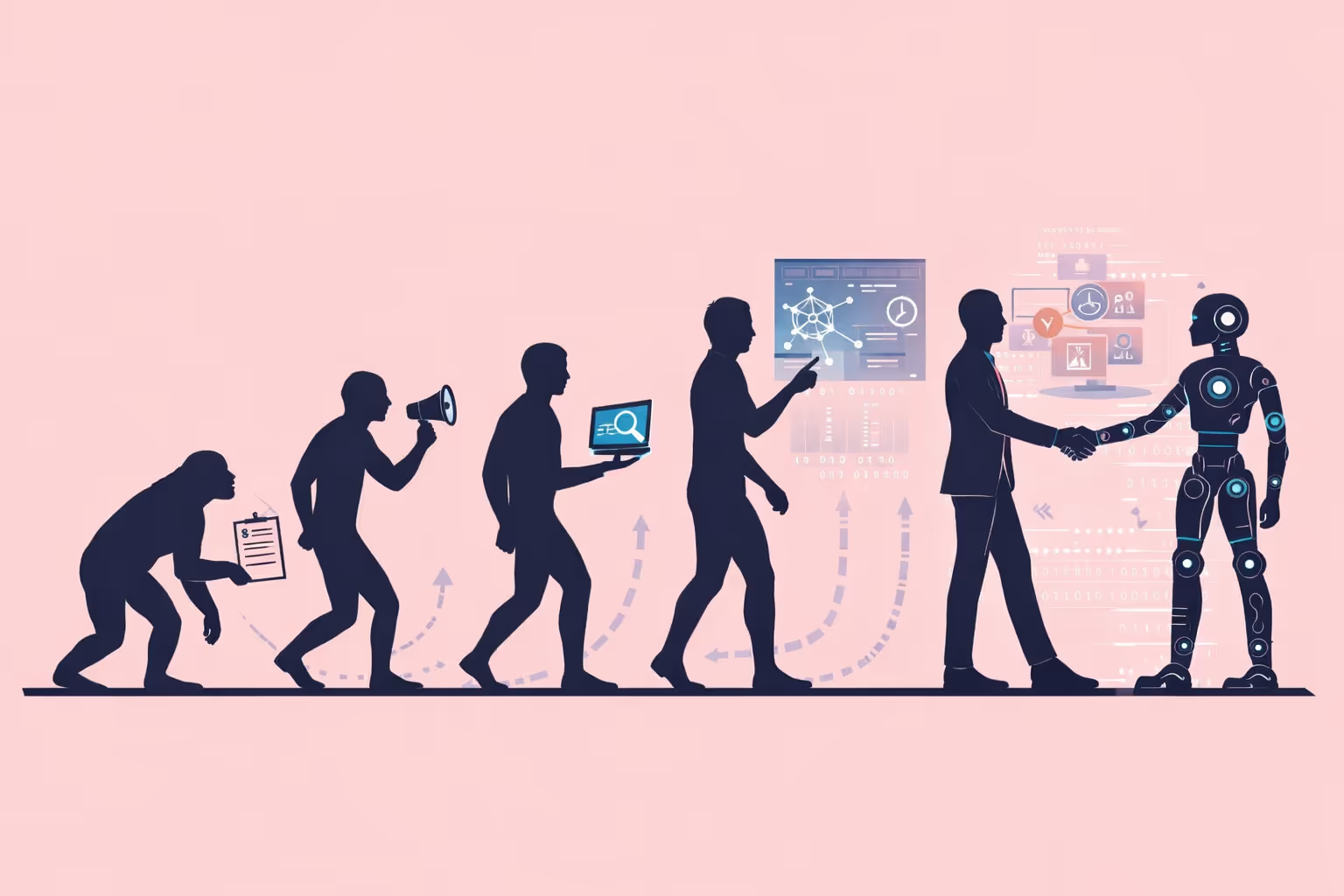
For most of the last decade, Account-Based Marketing lived in an odd in-between space. It was talked about as if it were a strategy but used as if it were a tactic — a way to slap some personalization onto a list of high-value accounts and call it sophistication. The premise was elegant, almost comforting: If we just focus a little harder on the right people, they’ll notice.
That approach made sense in the mid-2010s, when the internet still felt like a place where signal could break through noise, and where marketing teams could reliably predict what “engagement” meant. But the world changed. Buying behavior fragmented. Attention scattered. Data moved from static to living. And ABM — almost quietly — transformed into something much larger: a revenue motion, not a marketing motion.
It’s worth pausing to understand that shift, because it tells us something about how go-to-market systems evolve, and why the next decade of ABM won’t look anything like the last.
From Tactic to Strategy: The Reorientation of Revenue Teams
A decade ago, ABM was essentially targeted outbound dressed in nicer language. Choose some accounts, personalize an email, maybe run some ads, hope the gesture landed. But today, ABM is the connective tissue across marketing, sales, rev ops, and customer success. It drives how companies think about engagement, pipeline acceleration, forecasting, and renewal strategy.
This happened for a simple reason: the unit of value changed.
Leads became unreliable indicators of buying intent. Accounts became complex ecosystems of stakeholders. And companies realized that pipeline quality, not pipeline volume, was the lever that actually moved revenue. ABM — real ABM — became the operating system for managing that complexity.
The personalization we used to celebrate looks primitive now. We’ve moved from “Hi {{first_name}}” to predictive models, multi-channel orchestration, and real-time signal ingestion. The center of ABM isn’t message quality anymore; it’s timing and context.
The Rise of Signals: How Data Grew Up
To understand why ABM platforms like Engagio, 6sense, and Terminus mattered, you have to understand the state of data a decade ago. It was flat. It was slow. It described companies, but it didn’t explain them.
If firmographics were a census, today’s signals are a bloodstream.
We now track:
- New product launches
- Funding rounds and ownership shifts
- Strategic hiring patterns
- E-commerce performance
- Supply chain movement
- Social audience trends
- Onsite technology shifts
This is the difference between knowing who a company is and understanding where it’s going.
The best signal isn’t a page visit — it’s a strategic hire. It’s not a whitepaper download — it’s a sudden spike in a company’s developer activity or a quiet shift in supply chain vendors. Signals are no longer decorative; they’re predictive. They identify momentum before the market sees it.
And this is why bespoke data — real-time, context-aware, and constructed on demand — is rapidly overtaking prebuilt data lakes. Static datasets tell you who a company was. Signals tell you who they’re becoming.
Why Engagio, 6sense, and Terminus Were Inevitable
When Engagio first pitched the idea of “account orchestration,” it sounded almost abstract. But it was pointing to a structural gap: the CRM could store information, marketing automation could send emails, but no system could coordinate the revenue team around the same account-level intelligence.
6sense addressed a different gap: the inability to see what wasn’t yet visible. It reframed ABM not as a reaction to what accounts were doing, but as a prediction of what they were about to do.
Terminus tackled activation — the challenge of translating intelligence into motion across ads, web, and email.
What united all three wasn’t a feature set. It was an observation:
Modern selling requires visibility into account behavior that traditional databases can’t provide.
They weren’t replacing CRMs. They were filling in the blind spots the CRM couldn’t even acknowledge existed.
Where ABM Is Going: The Next Operating System for Revenue
If the last ten years were about alignment, the next ten will be about anticipation. ABM is moving from a strategy of finding accounts that might buy to understanding accounts that are already in motion.
Here’s what that means.
1. Signal-Based Prioritization Will Replace Static Segmentation
A company that just raised a funding round and hired an AI leadership team behaves differently than a similar company with no momentum. ABM will prioritize accounts not because they look good on paper, but because they show movement.
Firmographics tell you who to target.
Signals tell you when.
That timing is everything.
2. Intent Will Evolve Beyond Digital Exhaust
Intent used to mean: “They clicked something.” That won’t cut it in a privacy-centric world.
Tomorrow’s intent is:
- Reddit patterns
- Technical community discussions
- Shifts in hiring or job recs
- LinkedIn audience growth
- Onsite tech signals
- Operational behavior across the open web
Intent will stop being a proxy for interest and start being evidence of transformation inside an account.
3. AI Will Orchestrate What Revenue Teams Used to Manage Manually
Imagine:
A sales rep receives an alert:
Your top account just lost its CTO, hired a VP of Strategy, and added Snowflake and dbt to their stack within 30 days. Here’s the recommended play, messaging angle, and buying committee map.
That’s not a dashboard. That’s autopilot.
AI will:
- Predict account trajectories
- Recommend next actions
- Personalize messaging in context
- Identify expansion risk
- Trigger campaigns automatically
ABM becomes less about marketing and more about sense-making.
4. Measurement Will Move From Vanity to Velocity
Open rates and impressions will continue their decline into irrelevance. Revenue teams will measure:
- Pipeline acceleration
- Deal velocity
- Expansion likelihood
- Renewal stability
- Forecast accuracy
ABM will become a revenue intelligence layer that ties momentum → engagement → pipeline → outcomes.
It closes the loop Marketing and Sales have been pretending was closed for years.
The Bigger Picture: What ABM Was, What It Is, and What It’s Becoming
ABM began as a personalization tactic.
It evolved into an engagement strategy.
Now it’s becoming a predictive operating system for revenue.
The platforms that dominated the last decade succeeded because they recognized that the old data infrastructure wasn’t built for how modern companies buy. But the next decade belongs to systems — and teams — that can work with data that isn’t prepackaged, isn’t stale, and isn’t generic.
Static data lakes were the ZoomInfo era.
The future is bespoke signals that reflect the real world in real time.
ABM isn’t about targeted marketing anymore.
It’s about understanding momentum — and acting on it before anyone else can see it.
.avif)