
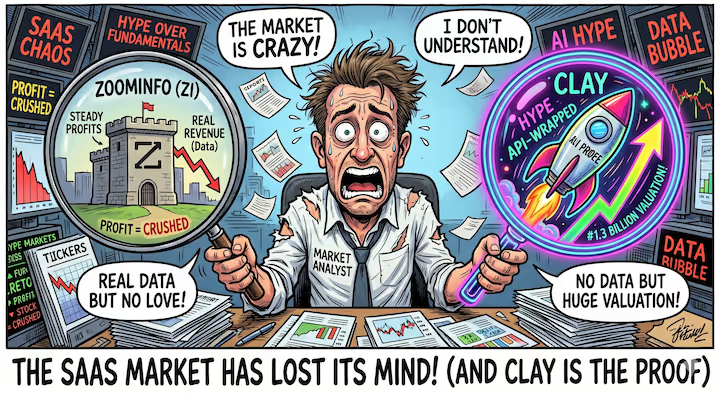
There is a particular kind of market madness that only surfaces when everyone is too excited about a category to read the actual unit economics. We saw it in 2021 with SaaS multiples that would have made a 1999 venture capitalist blush. We saw it with crypto. We saw it with the first wave of AI wrappers. And now, quietly, we are watching it play out in the B2B data and GTM intelligence space, with Clay at the center of the delusion.
Let me be clear: Clay is a good product. It is well-designed, it has cultivated a genuinely passionate user base, and its workflow-based approach to data orchestration was legitimately novel when it arrived. The Clay community, the so-called GTM engineers who built elaborate enrichment tables and waterfall sequences, helped define a new category of revenue operations thinking. That is real.
But a $3.1 billion private valuation, with employee share sales reportedly implying a $5 billion number on the secondary market, for a company doing $100 million in ARR? While ZoomInfo, a company doing $1.25 billion in annual revenue, sits at a $1.15 billion public market cap? That is not the market finding signal in noise. That is the market getting high on its own supply.
The Numbers Do Not Add Up
Start with the basic math. Clay raised its Series C in August 2025 at a $3.1 billion valuation. At the time, ARR had just crossed $100 million. That is a 31x revenue multiple for a private company that, by its own structural design, does not own the underlying product it sells.
ZoomInfo trades at roughly 0.9x revenue. It has 3,000+ employees, $1.25 billion in trailing twelve-month revenue, a vast proprietary data asset it has spent two decades building, and a sales and marketing platform that thousands of enterprise teams depend on. Its market cap has fallen 44.6% in the past year. Investors have largely written it off as an incumbent that missed the AI wave.
Clay has 1,040 employees, $100 million in ARR, and a business model that is fundamentally dependent on third-party data providers it resells at a markup.
| Metric | CLAY | ZOOMINFO |
|---|---|---|
| Valuation | $3.1B (private) | $1.15B (public) |
| Annual Revenue | $100M ARR | $1.25B TTM |
| Revenue Multiple | 31× | 0.9× |
| Employees | ~1,040 | ~3,180 |
| Owns Underlying Data? | Largely No | Yes |
| Waterfall Enrichment | Yes (core) | Yes (2025) |
| Ad Platform Integration | Clay Ads | Equivalent shipped |
| 12-Month Valuation Change | +140% (secondary est.) | -44.6% |
The implied message from the market is that Clay is worth nearly three times ZoomInfo. That Clay's future is so much brighter, its moat so much deeper, its margin profile so much more attractive, that $3.1 billion is a reasonable bet while $1.15 billion is where ZoomInfo belongs. That interpretation deserves serious scrutiny.
Clay's Dirty Secret: It Doesn't Own the Data
The most important thing to understand about Clay's business model is also the most underreported: Clay is largely a marketplace, not a data company. The platform aggregates more than 150 third-party data providers, from Apollo to Hunter to Clearbit to dozens of niche enrichment sources, and its famous waterfall enrichment feature routes queries across those providers sequentially until a match is found.
This is genuinely useful. The orchestration layer Clay built on top of those providers is clever and it saved RevOps teams from stitching together Zapier workflows and spreadsheet hacks. That innovation deserves credit. But it does not change the underlying economics.
When a Clay customer pays for credits to find an email address, Clay is often paying a data provider for that lookup. The spread is real, but it is structurally thin compared to ZoomInfo, whose marginal cost of delivering a contact record approaches zero once the underlying data infrastructure exists.
ZoomInfo spent decades building a proprietary database through a combination of community-contributed data, web crawling, third-party integrations, and direct data partnerships. That data asset has real defensibility, even if its presentation layer is dated and its product velocity has been frustratingly slow. The data itself is the moat.
Clay's moat is the workflow engine. The workflow engine is valuable right up until it isn't. And the evidence is accumulating that it is becoming less so.
The Pricing Revolt Nobody Is Talking About Loudly Enough
In March 2026, Clay overhauled its pricing model. On paper, the announcement was framed as a simplification: new plan tiers, a dual-credit system splitting Data Credits from Actions, and a notable reduction in what some features cost. In practice, the reception from Clay's most devoted user base ranged from confused to furious.
The GTM engineering community that Clay spent years cultivating, the power users who wrote Twitter threads about their Clay workflows, who evangelized the platform to their networks, who built entire agency businesses around Clay's infrastructure, suddenly found themselves doing math that didn't work in their favor. CRM sync, HTTP API access, and Web Intent features that previously lived at the $800 per month Pro tier were moved to a new Growth tier at $495 per month, which sounds like good news until you factor in the new dual-credit structure and recalculate the cost per enriched contact.
Third-party analysis estimated that a representative five-step, 500-contact enrichment workflow now runs between $325 and $600 total, or roughly $0.65 to $1.20 per contact on Growth. That is not cheap. And it arrives at a moment when alternatives are proliferating at every price point.
The backlash matters not because the pricing is irrational from Clay's perspective, the company needs to build toward real margins eventually, but because of what it reveals about the relationship between Clay and its users. The platform's growth was built on a community of enthusiasts who evangelized it largely because it felt like a power-user tool that offered outsized leverage for its price. The moment that perception cracks, the word-of-mouth engine that drove Clay's growth slows. And it is cracking.
The Token Subsidy Nobody Is Accounting For
Here is the number that almost no one is putting in the Clay valuation model: the cost of AI inference that was not being passed through to the end user.
Clay's enrichment workflows, its Claygent AI research features, its GPT integrations for personalization and categorization, all of these features consumed significant amounts of AI compute during a period when the major frontier AI labs were aggressively subsidizing inference costs. OpenAI, Anthropic, and Google were effectively running their models at a loss or near-loss to drive adoption, capture market share, and build switching costs. Clay, like hundreds of other SaaS companies that embedded AI into their workflows, benefited enormously from this period of subsidized tokens.
The AI token subsidy era is ending. The companies that built their value propositions, pricing models, and margin assumptions on cheap AI inference are about to find out what their products actually cost to deliver.
For Clay specifically, the math gets uncomfortable fast. Claygent, the AI research agent that scrapes publicly available web data on behalf of users, is a compute-intensive feature that drives a significant portion of Clay's differentiated value. When AI inference pricing normalizes, either Clay absorbs margin compression or it passes costs through to customers who are already complaining about the March 2026 pricing changes. Neither option is particularly attractive.
ZoomInfo faces this challenge too, and it is not immune to AI cost pressures. But ZoomInfo's core value proposition, access to a proprietary data asset, does not depend on cheap AI inference in the same structural way. You can argue ZoomInfo is bad at AI. You cannot argue that ZoomInfo's fundamental unit economics are secretly dependent on subsidized compute.
ZoomInfo Is Catching Up, And Nobody Is Giving It Credit
The conventional wisdom in the GTM tech community is that ZoomInfo is a slow, legacy incumbent that missed the AI era and is now being eaten alive by nimbler competitors. There is some truth to that characterization, particularly around product velocity and the perception that ZoomInfo's UX has never recovered from its acquisition-era complexity.
But the product gap is narrower than the valuation gap suggests.
ZoomInfo has shipped waterfall enrichment. It has launched ad platform integrations that directly mirror Clay Ads, Clay's own attempt to bring data enrichment into paid media workflows. It has ZoomInfo Copilot, an AI-powered workflow and signal-based outbound tool that, while not as developer-friendly as Clay, delivers meaningfully similar outcomes for less technical GTM teams. And it does all of this sitting on top of proprietary data that it does not need to purchase from a third-party marketplace at a per-lookup cost.
Is ZoomInfo's execution perfect? No. Is their sales motion too enterprise-heavy and their self-serve experience underwhelming? Yes. But when you strip away the community buzz and the GTM engineer aesthetic, ZoomInfo is doing things that Clay is doing, at 10x the revenue scale, on data it owns, and the market is pricing it at less than 40% of Clay's private valuation.
The argument for that gap existing requires believing that Clay will not only maintain its current differentiation but will widen it, in an environment where its pricing is under pressure, its AI cost assumptions are about to be stress-tested, its marquee differentiators are being replicated by incumbents, and the open-source and AI-native tooling landscape is eating into the workflows that made Clay indispensable. That is a very large number of assumptions to stack.
Claude, Cursor, and the AI-Native Threat
There is a dynamic in the current AI landscape that the Clay bull case almost entirely ignores: AI-native tools are collapsing the complexity floor.
The GTM engineering workflows that Clay made possible, pulling enrichment data across multiple sources, building conditional logic for personalization, routing leads based on signal combinations, these tasks were genuinely hard before Clay. Clay's no-code interface made them accessible to people who could not write Python. That was the product-market fit.
But Claude can now write that Python. Cursor can scaffold the entire data pipeline. Base44 and similar no-code AI app builders can produce functional enrichment workflows in an afternoon without a Clay subscription. The barrier to entry that Clay's workflow complexity created is being demolished in real time by the same AI wave that Clay has been riding.
The power users who most loved Clay were often technically fluent enough to eventually outgrow it or replicate it. The less technical users who needed Clay's structured interface are increasingly finding that AI assistants can walk them through or outright build the equivalent workflows without a $495 per month platform dependency. This is not a hypothetical risk. It is happening.
The Broader SaaS Sanity Check
Clay is the most vivid example of a larger pattern: the SaaS market assigning premium valuations to the aesthetic of disruption rather than the economics of disruption.
The aesthetic of disruption looks like: a passionate developer community, a Twitter presence built on workflow screenshots, a product that makes previously inaccessible power accessible, and a narrative that positions you against a slow-moving incumbent. Clay has all of these things. They are real, and they drove real growth.
The economics of disruption require: durable margin advantages, structural switching costs that compound over time, a data or network asset that gets more valuable as it scales, and a cost structure that survives the maturation of the underlying infrastructure. Clay's economics are less clear on every one of these dimensions.
ZoomInfo's collapse in market value reflects genuine problems: customer churn, an over-leveraged capital structure from its acquisition era, and a product motion that has been too slow to adapt to the self-serve and AI-first expectations of the current buyer. Those problems are real and they deserve the discount the market has applied.
But the gap is explained by a market that has decided the future belongs to the new thing and is pricing accordingly, regardless of whether the new thing has demonstrated the business model durability to justify $3 to $5 billion. That is narrative arbitrage.
Clay is a real company with real revenue and a real user base, and it could build toward a defensible position as a GTM orchestration layer if it navigates the pricing transition and the AI cost reset without losing the community that drove its growth. That path exists.
But it is not worth $3.1 billion today on $100 million in ARR from a marketplace model whose cost structure is about to get significantly more expensive, in a competitive landscape that is catching up from both below and above.
The market does not always correct quickly. But it does correct.
.avif)