UK & Ireland GTM Compliance Playbook: Turning Privacy Law into Pipeline
Imagine for a moment that compliance wasn’t a tax on creativity, but a catalyst for it.
That the same laws we once treated as guardrails—GDPR, PECR, the alphabet soup of privacy acronyms—were actually the blueprint for a smarter, more human form of go-to-market.
Imagine for a moment that compliance wasn’t a tax on creativity, but a catalyst for it.
That the same laws we once treated as guardrails—GDPR, PECR, the alphabet soup of privacy acronyms—were actually the blueprint for a smarter, more human form of go-to-market.
We’re entering a phase of marketing and sales where precision beats reach, where the credibility of your data matters more than the size of your database.
The future of GTM isn’t about the loudest signal or the longest list—it’s about the right context at the right time, built on trust you can prove.
This guide is written for the people building that future: Marketing Leaders, Sales Leaders (AEs/SDRs), Revenue Operations, and Legal/Security.
Because the next competitive edge won’t come from who you can find, but from how responsibly—and intelligently—you can reach them.
Executive summary
Why it matters (UK & Ireland):
Both the UK GDPR (post-Brexit version of the EU GDPR) and Ireland’s Data Protection Act 2018 carry the same DNA as the EU regulation—anchored in seven principles: lawfulness/fairness/transparency; accuracy; purpose limitation; data minimization; storage limitation; integrity & confidentiality; accountability. These principles shape enforcement trends like 72-hour breach notification, the role of the Data Protection Officer (DPO), and fines up to £17.5M / 4% of global revenue in the UK, or €20M / 4% in Ireland.
What you get today:
A region-specific GB & Ireland playbook detailing lawful bases for B2B outreach, cold email & call allowances under PECR and the Irish ePrivacy Regulations, cookie consent expectations, breach protocols, data-transfer posture (UK-US Data Bridge & EU-US DPF), supervisory authorities, and AE/SDR talk-tracks that stay compliant without killing conversion.
How to win:
Treat compliance as a GTM system, not a legal memo. Embed lawful basis + consent provenance in CRM fields and MAP/CMP workflows. Combine privacy-first targeting with account signals—using Legitimate Interest only when defensible—and leverage opt-in activation where consent is required. That’s how LeadGenius outpaces static lakes like ZoomInfo and Apollo: custom compliance meets custom insight.
The Harsh Reality
In the years since GDPR rewrote the global rulebook on data privacy, most companies have treated compliance as something like cholesterol—necessary to monitor, annoying to deal with, and best kept out of sight. But for the smartest go-to-market teams, that mindset has quietly flipped. Compliance isn’t the cost of doing business anymore; it’s the architecture of how business gets done.
In the UK and Ireland, that architecture is defined by two frameworks with the same DNA: the UK GDPR and Ireland’s Data Protection Act of 2018. Both descend directly from the EU regulation, built on seven deceptively simple principles—lawfulness, fairness and transparency; accuracy; purpose limitation; data minimization; storage limitation; integrity and confidentiality; and accountability. Those ideas underpin everything from the 72-hour breach notification window to the modern role of the Data Protection Officer and the fines that make headlines—£17.5 million or four percent of global turnover in the UK, €20 million or four percent in Ireland. They’re the invisible scaffolding of every legitimate marketing workflow in these regions.
What LeadGenius offers is a practical, region-specific playbook for turning that scaffolding into a system—a living, breathing compliance engine that fuels smarter outreach. The UK and Ireland edition lays out, in plain English, the lawful bases for B2B engagement: when you can rely on legitimate interest, when consent is non-negotiable, and how to navigate cold email and calling under PECR and Irish ePrivacy law without choking the pipeline. It explains how to align your cookie consent tools with analytics and ad platforms, how to handle breach notifications and international data transfers under the UK-US Data Bridge or EU-US DPF, and how to give AEs and SDRs the language to stay compliant while still sounding human.
The philosophy is simple but powerful: treat compliance not as a legal memo, but as a GTM system. Embed lawful basis and consent provenance directly into CRM fields and marketing automation workflows. Replace abstract policies with concrete data—fields, timestamps, and suppression logic. Pair privacy-first targeting with account signals that actually matter: new funding, strategic hires, product launches, shifting technographics. Use legitimate interest only where it’s defensible, and use consent-driven activations to earn opt-ins where it’s required.
This is where LeadGenius beats static databases like ZoomInfo and Apollo—by combining custom compliance with custom insight. In this model, compliance isn’t a constraint; it’s a differentiator. It’s the way you prove to your audience—and your board—that your data isn’t just big, it’s right.
Over the next 90 days, a team can operationalize this playbook through a sequence that looks less like legal prep and more like a product launch. Map your lawful basis, load your DNC registries, wire your consent management and marketing platforms together. Train SDRs on how to navigate the nuances of PECR and Irish ePrivacy, then pilot opt-in reactivation campaigns alongside signal-driven legitimate interest plays. Run breach tabletop exercises like fire drills. Measure everything—consent coverage, opt-out speed, complaint rates, and the lift in reply and conversion rates that comes when trust becomes part of the brand.
This is what the UK & Ireland GTM Compliance Playbook delivers: a framework for privacy-first growth that turns regulation into relevance. When compliance becomes part of your data architecture, trust becomes part of your go-to-market motion—and trust, as it turns out, converts better than any subject line ever written.
GB/IE Compliance Matrix (mirrors the global model)
Columns: Country • Lawful Basis • Cold Email Allowed? • Cold Call Allowed? • Consent Needed? • LI OK? • DNC Registry • Cookie/Tracking Rules • Data Localization? • Breach Window • Max Fine • DPA Name • AE/SDR Notes • Last Updated.
Use cases:
AEs/SDRs: Validate lawful basis before any outreach; confirm opt-out line and suppression sync.
Marketing: Wire CMP↔MAP to enforce cookie consent; maintain consent logs and audit trails.
Log LIA reference, date, and role relevance in CRM.
Avoid personal addresses unless consented. When consent is required:
Consumer domains, events, gated content, or non-corporate lists.
Use double opt-in and timestamp consent. Trust talk-track:
“We only reach out to professional roles about relevant solutions. You can update your preferences anytime here.”
For Marketing Leaders
CMP orchestration: tags blocked pre-consent; sync CMP decisions to analytics/ads.
The UK & Ireland GTM Compliance Playbook gives sales and marketing teams a practical framework for privacy-first growth under UK GDPR, PECR, and Irish data laws, showing exactly where consent and legitimate interest apply. By embedding compliance into GTM systems, teams can scale outreach confidently—building trust, avoiding fines, and outperforming static data vendors.
Share
Related Resources
Guide
Germany GTM Playbook: Turn GDPR Compliance into Your Competitive Edge
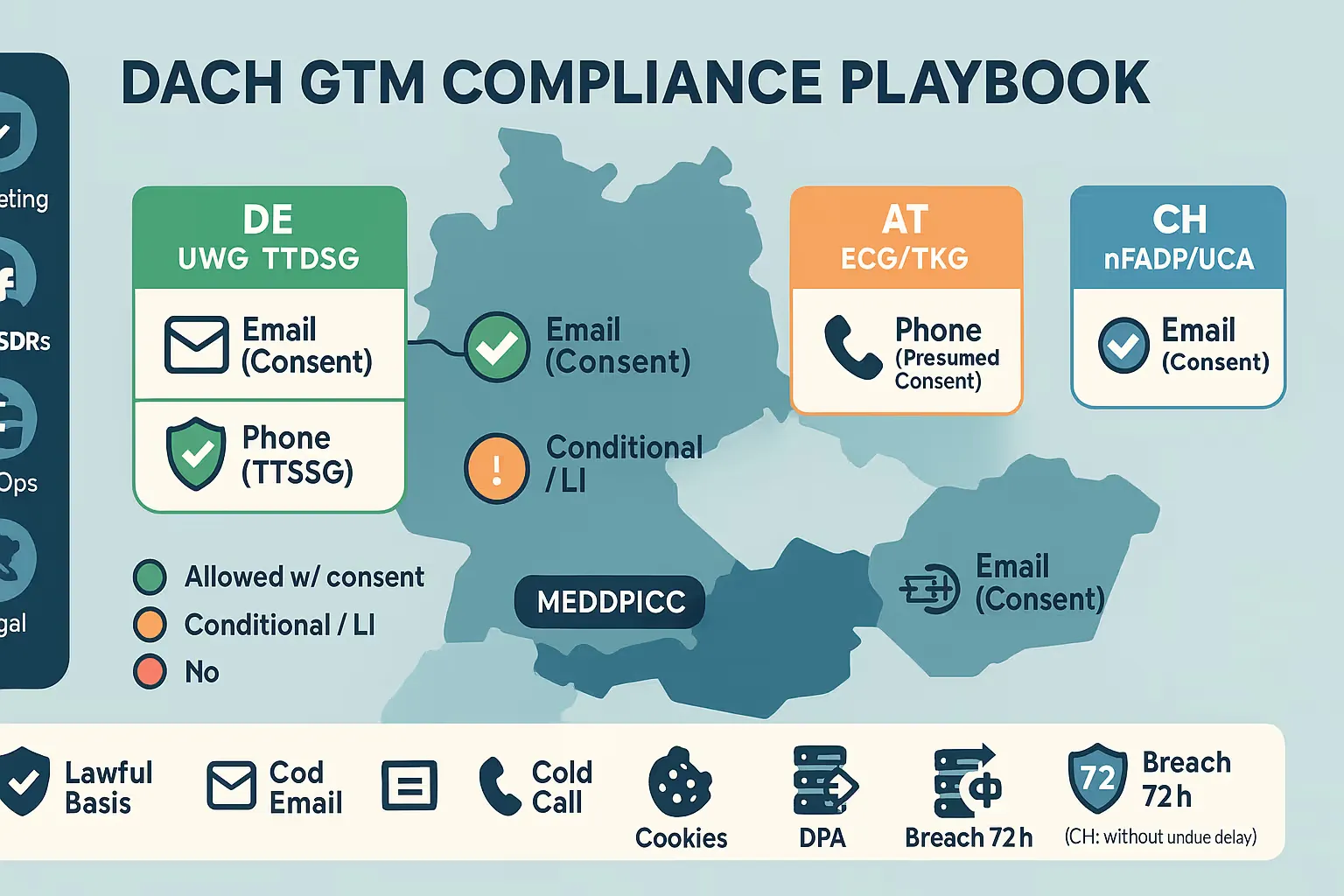
The DACH GTM Compliance Playbook visualizes data privacy expectations across Germany (DE), Austria (AT), and Switzerland (CH), clarifying where consent or legitimate interest applies for outreach and cookies. It helps GTM teams quickly understand what’s allowed—showing at a glance that email marketing requires consent everywhere, while B2B calling remains conditional under German and Austrian law.
Data Privacy and Compliance: how to approach GDPR and LGPD
Permission Pass advances in aligning marketing strategies with data privacy standards and offering a method to engage audience responsibly while following GDPR.