
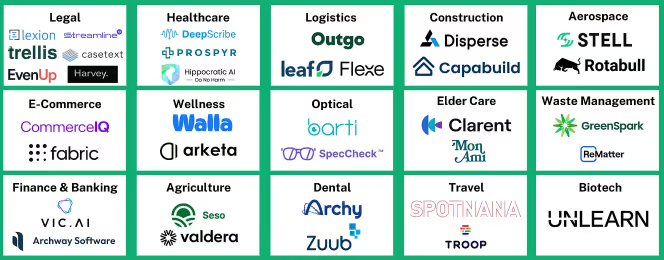
Vertical SaaS occupies a fundamentally different competitive landscape than horizontal SaaS. While horizontal platforms succeed through broad applicability—"if you employ people, we're relevant"—vertical SaaS companies win by developing an unmatched understanding of a single industry's operational reality and translating that expertise into a repeatable go-to-market motion.
This creates a paradox: the more specialized your product becomes, the less valuable generic market data proves to be. Yet many vertical SaaS teams continue building their go-to-market strategies on general-purpose databases like ZoomInfo or Apollo, inadvertently undermining their segmentation, messaging, prioritization, account routing, lead scoring, territory planning, and ultimately their pipeline generation.
The issue isn't that these platforms lack merit. Rather, vertical go-to-market success depends on granular details that generic databases simply cannot capture.
The Real Problem: Taxonomy, Not Just Data Volume
When vertical SaaS teams request "better data," they're rarely asking for more contact records. What they actually need are answers to deeper questions:
- How do we sharpen our ideal customer profile beyond vague descriptors?
- How can we distinguish truly qualified prospects from superficial matches?
- Why are our sales representatives investing time in low-fit accounts?
- Why does our messaging fail to resonate despite being technically accurate?
- Why do our total addressable market calculations seem inflated, and how do we correct them?
These challenges can't be resolved by acquiring more database rows. They require industry-specific taxonomy, operational nuance, intelligent labeling systems, and market coverage that reflects how the target industry actually functions.
Five Critical Gaps in Generic B2B Databases
1. Taxonomy Misalignment
General-purpose vendors categorize companies using broad industry classification codes. Vertical SaaS requires operational precision: understanding what type of firm this truly is, how it operates, and what problems it faces daily.
2. Loss of Meaningful Nuance
Consider legal services. Labeling a company as a "law firm" provides virtually no actionable insight. A personal injury practice and an intellectual property boutique operate so differently they might as well exist in separate industries entirely.
3. Inadequate Title Normalization
In specialized industries, job title parsing often fails completely. In law firms, "Partner" and "Associate" represent not just seniority levels but distinct commercial roles with different purchasing authority and incentive structures.
4. Contact Coverage Gaps at Critical Points
Even when you successfully identify a target organization, you still need access to the right decision-makers—and in vertical markets, the "right" contacts vary dramatically based on specialization and organizational structure.
5. Absence of Custom Predictive Signals
In vertical SaaS, the strongest predictors of buying intent frequently aren't standard firmographic data like revenue or employee count. They're domain-specific operational signals that generic databases don't track.
This explains why vertical SaaS teams can execute flawlessly on standard best practices yet still underperform expectations. When your data foundation contains structural flaws, your entire go-to-market motion becomes inherently fragile.
Case Study: Why Generic Data Fails Legal Technology Companies
Let's examine a concrete example. If you're selling legal technology solutions, your go-to-market team isn't simply targeting "law firms." You're pursuing a precisely defined subset of legal practices with specific operational characteristics:
Practice area composition: Personal injury versus workers' compensation versus immigration versus family law versus intellectual property
Attorney count by discipline: How many attorneys actually practice in their core specialty area?
Jurisdictional coverage: Which states do they maintain bar admissions in? Do they operate across multiple jurisdictions?
Case volume patterns: Are they high-volume practices driven by advertising, or do they handle fewer, higher-value matters?
Firm size versus specialization dynamics: Are they a large firm with narrow focus, or a small practice offering broad services?
Here's the uncomfortable reality: if you cannot answer these questions with confidence, you don't possess a true ideal customer profile. You're operating on intuition.
What Standard Databases Typically Provide
- Firm name, website, and general contact information
- Approximate employee count (frequently inaccurate for smaller firms)
- Generic industry classification ("Legal Services")
- Job titles (often inconsistently formatted)
- Email addresses (with variable accuracy)
What Legal SaaS Companies Actually Require
- Detailed practice area breakdown and specialization mix
- Business model indicators (contingency-based versus retainer-based)
- Marketing approach (advertising-intensive versus referral-driven)
- Physical presence (single office versus multi-location)
- Multi-state operational capability
- Organizational structure indicators (dedicated intake teams, case management systems)
- Growth signals (new office openings, partner additions, practice area expansion)
This gap explains systematic failures in legal tech go-to-market execution. Generic tools don't model practice-area operational reality. They cannot reliably map attorney specializations or understand firm structural dynamics.
When this foundational knowledge is missing, downstream consequences cascade quietly:
- Account-based marketing lists become diluted with poor-fit prospects
- Sales development representatives waste cycles pursuing unqualified firms
- Paid advertising campaigns exhaust budgets targeting inappropriate subsegments
- Conversion rates decline without clear diagnostic explanations
The Competitive Advantage of Custom Data Infrastructure
A bespoke data approach inverts the traditional workflow. Instead of beginning with "here are all companies in this industry category," you start by asking: "What does an ideal-fit customer look like in operational terms?"
Then you construct data collection and enrichment systems specifically designed to identify those characteristics.
Consider a legal SaaS company selling intake automation for high-volume personal injury practices. A custom dataset might include:
- Practice area classification at the firm level (personal injury, workers' comp, family law, etc.)
- Estimated attorney count by specialty
- Multi-office indicator plus location count
- Advertising intensity signals (television, billboard, digital presence indicators)
- Technology stack indicators (intake forms, chat widgets, call tracking systems)
- Hiring signals for paralegals, intake specialists, and case managers
- Website language indicating high-volume case handling processes
This transforms your outbound and paid acquisition strategies from commoditized to strategically differentiated.
Your sales representatives don't open conversations with generic value propositions like "we help law firms improve efficiency."
Instead, they lead with insight: "I noticed you operate a multi-office personal injury practice with significant inbound lead generation. Firms with your profile typically encounter intake capacity constraints before they become apparent at the leadership level."
This is Challenger selling executed with precision—you're teaching prospects about their own business using their specific operational context.
This approach creates a powerful psychological moment when prospects think: "How do they know that about us?"
That moment of recognition is where competitive advantage lives.
Why Vertical SaaS Companies Hire GTM Engineers and Data-Sophisticated Marketers
Vertical SaaS companies don't just maintain product differentiation. They can build data advantages—if they invest deliberately.
This explains the emerging hiring patterns at successful vertical SaaS companies:
- Go-to-market engineers who can build custom data pipelines
- Revenue operations leaders with sophisticated analytics capabilities
- Marketers who think in terms of dataset architecture and labeling taxonomies
- Growth professionals who understand data enrichment and identity resolution
The constraint isn't "insufficient email volume." The real bottlenecks are:
- Defining clean, industry-specific taxonomies
- Creating repeatable segmentation frameworks
- Building reliable account routing and lead scoring systems
- Producing prospect lists that align precisely with messaging strategies
In essence, they're constructing signal-driven go-to-market engines. And they recognize that standard data stacks cannot support this level of precision.
Why Vertical SaaS Teams Choose Custom Data Solutions
Vertical SaaS companies increasingly partner with providers like LeadGenius because these solutions don't force them into generic data schemas.
The value proposition aligns with how vertical SaaS actually competes:
Custom taxonomy: Industry-specific classification systems including practice areas, specializations, and operational attributes
Nuanced labeling: Context-aware normalization that understands what "Partner" means in a law firm versus other organizational contexts
Strategic coverage: The right contacts connected to the right organizational context
Custom datapoints: The unusual, specific signals that correlate with genuine buying intent
Adaptive intelligence: The capability to refresh and evolve as market conditions shift
Pre-built databases are engineered to be "adequate" for the broadest possible customer base.
Vertical SaaS isn't broad. It's surgically precise.
Therefore, your data foundation must be equally sharp.
.avif)