Article
Cross-Channel Paid Media Orchestration
9 Best Practices for Maximizing ROI Across Every Ad Platform
Modern paid media teams are moving away from channel silos and fixed budgets toward a fully centralized, signal-driven system where every platform feeds into one real-time optimization engine. The teams who win are the ones who follow the buyer — not the channel — using bespoke data, dynamic budget allocation, and automated activation to drive MQLs, meetings, and revenue with far greater precision.
Most marketing teams will tell you they’re “data-driven.” Hell, most even believe it. But every so often, you sit down with a truly advanced paid media organization — one that’s rebuilt its entire engine around real-time signals, ownership, behavioral context, and a single source of truth — and you realize how far the frontier actually is.
I had one of those conversations recently with the global paid media lead at a large cloud software company. And what stuck with me was this: the teams winning today aren’t the ones with bigger budgets or flashier tech stacks. They’re the ones who understand that the buyer, not the channel, is the center of gravity.
They’re the ones who treat data not like a dashboard, but like a living system.
And they’re the ones who understand that the playbook that worked from 2015–2022 simply can’t keep up with how revenue teams operate now.
Let’s walk through what their evolution can teach every modern marketer out there.
They started the way almost everyone starts:
hire a big agency, outsource the messy stuff, rely on channel specialists, run everything natively inside the platforms. Each channel optimized itself, celebrated itself, and reported success based on its own scoreboard.
And for a while, it worked — until it didn’t.
Everything changed the moment they built a unified data foundation inside their warehouse. Suddenly, the fog lifted. Patterns emerged. And the truth became obvious:
Channels optimize for themselves.
Revenue teams optimize for outcomes.
And those two incentives rarely, if ever, align.
This is why the old playbook stalls. When LinkedIn, Google, Meta, Reddit, and DSPs all chase their own KPIs, you get fragments — not a strategy.
The real breakthrough came from centralization: one “media brain” that sees everything and dictates where attention should go next.
Before the shift, budgets were fixed per channel. “X for LinkedIn, Y for Google, Z for Meta.” Finance loved the predictability. Performance hated it.
Because when you lock budgets, you lock outcomes.
The moment they centralized their spend into one real-time system, everything changed. Offers shifted by region based on actual demand. Seasonality became visible instead of guessed. Underperforming platforms were throttled instantly. Winning channels got more fuel without waiting for next quarter’s spreadsheet review.
Pipeline went up. Waste went down. Learning cycles collapsed from weeks to hours.
This is the new game: dynamic optimization at the buyer level, not the channel level.
This team told me something I wish every marketer would internalize:
“We don’t care about clicks anymore.”
That’s not an exaggeration. The KPIs that matter to them now are the ones tied to real revenue outcomes:
Quality of the MQL.
Sales engagement.
Meeting conversion.
Progression to SQL and opportunity.
This is where the market is heading. Impressions don’t matter. Clicks don’t matter. Not in isolation. Not when you’re accountable for pipeline.
The modern paid media org optimizes for what creates revenue — not what makes a dashboard look good.
If there’s one myth that needs to die, it’s the hand-wringing about $120 cost-per-lead on LinkedIn.
This team said the quiet part out loud:
LinkedIn isn’t expensive.
LinkedIn is precise.
It’s the only channel with reliable company-level accuracy.
It’s the only place you can guarantee enterprise targeting without spraying money into the void.
And when you look at down-funnel performance — meetings, opportunities, revenue — the cost normalizes instantly.
LinkedIn isn’t a cost center. It’s a quality engine.
Revenue teams understand this. Marketing teams are just starting to catch up.
Here’s the part that surprised me: despite having one of the most sophisticated B2B data ecosystems I’ve ever seen, they still struggle with the same bottlenecks everyone else does.
Creative uploads are manual.
UTM QA is manual.
Ad builds are manual.
Every campaign is launched natively inside each individual platform.
This is where the entire industry is stuck. The data has evolved. The strategy has evolved. But activation — the process of actually getting campaigns live — is still painfully human.
And that gap is where platforms like AdGenius have an enormous opportunity.
Because whoever fixes activation is going to own the next decade of paid media.
Their biggest organizational shift wasn’t technical — it was philosophical.
They stopped organizing around channels.
They started organizing around regions and buying behavior.
Because the truth is simple:
APJ buyers behave differently than EMEA buyers.
EMEA buyers behave differently than North American buyers.
And channels behave differently depending on who’s using them and why.
The modern paid media professional doesn’t care where the conversion happened. They care about who converted, what signal triggered the behavior, and how quickly that insight feeds back into the system.
This is how revenue teams think. Marketing functions finally need to catch up.
Despite all the sophistication, this team still shared their blind spots — and these are the gaps every advanced GTM org is now confronting:
Creative workflows are slow.
Activations aren’t automated.
Cross-channel orchestration is limited.
And perhaps the biggest gap of all:
they still don’t have buyer-level intelligence.
They don’t know who actually owns each tool.
Who approves integrations.
Who influences migrations.
Who controls the workflows tied to their product.
This is where bespoke data becomes mandatory.
This is where LeadGenius shines.
This is where the market is moving whether teams are ready or not.
When you combine centralized data with real-time buyer signals and automated activation, you’re no longer “data-driven.”
You’re adaptive.
And that’s the future every modern marketing leader is racing toward — whether they realize it yet or not.
Article
9 Best Practices for Maximizing ROI Across Every Ad Platform
Article
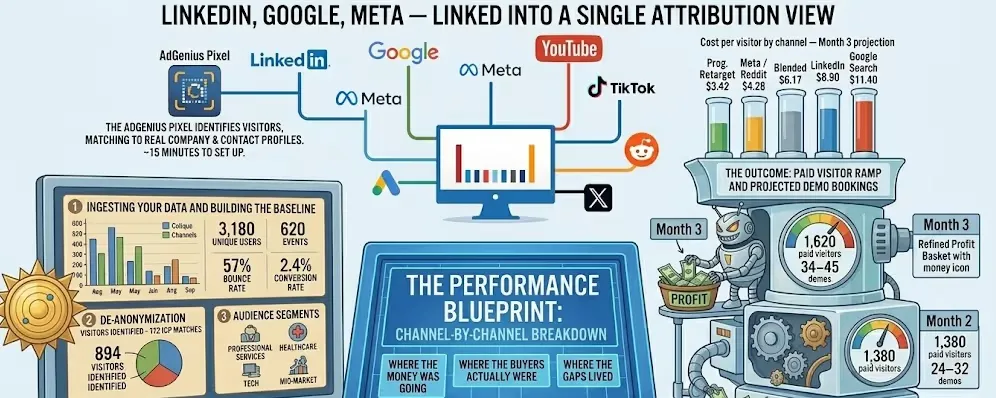
Most paid media waste is not coming from creative or conversion tactics, but from overfunding saturated channels.

Guide
Why more budget isn't fixing your pipeline, and why the system can be working perfectly while your business gets less efficient by the quarter.

Get precise, compliant, and on‑demand contact data—tailored to your business needs.