
Guide
How to build an ICP
How to build an ICP using modern data tools and statistical analysis
Why the Most Valuable GTM Advantage of the AI Era Is the One No One Can Copy
There is a strange paradox in the AI moment we are living through.
On one hand, AI has given every company, no matter how small, access to computational power and automation that once required armies of engineers. Tools that scrape the web, classify accounts, track intent, surface opportunities, and generate outreach are no longer exclusive. They are abundant, cheap, and everywhere.
On the other hand, as this technological abundance accelerates, the strategic advantages are shrinking. When everyone has access to the same signals, the same engines, the same data feeds, and the same models, advantage collapses into symmetry.
And symmetry is the enemy of growth.
The hard truth revenue leaders are confronting is simple:
Public signals, the fuel of most modern GTM engines, are no longer a moat. They are a commodity.
Funding rounds, hiring trends, technographics, intent hits, website traffic. These used to feel like secret windows into your market. Now they are wallpaper. Every AI tool sees the same thing. Every playbook tells teams to react the same way. The market becomes more efficient, more crowded, and more painfully noisy.
What used to be insight has become inertia.
But this collapse reveals a more important question:
If AI levels the playing field, what still creates advantage?
The answer is surprisingly old-school:
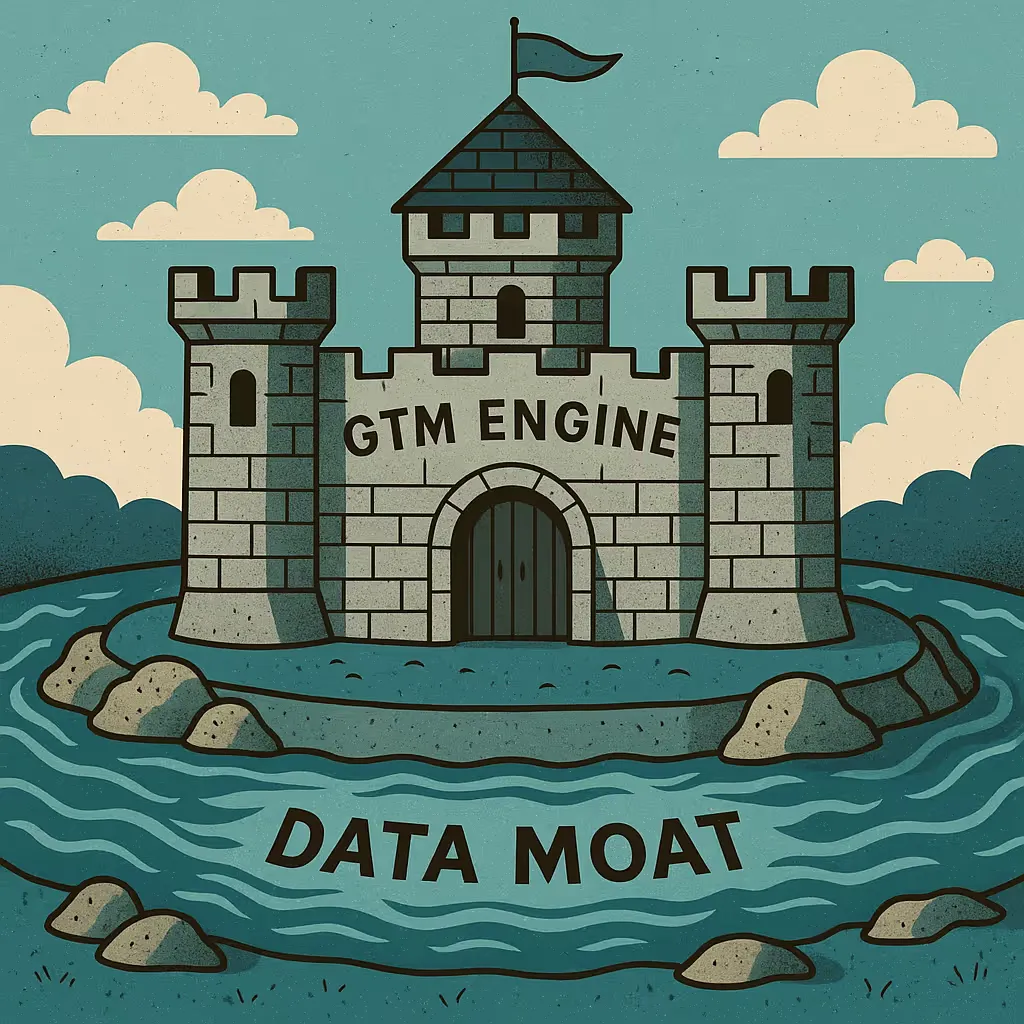
Your moat is the data no one else can access.
The data you produce, not the data you borrow.
The data you own, not the data you rent.
And this is quickly becoming the defining GTM principle of 2026.
Public signals are deteriorating for three reasons.
The market is flooded with what looks like insight but behaves like spam.
What AI cannot scrape, and what competitors cannot copy, is the dense, behavior-rich universe of first-party and non-public data living inside your ecosystem.
This is where depth replaces breadth.
Where precision replaces volume.
Where proprietary truth replaces public noise.
Here is where the moat actually forms.
What people do inside your product reveals more about churn, expansion, and deal progression than any funding or hiring signal.
Your real intent comes from:
• who reads long-form content
• who returns to pricing
• who watches full webinars
• who bookmarks documentation
• who searches your help center
• who consumes thought leadership late at night
This is not noise. This is demand.
Your sales calls contain qualitative intelligence competitors will never see:
• call transcripts
• objection patterns
• stakeholder sentiment
• deal velocity markers
• signs of champion creation
This is insight earned, not scraped.
Buying is not linear. It is relational.
• who joins calls
• who asks the technical questions
• who disappears at stage two
• who becomes the internal advocate
This is the real map of influence.
Your internal systems know:
• who is thriving
• who is frustrated
• who is primed for expansion
• who is trending toward churn
• who quietly became a power user
• who is ready for a case study
This is the heartbeat of your business.
This is the true fortress. Few companies have it, and the ones that do cannot be caught easily.
• transaction data
• supply chain data
• partner ecosystem activity
• offline operational workflows
• contact-level technographics produced through real research
This is not an advantage.
This is a competitive wall.
For years, GTM rewarded teams for collecting more signals.
More accounts.
More contacts.
More triggers.
More scraped insights.
That era is over.
Buyers are overwhelmed with automated outreach triggered by the same scraped inputs. What feels personalized on your end feels algorithmic on theirs.
The new GTM advantage is depth.
Depth your ecosystem produces.
Depth in how your buyers behave, stall, expand, engage, and convert.
AI amplifies depth.
AI does nothing for breadth.
Most companies treat their internal data like residue. A pile of unstructured logs stored across systems with no unified model.
Here is the turning point:
Internal data is not the output of GTM.
Internal data is the foundation of GTM.
It improves:
• ICP accuracy
• segmentation
• routing
• sequencing
• forecasting
• expansion
• retention
• product strategy
And when AI trains on your internal dataset instead of the public internet, the value multiplies.
Public signals evaporate.
Owned signals compound.
This is the strategic imperative revenue leaders need to internalize.
• Stop obsessing over tools that scrape the market.
• Start building systems that understand your market.
• Stop buying the same data your competitors buy.
• Start enriching the data no one else can access.
• Stop treating internal signals like optional reports.
• Start treating them as your moat.
The GTM organizations that win from 2025 to 2030 will not be the ones with the most AI features.
They will be the ones whose AI is trained on the most proprietary, most behavior-rich, most accurate dataset in the room.
Your data.
Your interactions.
Your patterns.
Your system truth.
That is the moat AI cannot copy.
And the companies that recognize this early will own the next decade of GTM.
Guide
How to build an ICP using modern data tools and statistical analysis

Article
Exploring untouchable: how to navigate around Hadrian’s Wall. Levitt's critique of sales remains relevant. Sales and technology thrive, but the focus on values
Article
Rising CPL is not the real problem. Rising CPL on lower-conviction leads is. Here is how the smartest demand gen teams are rethinking acquisition economics.

Get precise, compliant, and on‑demand contact data—tailored to your business needs.