
There's a quiet moment that happens inside almost every B2B marketing team.
It usually shows up in a QBR. The dashboards are polished. The charts look impressive. Pipeline is attributed.
And then someone asks a simple question: "So… what's actually driving revenue?"
That's when things get uncomfortable. Because the truth is — nobody really knows.
The System Isn't Broken. It Was Never Designed to Work.
If you're running campaigns across LinkedIn, YouTube, and Meta — while managing Salesforce and Marketo as your systems of record — you're not dealing with a tooling problem.
You're dealing with a system design problem.
Every platform in your stack is optimized for a different outcome:
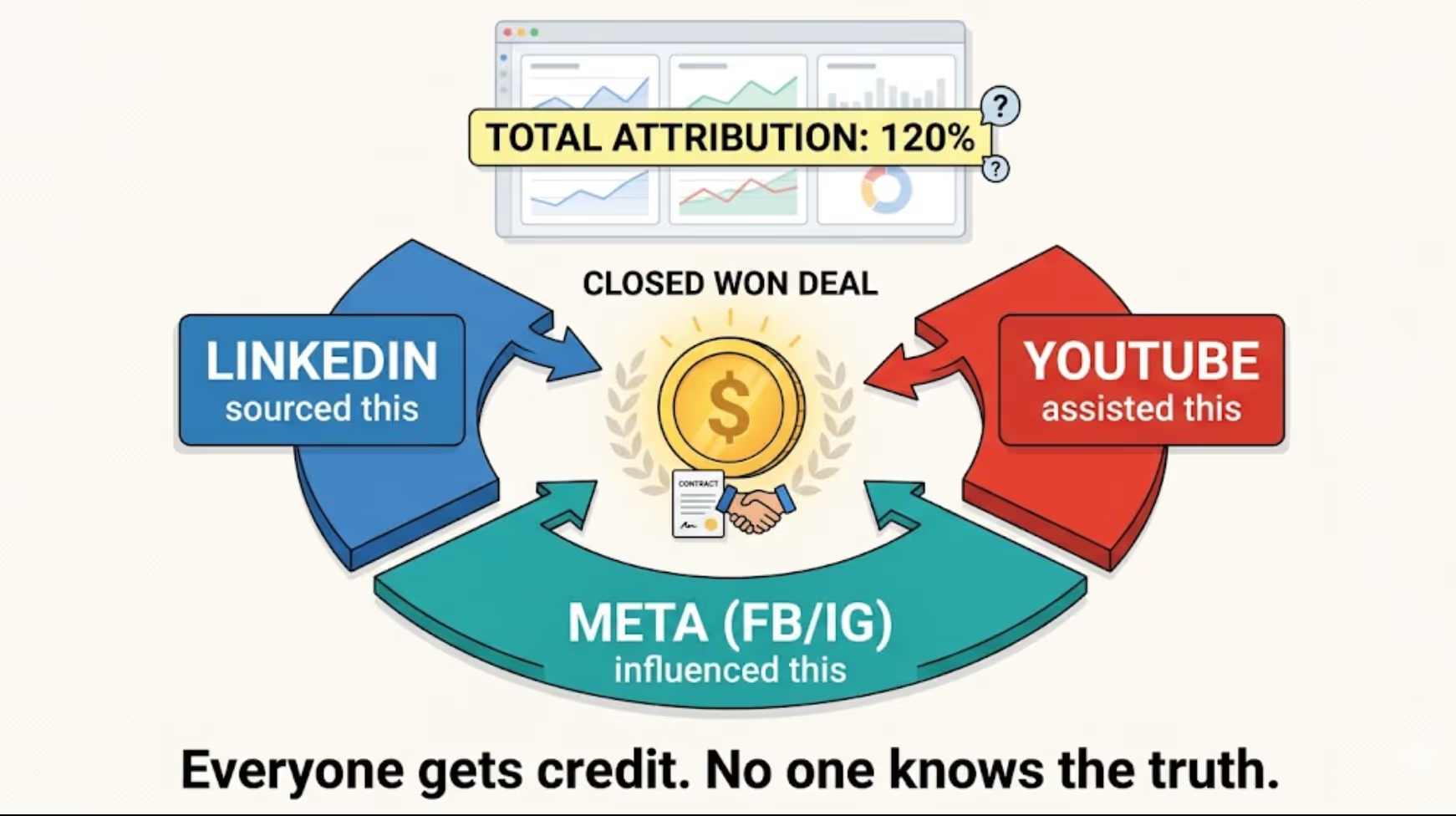
And here's the part nobody says out loud: they are all grading their own homework.
The Attribution Illusion
This is what we call the Silo Tax — the hidden cost of fragmented attribution. It's the gap between what your platforms report and what actually drove revenue. For most B2B teams, that gap is massive.
Calculate Your Silo Tax
Answer three simple questions and see how much revenue is being double-counted, how much performance is inflated, and how much budget is being misallocated.
Run the CalculatorWhat B2B Teams Actually Need (But Rarely Have)
To solve this problem, you need more than dashboards. You need four things working together:
Most tools solve one or two of these. Very few solve all four.
Who's Solving the Measurement Problem
For RevOps & Demand Gen Leaders
A new category of tools is emerging to address attribution fragmentation. Here's the honest landscape:
Dreamdata
Built specifically for B2B revenue attribution. Strong at tying ad touchpoints to pipeline, mapping account journeys, and reconciling marketing activity with Salesforce opportunities.
HockeyStack
More technical, but incredibly powerful. Combines attribution, product analytics, and account intelligence. Especially strong for teams running ABM or complex buyer journeys.
Adobe Marketo Measure
Deeply integrated into Marketo + Salesforce ecosystems. Heavier to manage, more rigid in modeling, and often slower to adapt to modern buying behavior. Still widely used in enterprise.
Improvado & Funnel.io
These tools centralize data and normalize campaign reporting. Less plug-and-play attribution, more "build your own truth." Great for teams with technical capacity.
Northbeam & Rockerbox
Pushing into marketing mix modeling, incrementality testing, and probabilistic attribution. Increasingly important as cookies disappear and deterministic tracking breaks down.
The Missing Layer: Coordination, Not Just Measurement
All of these tools are trying to answer: "What happened?"
But very few are built to answer: "What should we do next?"
That's where a different category is emerging.
Where AdGenius Changes the Game
AdGenius doesn't try to be another attribution tool. It operates one layer above. Instead of just measuring performance, it coordinates it.
Identity Resolution Across Channels
Ad platforms are anonymous. Salesforce is known — but late. AdGenius connects the two: de-anonymizing visitors, mapping engagement to accounts, and creating a unified view of who is actually in-market.
Cross-Channel Audience Orchestration
Instead of three separate audiences running on LinkedIn, Meta, and YouTube — you get one unified ICP audience synced across all channels, continuously refined based on real engagement. This eliminates one of the biggest hidden costs in paid media: duplicate spend on misaligned audiences.
Mid-Funnel Recovery
The most expensive mistake in B2B marketing isn't bad targeting. It's missed follow-up. Hundreds of ICP visitors. Dozens of high-intent actions. Zero coordinated retargeting or outreach. AdGenius identifies those accounts and ensures they don't disappear. This is not attribution. This is revenue recovery.
Budget Allocation Based on Reality
Instead of trusting platform-reported conversions, AdGenius uses Salesforce opportunity data, cross-channel engagement, and account-level signals to answer the only question that matters: which channels actually create sales conversations? Then it reallocates budget accordingly.
The Real Shift Happening Right Now
- Run campaigns in silos
- Measure performance after the fact
- Optimize inside each platform
- Signals were strong
- Channels were isolated
- Unify identity across channels
- Coordinate targeting in real time
- Optimize across channels, not within them
- Signals are degraded — work around it
- Platforms overlap — manage it deliberately
Attribution tools tell you "LinkedIn influenced 32% of pipeline."
Serious revenue teams are asking something else entirely:
"Which accounts should we engage right now?"
That's a different problem. And increasingly, it requires a different kind of solution.
See AdGenius in Action
Get a live look at how AdGenius coordinates cross-channel spend, resolves identity, and recovers mid-funnel revenue — without replacing your current attribution stack.
Schedule a Demo.avif)