
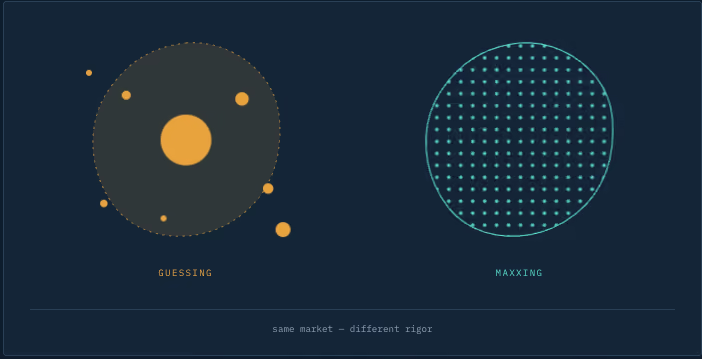
Every go-to-market team eventually says the quiet part out loud: "our TAM is basically everyone." It's the sales-deck equivalent of a shrug. Someone draws a big circle labeled Total Addressable Market, throws in a global population or business count, and calls it strategy.
That's not TAM maxing. That's TAM guessing.
Real TAM maxing, total addressable market maximization, is the opposite instinct. It's not about claiming the widest possible circle. It's about proving, company by company, segment by segment, geography by geography, that the circle you've drawn is both complete and correct. It's a precision exercise disguised as a growth exercise.
A market map is only as good as the data holding it together.
The Starlink Trap
Here's the failure mode: a company convinces itself that because its product could theoretically serve almost anyone, its TAM is almost everyone. Starlink is the classic cautionary tale: "everyone on Earth needs internet, therefore everyone on Earth is our TAM." Technically true. Practically useless. It ignores density, existing infrastructure, price sensitivity, regulatory access, and actual buying intent. A TAM that includes people who will never plausibly buy isn't a TAM, it's a rounding error dressed up as ambition.
TAM maxing rejects that shortcut. Instead of asking "who could theoretically use this," it asks "who actually fits, and can we prove it with data, one record at a time?"
Where the Real Work Lives: SMB Mapping
This gets hardest, and most valuable, in the SMB world. Enterprise TAM is comparatively easy: there are only so many companies with 5,000+ employees, and they're all cataloged somewhere. SMB is a different animal. There are tens of millions of small businesses globally, they form and dissolve constantly, their firmographic data decays fast, and most data providers treat them as an afterthought compared to the enterprise logos everyone wants to chase.
That's exactly why SMB-focused companies can't afford to skip TAM maxing: it's not a nice-to-have, it's survival. In an AI-led market where every competitor now has AI SDRs, AI-written sequences, and AI-scored leads, the old advantages have compressed to nearly zero. What differentiates winners now is the underlying map: how precisely you've segmented it, and how confidently you can say "this is the full universe, not a sample of it."
Real SMB TAM maxing means getting granular:
- 1
Geographic-specific mapping. Not "SMBs in the US," but SMBs in specific metros, counties, or service areas, since an SMB's reality changes block by block.
- 2
Vertical and sub-vertical precision. "Home services" isn't a segment; HVAC vs. plumbing vs. pest control behave like entirely different markets.
- 3
Firmographic freshness. Employee counts, revenue bands, and ownership shift constantly. A TAM built on 18-month-old data is a fossil.
- 4
Entity resolution. The same business under three DBAs and two addresses isn't three prospects, it's one messy record tanking your match rate.
This is precisely the layer where most off-the-shelf data falls apart. Generic firmographic databases are built for breadth, not for the last-mile precision SMB segmentation actually demands.
A Data Hygiene Exercise First
This is the part people underrate: TAM maxing is, at its core, a data hygiene discipline. You can have brilliant segmentation logic and it means nothing if your underlying records are duplicated, stale, mismatched, or missing key attributes. Coverage without cleanliness just means you're confidently wrong at scale.
- 1
Audience match. Does this record actually match your ICP, or just resemble it on the surface?
- 2
Cleanliness. Is it deduplicated, current, and attributed to the right entity?
- 3
Depth and magnitude. Have you captured the full universe, or just the easy-to-find 60%?
Miss any one of these and your TAM inflates or deflates in ways that quietly sabotage planning: bad territory design, wrong quota math, reps working ghost accounts that don't exist anymore.
Tools Help. They Don't Replace Rigor.
Platforms like Clay and FullEnrich have genuinely changed what's possible here. Clay's ability to orchestrate waterfall enrichment across dozens of sources, and FullEnrich's approach to stitching together contact and firmographic signals, mean teams can now build and refresh TAM maps at a speed that was unthinkable a few years ago. They're a real unlock, especially for automating the mechanical parts of the process.
But tools alone don't max your TAM. They accelerate whatever process you feed them. If your segmentation logic is shallow, they'll enrich a shallow list faster. The nuance still has to come from somewhere: proprietary or under-tapped data sources, local business registries, industry-specific databases, and genuine deep research into how a given vertical actually segments itself.
This is the gap LeadGenius was built to close. Orchestration tools are the engine, but an engine still needs fuel, and generic data doesn't cut it for granular SMB mapping. LeadGenius pairs human-in-the-loop research with machine-scale sourcing to go after exactly the accounts pure automation misses: the ones with no clean web presence, ambiguous entity structure, or a footprint that only makes sense once you understand the local market context.
TAM maxing isn't about drawing a bigger circle. It's about drawing the right circle, at the right resolution, and defending every inch of it with clean, current, well-matched data. The teams that win won't be the ones with the biggest TAM slide. They'll be the ones whose TAM slide is actually true.
Get your SMB coverage right first.
No segmentation strategy outruns bad data. LeadGenius delivers enterprise-grade, compliant B2B contact intelligence, AI plus human-in-the-loop, so the map underneath your TAM is actually true.
Talk to a Strategist.avif)