
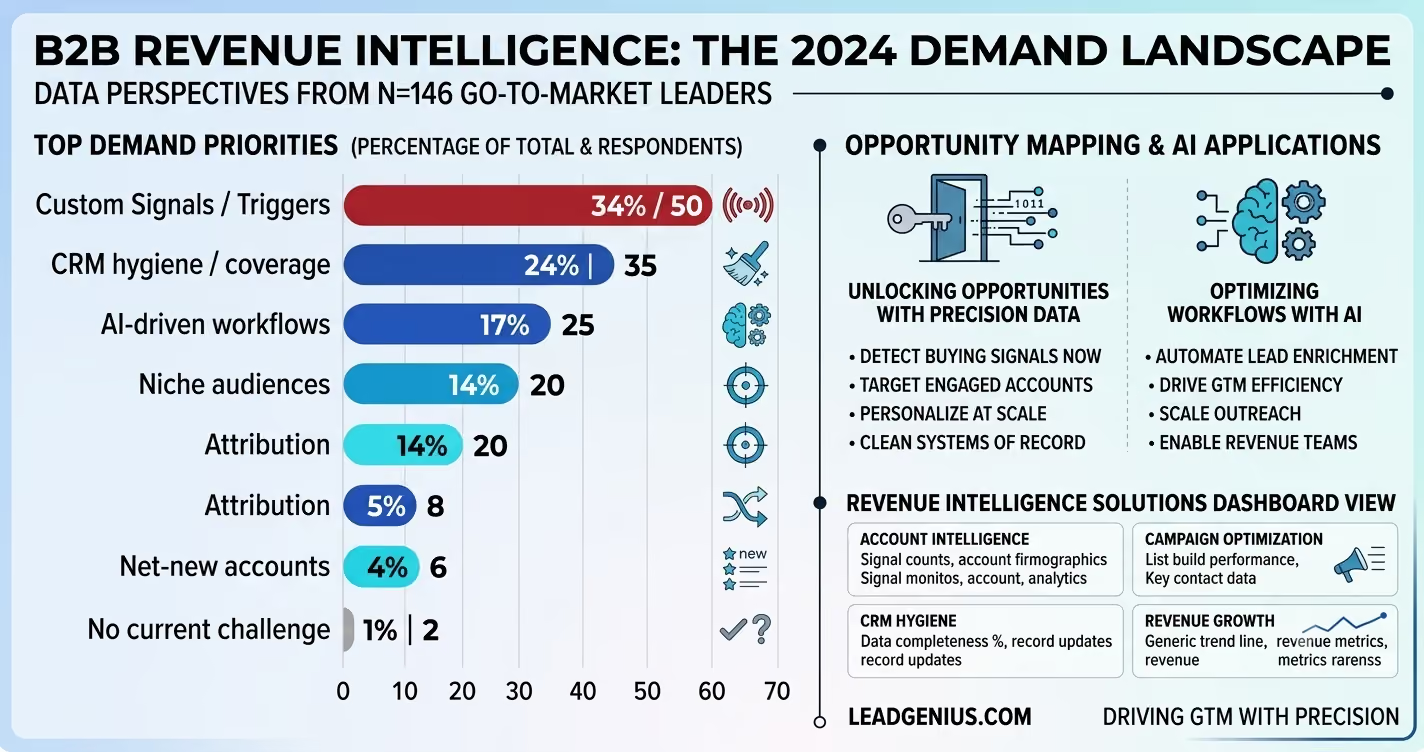
We asked former LeadGenius customers a deceptively simple question: what GTM data problem would you most like to solve in 2026? The answers were not really about finding more records. They were about making data usable.
Respondents wanted better buying signals, cleaner CRM coverage, hard-to-find audiences, AI workflows they could trust, and a clearer next best action. One person summarized the broader frustration in six words:
"Too many tools, not enough integration."
That may be the defining problem in GTM technology right now. Revenue teams have accumulated more enrichment vendors, intent platforms, research agents, workflow builders, advertising systems, and AI tools than ever. Yet many still cannot confidently answer four basic questions.
Which accounts should we prioritize?
What changed inside those accounts?
Who is actually involved in the buying decision?
What should we do next?
The industry has spent years expanding access to data. The next era will be defined by reducing the distance between a meaningful change in the market and the action a revenue team takes because of it.
What 146 Former Customers Told Us
Our survey included 146 former LeadGenius customers. It was not designed as an academic market study, and the results should be read as directional evidence from experienced GTM practitioners. Even so, the distribution was decisive.
GTM Data Priority for 2026
Share of respondents who selected each challenge as their primary priority (n = 146)Nearly three quarters of respondents selected custom signals, CRM hygiene, or AI-driven workflows. These may sound like three separate categories. In practice, they are three parts of the same operating problem.
Three Layers, One Operating Problem
Why signals, hygiene, and AI workflows can't be solved in isolationA team that solves only one layer still leaves substantial work for the customer. Clean contact data without relevant signals produces larger lists, not better prioritization. Signals without account and buying-center resolution create noise. AI automation without trusted inputs simply executes bad decisions faster.
The Static Database Era Is Running Out of Road
For years, the dominant model in B2B data was ownership. A company bought access to a large database, exported records, loaded them into a CRM, and tried to keep the information current through periodic enrichment.
That model worked when the primary job was finding a title, email address, or phone number. It is less useful when the job is understanding a changing company, a distributed buying center, or a narrow market that does not fit neatly inside a prebuilt taxonomy.
People change roles. Companies open and close locations. New products appear. Technologies are adopted or replaced. Hiring patterns accelerate. Funding, ownership, supply-chain relationships, and e-commerce activity change. Buying committees form at a regional office or business unit that may look nothing like the corporate headquarters record.
A quarterly refresh cannot fully represent that motion. And a sales representative should not need to become a part-time data engineer to interpret it.
The next generation of GTM data will not win because it contains the most records. It will win because it can identify the right account, explain why that account matters, resolve the people and locations involved, and make the next action available inside the systems where revenue teams already work.
AI Changes the Value of Data, but It Does Not Eliminate It
The rapid adoption of Clay, AI research agents, enrichment chains, and automated outbound has created a tempting narrative: if a model can research the web, perhaps companies no longer need a differentiated data provider.
We believe the opposite is happening.
AI is making the quality of underlying context more important because automation increases both speed and consequence. A human SDR may notice that a title looks wrong, a location is irrelevant, or an intent signal makes no sense. An automated workflow can send the wrong message to thousands of records before anyone notices.
The scarce asset is no longer access to a record. It is confidence that the record is current, correctly mapped, relevant to the buying center, compliant for the intended use, and enriched with the specific evidence needed to make a decision.
This is where bespoke data becomes more valuable, not less. Prebuilt data lakes are optimized for the fields that most customers request most often. AI-native GTM teams increasingly need the opposite: specialized evidence for their product, market, geography, and play.
From Data Delivery to a GTM Context Layer
The survey suggests that revenue teams do not want to assemble this future from another dozen disconnected products. They want a reliable context layer that can sit between the open web, their CRM, their AI systems, and the channels where work gets done. That layer needs to perform four jobs.
This is also why we are building a LeadGenius MCP.
Why LeadGenius Is Building an MCP
Model Context Protocol, or MCP, is an open standard for connecting AI applications to external systems. An MCP server can expose resources that provide context, prompts that define repeatable workflows, and tools that allow an AI model to interact with external systems. In practical terms, it creates a standardized way for AI applications to discover and use approved data and capabilities.
For LeadGenius, the opportunity is not merely to provide another endpoint for downloading records. It is to make differentiated GTM intelligence available to the agents and workflows that need it, when they need it.
The goal is a future where an authorized AI workflow can ask questions such as:
Which companies in this territory launched a relevant product in the last 90 days?
Which locations show evidence of the technology our product replaces?
Who are the likely members of the buying group at those locations?
What changed since the last time this account was evaluated?
Instead of returning a generic list, the system can deliver context shaped around the customer's actual market definition and operating rules. The AI application does not need to guess which public-web evidence is trustworthy or rebuild account mapping from scratch every time. It can work from an approved, purpose-built data layer.
Fewer manual handoffs between data discovery, validation, CRM enrichment, audience creation, and AI-driven execution. The objective is to preserve the depth of custom research while making it easier for modern GTM systems to access and use.
This matters because MCP can help separate the intelligence layer from the interface. A revenue team should not be forced to adopt one more standalone destination merely to use better data. The same trusted context should be available wherever authorized work happens, whether that is an AI assistant, a CRM workflow, a research process, or an audience activation system.
What Revenue Leaders Should Demand From the Next Generation of GTM Data
As this market evolves, revenue leaders should evaluate data systems against a different standard. Volume and field count will still matter, but they are no longer sufficient.
The companies that solve these problems will not look like traditional contact databases. They will look like intelligence infrastructure: continuously refreshed, specific to the customer's market, available through standardized interfaces, and accountable to a business outcome.
Fewer Steps Between Signal and Action
Our survey did not tell us that customers want more data. It told us they want less friction between the data they trust and the decisions they need to make. That distinction matters.
The future of GTM data is not a larger static lake. It is a living stream of validated company, contact, location, and market intelligence that can be shaped around a specific strategy. It is custom signals connected to accurate account maps. It is clean CRM data that gives AI a reliable foundation. It is niche audience discovery that can move directly into activation. And it is a clear next best action that a human or agent can understand and execute.
The market does not need another shiny object. It needs fewer steps between signal and action. That is the problem LeadGenius is working to solve.
Methodology
LeadGenius surveyed 146 former customers about the GTM data challenges that mattered most to their teams in 2026. Respondents selected one primary challenge. Results are directional and reflect the experiences and priorities of this respondent group. Percentages shown are based on 146 responses and may not total exactly 100.0% because of rounding.
Derek Rahn
VP of Demand Generation at LeadGenius. Derek leads research and demand strategy focused on how GTM teams turn market signal into pipeline.
Ready to Find the Contacts That Matter?
Get precise, compliant, and on-demand contact data — tailored to your business needs.
Connect with a Strategist.avif)