
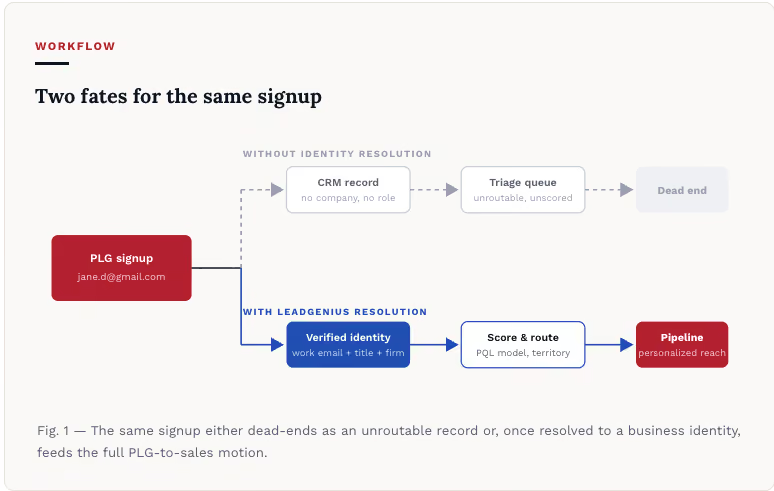
Product-led growth changed who fills out your forms. It didn't change what your go-to-market team needs to act on them. In a PLG motion, the front door is the product itself — users sign up in seconds, often on a phone, often on a whim, and they overwhelmingly sign up with the address that autofills first: their Gmail, their Yahoo, their iCloud.
Depending on the product, a third to well over half of self-serve signups arrive on personal domains — and the more frictionless the flow, the higher that share climbs. For the product, that's fine. For sales, marketing, and RevOps, it's a wall. A personal email tells you nothing about company, role, seniority, buying power, or territory. You can't score it, route it, segment it, or run an ABM play against it.
Every firstname.lastname@gmail.com sitting in your CRM is a real human — possibly a champion inside a target account — rendered invisible to your entire revenue engine.
Where PLG leads go to die
The failure is structural, not tactical. Most GTM stacks assume a business identity exists at the moment of capture. When it doesn't, every downstream system — lead scoring, routing, territory assignment, ABM matching — either drops the record or parks it in a triage queue nobody works.
This is the PLG blind spot: the leads are coming in, but the identity resolution layer that turns a signup into a sellable account signal is missing. And these aren't cold names from a content download — they're people actively using your product. The intent is already there. The only thing missing is the identity.
Why one database is never enough
Most enrichment tools were built to solve the opposite problem: start with a work email or company domain and attach more attributes to it. Reverse the direction — start from a personal email and resolve it back to a verified business identity — and the difficulty jumps by an order of magnitude. There's no domain to key off. The match must be triangulated from fragments.
No single source resolves more than a fraction of personal emails. Stacking dozens of sources — and reconciling conflicts between them — is what maximizes match rates.
This is exactly the use case LeadGenius specializes in. Rather than querying one static database, LeadGenius runs every record through a multi-source waterfall — proprietary identity graphs, professional profiles, company registries and employment records, phone-to-identity resolution — then cross-validates candidates and applies human-in-the-loop verification on ambiguous or high-value matches.
The proof: 3,200 records, head to head
A B2B SaaS company recently put this to the test. It took 3,200 inbound records — first name, last name, personal email, phone number — and ran the identical file through both Clay and LeadGenius to see which platform could resolve more personal emails into verified work contacts.
Head-to-head results · 3,200 records
And the matches weren't just email addresses. Every LeadGenius match came back with job titles and roles, company size, industry and location, technographics, and firmographics like revenue and employee count. Clay returned basic email matches without that depth. Downstream, the enrichment translated into cleaner routing by role and decision-making power, sharper territory assignment, and a 26% higher engagement rate — driven by verified deliverability and personalization that generic matching can't support.
What resolution unlocks in a PLG motion
In a traditional demand-gen funnel, an unresolvable email is a lost lead. In a PLG funnel it's worse — it's a lost product-qualified lead. High-match-rate resolution unlocks the entire PLG-to-sales handoff:
Ten "random" Gmail signups may be ten users inside one enterprise account — a bottom-up adoption wave invisible until identities are resolved and rolled up to a company.
Product usage plus resolved firmographics is the foundation of any credible product-qualified lead model. Usage alone can't tell a hobbyist from a VP at a Fortune 500.
Work email, title, and geography mean leads land with the right rep automatically instead of sitting in a triage queue.
Verified business addresses with real context convert better and bounce less than guessing — or blasting personal inboxes.
If personal-to-work email conversion is a rounding error in your vendor's product, it will perform like one.
Every PLG company is sitting on a pool of personal-email signups its current stack can't resolve. The head-to-head data shows a purpose-built, multi-source approach recovers more than twice as many contacts — each one arriving with the enrichment needed to route, score, and engage it. At LeadGenius, this is a core specialty: dozens of sources, waterfall matching, human verification, and enrichment depth designed for one job — turning anonymous signups into pipeline.
Your users have already raised their hands.
The only question is whether you can see who they are. Talk with a LeadGenius strategist about running your own file through the inbound enrichment play and benchmarking the match rate yourself.
Connect with a strategist.avif)