
Why revenue leaders in adtech & marketing tech use LeadGenius
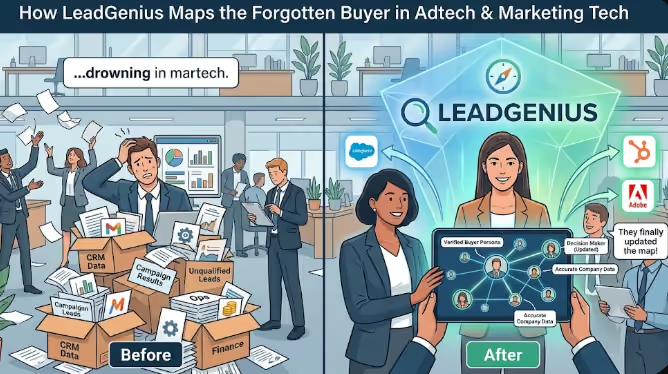
Marketing platforms sell to marketers who are themselves drowning in martech, and to the RevOps and finance leaders who now hold the budget. LeadGenius maps the buyer the category forgot to update.
Selling marketing software to marketers is the toughest audience in B2B: they invented the tactics you are using on them, and the budget has quietly moved to people who do not have "marketing" in their title.
If you lead revenue at an adtech or martech company, an intent-data platform like Bombora, a data-management or identity player like Lotame, a creative or messaging platform like Persado, an analytics tool like Singular, or an engagement platform like ON24, you face two compounding problems. Your buyers are sophisticated marketers who recognize and discount generic outreach instantly, and the buying committee has expanded beyond marketing into RevOps, marketing operations, and finance.
Generic databases make both problems worse. They flood you with the same over-collected "marketing manager" records every competitor also bought, and they under-cover the operations and finance leaders who increasingly approve martech spend. For a category that sells precision targeting, running on imprecise data is a credibility problem before it is a coverage one.
The martech buyer moved and the data did not follow
Budget authority for marketing software has shifted. The CMO still has a voice, but RevOps and marketing-ops leaders now own the stack decisions, and finance scrutinizes every renewal in a consolidating martech market. A platform that maps only the CMO or a field-marketing manager is targeting yesterday's committee.
LeadGenius builds the modern martech committee, marketing leadership, marketing and revenue operations, and the finance approver, mapped by responsibility rather than literal title. For a revenue leader, that means reaching the person who actually owns the stack decision, with the operations and finance stakeholders already identified, instead of pitching a marketing contact who no longer controls the budget.
Lead quality is the whole game in martech
Martech marketing generates volume easily and quality rarely. The funnel fills with competitors, agencies, students, and curious individuals, and the MQL-to-SQL rate tells the story. When acceptance is low, sales stops trusting marketing's leads, an especially bitter outcome for a company whose entire product is supposed to make marketing better.
That turnaround, from a 22% MQL-to-SQL rate to over 90% sales acceptance, is the canonical martech fix, and it came from targeting, not volume. Tying interest to verified, ICP-fit committees made the leads worth working. For an adtech or martech revenue leader, ending the internal lead-quality argument is worth as much as the pipeline itself, because it restores the trust the whole funnel runs on.
Intent and stack signals are native to this category
No category understands signals better than martech, which makes it inexcusable to prospect without them. A company that just hired a head of growth or RevOps has decided to invest in the stack. A company that just adopted a competing tool is a displacement target. A funding event precedes a marketing build-out. A company expanding channels needs new measurement and engagement tooling.
LeadGenius treats hiring, tech-stack changes, funding, and expansion as research outputs, so a martech team can reach the buyer at the moment the stack is in flux. Selling against a specific incumbent tool means targeting exactly the accounts running it, a precision that generic firmographics cannot deliver because they infer the stack rather than research it.
Why "buy more intent data" is not the answer
Generic intent and contact databases are sold to your competitors too, so they target the same accounts the same way. Bespoke sourcing finds the operations and finance approvers, and the specific stack matches, that off-the-shelf data structurally under-covers.
Why another generic source erodes your own pitch
An adtech or martech company running on the same generic database as everyone else is, in effect, contradicting its own value proposition. You sell sharper targeting; your own outbound proves you could not get it. Buying a second generic source adds duplicate marketing records and still misses the RevOps and finance buyers who now hold the budget.
LeadGenius resolves the contradiction. Because sourcing is a bespoke research brief, a martech team can request the full modern committee at accounts running a specific competing tool, in a specific segment, and receive data as precise as the product it is selling, which is the only kind of data a precision company should be prospecting with.
Consolidation is reshaping every martech committee
The martech market is consolidating, and that changes who buys. Finance now scrutinizes every overlapping tool, RevOps is mandated to rationalize the stack, and a purchase that used to be a marketing manager's call is now a committee review against existing spend. A platform still selling to a single marketing contact is selling into a committee that no longer makes the decision that way.
LeadGenius keeps the committee current as these structures shift, surfacing the operations and finance stakeholders who entered the decision when budgets tightened. For an adtech or martech revenue leader, that means outbound reaches the people who actually weigh a new tool against the existing stack, which, in a consolidating market, is the only conversation that converts.
What to ask for first
Ask for a benchmark that tests two things at once: whether your target committees include the RevOps and finance buyers, and whether the data is precise enough about the martech stack to support a credible first message. Revenue leaders in adtech and marketing tech use LeadGenius because selling precision on top of generic data is a contradiction, and closing it is what the best teams in the category do first.
See the gaps in your own accounts
Ask for a complimentary coverage benchmark: hand us a slice of your target accounts and we will show where the committee is incomplete, where contacts have gone stale, and which accounts are showing live buying signals you are not acting on yet.
Connect with a strategistMore in this series
- Why revenue leaders in payment tech use LeadGenius
- Why revenue leaders in marketplaces use LeadGenius
- Why revenue leaders in cloud & SaaS use LeadGenius
- Why revenue leaders in HRIS & HR tech use LeadGenius
- Why revenue leaders in back-office software use LeadGenius
- Why revenue leaders in fintech & banking use LeadGenius
.avif)