
Why revenue leaders in marketplaces use LeadGenius
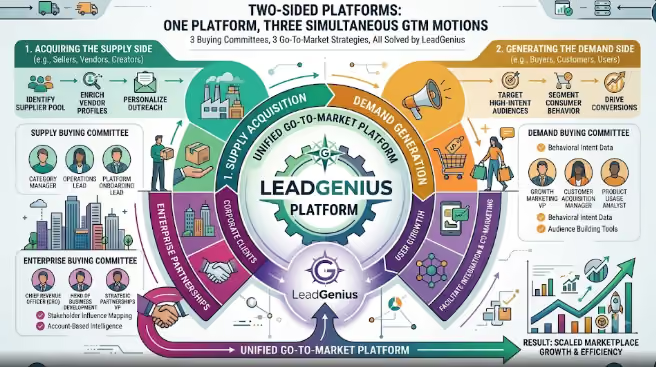
Two-sided platforms have to sell supply, demand, and enterprise partnerships at once. That is three GTM motions and three buying committees, and one reason marketplace revenue teams turn to LeadGenius.
A marketplace is not one business. It is at least two, supply and demand, plus an enterprise-partnerships motion stacked on top. Each side has its own buyers, its own urgency, and its own definition of a good lead. Most contact data is built for companies that sell one thing to one buyer.
If you lead revenue at a platform in the mold of DoorDash, TikTok, Amazon, or eBay, you are running parallel go-to-market machines. One team signs merchants, restaurants, sellers, or creators, the supply side. Another sells ads, placements, fulfillment, or enterprise services, the demand and monetization side. A third chases strategic partnerships that do not fit either pipeline. The accounts overlap, the data does not, and a generic database treats all of it as one undifferentiated firmographic blob.
That mismatch is why marketplace revenue leaders end up doing data work by hand. The supply team needs operators and owners at thousands of small businesses. The monetization team needs brand, performance-marketing, and media-buying leaders at large advertisers. The partnerships team needs corporate-development and BD executives. No off-the-shelf list serves all three, so reps cobble it together, and burn the week doing it.
Three buying committees, not one
The supply side of a marketplace sells to operators: a restaurant group's COO, a seller's e-commerce lead, a creator's management team. The pitch is volume, economics, and tooling. The monetization side sells to a completely different person, a brand's head of performance marketing, a media buyer, a retail-media strategist, and the pitch is reach and ROAS. Trying to run both from one contact source guarantees that one motion is always starved.
LeadGenius builds and maintains each of those committees as a distinct, fit-for-purpose dataset. The supply brief and the monetization brief are sourced against different ICPs, with different signals and different titles, so the supply team is never handed a list of ad buyers and the monetization team is never handed a list of small-business owners. For a revenue leader juggling parallel quotas, that separation is the whole point.
Scale is the marketplace data killer
The supply side of a large platform is a long-tail problem: tens of thousands of small operators, each with messy or missing contact data, most of whom no static database covers well because they are too small to be worth indexing. The monetization side is the opposite, a smaller set of large, heavily-covered advertisers where the challenge is not finding the company but finding the specific media decision-maker inside a sprawling org.
Those outcomes, measured across LeadGenius enterprise programs, are what scale-appropriate data buys you. On the supply side, custom sourcing reaches operators that generic databases skip entirely. On the monetization side, committee mapping finds the actual media buyer instead of a generic "marketing" contact. Either way, the AE stops spending a quarter's worth of days reconstructing accounts and starts spending it selling.
Signals tell a marketplace which side to push
A restaurant group opening ten new locations is a supply-expansion signal. A brand that just hired a head of retail media is a monetization signal. A competitor platform raising prices is a switching signal across both sides. Marketplaces live and die on timing, and timing is exactly what a flat firmographic record cannot encode.
LeadGenius treats expansion, hiring, funding, and tech-stack changes as research outputs you can act on. For a platform, that means routing the right signal to the right team, sending the new-location signal to supply and the new-CMO signal to monetization, instead of dumping one undifferentiated lead list on everyone.
The partnerships motion no database serves
Strategic BD at a marketplace targets corporate-development and partnership executives, a tiny, senior, hard-to-find population. This is precisely the kind of bespoke, named-target sourcing a generic database cannot do and a research-driven model can.
Why bigger databases make the problem worse
Buying a second database to cover a marketplace's range feels logical and almost never works. The supply long tail still is not covered, because long-tail operators are unprofitable for any generic vendor to index. The monetization side just gets more duplicate records of advertisers you already had. You have paid twice for the same coverage and still cannot reach the operator in a town of 40,000 or the media buyer inside a 5,000-person brand.
LeadGenius is built for exactly the targets a fixed index gives up on. Because sourcing is bespoke, the supply team can ask for every operator of a given type in a given geography, and the monetization team can ask for the named media decision-makers at a specific list of brands. The data is fit to the motion, not to whatever a database happened to already hold.
Data freshness decays fastest on a platform
Marketplace orgs reorganize constantly. The supply team that owned a region last quarter has been re-cut into verticals; the monetization team has renamed every title; the partner you sold last year has been acquired by another seller on the same platform. Contact data that was accurate in January is materially wrong by summer, and on a two-sided business that decay happens on both sides at once.
LeadGenius keeps committees current as a maintained deliverable rather than a one-time pull. For a revenue leader, that means the supply and monetization datasets do not quietly rot between quarters, the new operator, the new media buyer, and the new partner contact get refreshed before a rep wastes a sequence on someone who left.
What to ask for first
Start with one side and one benchmark. Hand LeadGenius a slice of your supply targets or your advertiser targets and let it show the coverage gaps, the stale records, and the live signals you are not acting on. Marketplace revenue leaders use LeadGenius because running three GTM motions on one generic list is a tax on every rep, and the platforms that grow fastest are the ones that stop paying it.
See the gaps in your own accounts
Ask for a complimentary coverage benchmark: hand us a slice of your target accounts and we will show where the committee is incomplete, where contacts have gone stale, and which accounts are showing live buying signals you are not acting on yet.
Connect with a strategistMore in this series
- Why revenue leaders in payment tech use LeadGenius
- Why revenue leaders in cloud & SaaS use LeadGenius
- Why revenue leaders in HRIS & HR tech use LeadGenius
- Why revenue leaders in back-office software use LeadGenius
- Why revenue leaders in fintech & banking use LeadGenius
- Why revenue leaders in adtech & marketing tech use LeadGenius
.avif)