
Article
Executing Permission Pass Data with LeadGenius: A Comprehensive Guide
LeadGenius boosts digital marketing with privacy-compliant contact management and permission pass campaigns. See why it is invaluable in global data compliance.
Your contact list is only as useful as your ability to say where each record came from, what you can do with it, and whether the person already said no. A practical guide for revenue, marketing, sales, RevOps, and privacy teams.
Most international campaigns don’t stall because of the law. They stall at the handoff. Marketing has an account list. Sales has a territory plan. RevOps has routing rules. Then, a few days before launch, someone asks privacy or legal whether a specific person, source, market, channel, and message can all go together.
A checkbox labeled “consent” can’t answer that. The real answer depends on what you’re using the data for, how you got it, who will use it, where the person is, which channel you plan to use, and whether they’ve already objected or opted out.
Permission is an operating system: connected decisions, evidence, controls, and actions that travel with each record from sourcing to suppression.
That’s why a huge contact database can still be unusable. A name and an email address aren’t enough. You need to know where each record came from, what notice or permission applies, what outreach your policy allows, and what happens the moment the person changes their mind.
Most teams treat privacy review as the final gate. The audience is built, the campaign is scheduled, and legal gets a list on short notice. Legal ends up looking like the team that blocks everything, and GTM has no time left to fix the actual gaps in source, permission, or workflow.
The fix is to make permission part of campaign design. Before anyone builds a target account list, an ABM audience, or an SDR sequence, the team should be able to answer these questions:
For a high-revenue SaaS company, this is an execution problem as much as a legal one. When permission status is missing or stale, records get held back from activation, sent to manual review, or used differently by each business unit. A good process keeps your audience coverage and sends each record down the right path.
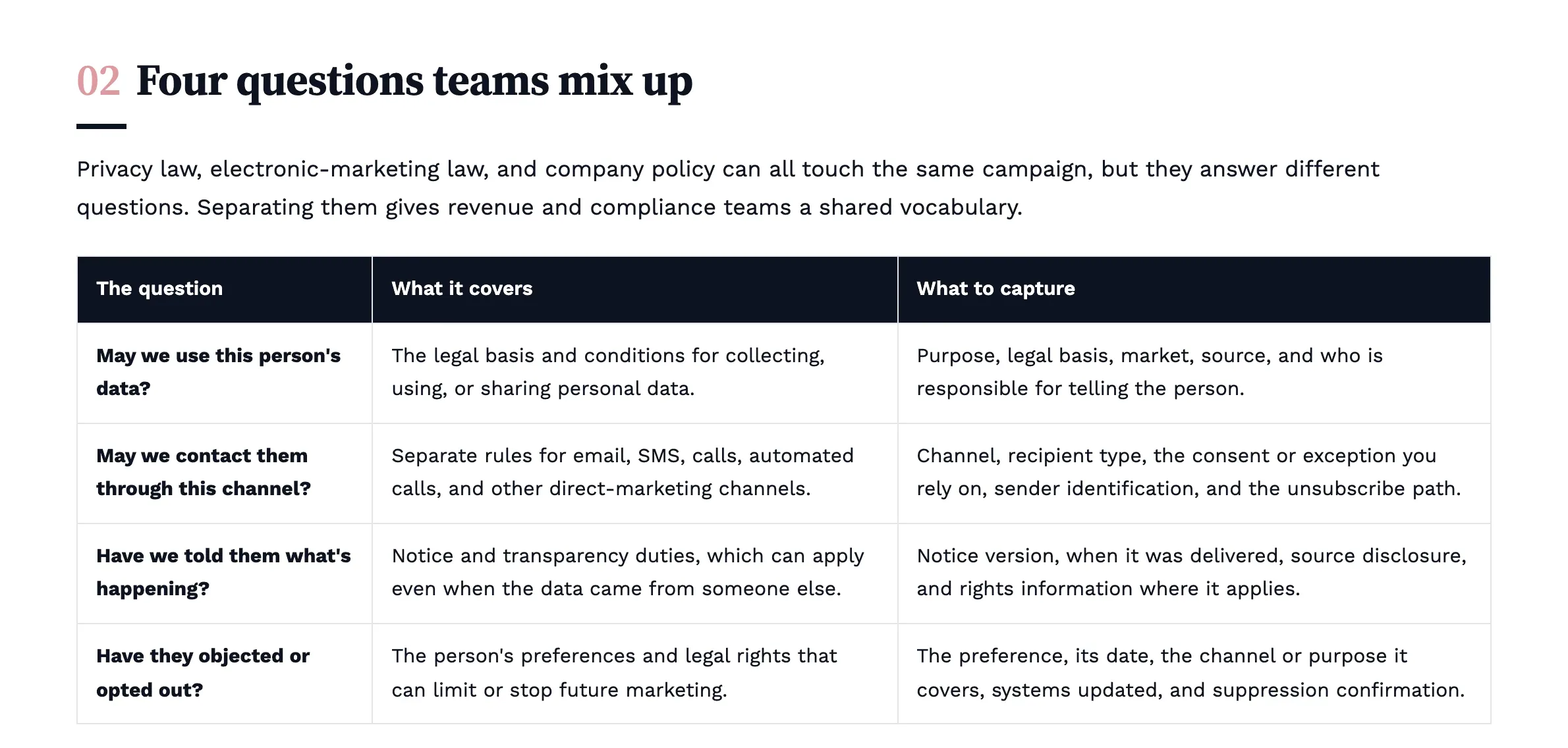
Privacy law, electronic-marketing law, and company policy can all touch the same campaign, but they answer different questions. Separating them gives revenue and compliance teams a shared vocabulary.
| The question | What it covers | What to capture |
|---|---|---|
| May we use this person's data? | The legal basis and conditions for collecting, using, or sharing personal data. | Purpose, legal basis, market, source, and who is responsible for telling the person. |
| May we contact them through this channel? | Separate rules for email, SMS, calls, automated calls, and other direct-marketing channels. | Channel, recipient type, the consent or exception you rely on, sender identification, and the unsubscribe path. |
| Have we told them what's happening? | Notice and transparency duties, which can apply even when the data came from someone else. | Notice version, when it was delivered, source disclosure, and rights information where it applies. |
| Have they objected or opted out? | The person's preferences and legal rights that can limit or stop future marketing. | The preference, its date, the channel or purpose it covers, systems updated, and suppression confirmation. |
Under GDPR, consent is one of several lawful bases, meaning the legal reasons you’re allowed to use personal data. The European Data Protection Board says you can rely on another basis when it genuinely applies. That doesn’t cancel the separate rules for electronic marketing, and it doesn’t touch the right to object. A GDPR objection to direct marketing is absolute for that purpose, and you have to make the right clear at the latest in your first communication. [1] [2]
The UK shows why channel and recipient matter. Under PECR, the ICO treats corporate subscribers differently from individuals. Some B2B email to corporate subscribers doesn’t need PECR consent, but you still need a lawful basis for the data and a working opt-out. Sole traders and some partnerships are treated differently. So a “B2B is fine” rule for one channel doesn’t carry over to every person or market. [3]
You can run the same campaign concept in ten countries. You can’t run it the same way. Execution changes by channel, sending entity, recipient, and local rule, so treat a market matrix as a planning tool, not a global yes-or-no label.
It works a lot like driving abroad. The car is the same everywhere. The side of the road, the speed limits, and whether you can turn on red are not, and “that’s how we do it at home” isn’t a defense.
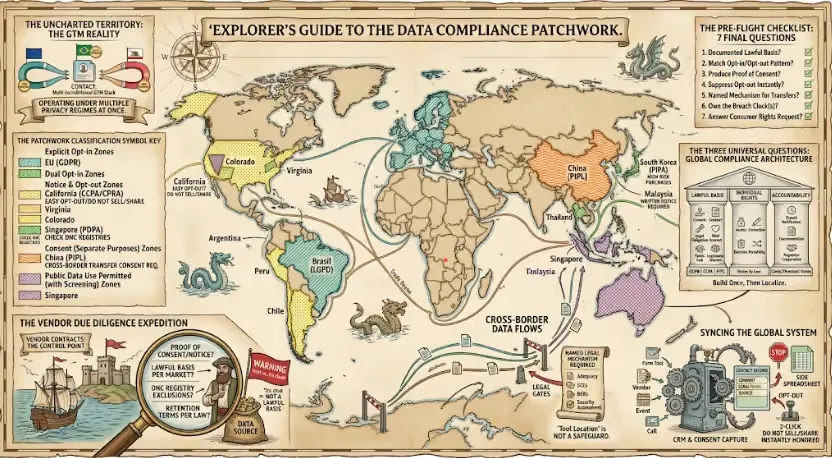
Start with the map, then confirm with counsel. LeadGenius’s working country map shows how markets differ on transparency, opt-out, explicit opt-in, direct-marketing registries, and sourcing workflows. Local rules and interpretations change, so have qualified counsel validate each country-and-channel decision before launch. The map is a planning aid, not legal advice or a certification of any specific campaign.
Permission gets manageable once you turn it into a lifecycle with clear states, required evidence, and named owners. Your organization and its counsel make the legal calls. The workflow makes those calls repeatable across list building, enrichment, activation, and suppression.
Plenty of revenue teams put a clock on leads. A company might route an inbound form fill to sales for 60 days, then require review or fresh permission before a specific follow-up program. That’s a reasonable operating rule.
It isn’t a GDPR rule. The ICO says UK GDPR sets no fixed time limit on consent. Consent can go stale or stop being valid if the purpose changes or the original choice no longer meets the standard, and an organization can set its own shorter window. [9]
Build your CRM around that distinction by keeping three things separate:
Store the evidence and the policy decision side by side. If every record just says “expired at 60 days” without saying whether that’s law, contract, customer policy, or campaign design, people will guess wrong in both directions.
Suppression is a minimal record that tells every system not to contact someone. It protects the person’s choice and keeps you from wasting outreach. It also creates a data problem: if you delete a suppressed contact entirely, the same person can come back through your next enrichment run or list purchase, and you’ll contact them again.
So keep a small suppression record, match every new record against it, and share it with every system and vendor involved in activation. Store only what you need to honor the preference, protect it, and keep it under a reviewed retention policy. The ICO specifically recommends suppression lists as a practical way to avoid re-contacting people who object to direct marketing. [10]
Repermission isn’t a loophole around an opt-out. If someone opted out of a channel or objected to direct marketing, don’t use that same channel to ask them back unless counsel has confirmed a lawful route. The ACMA warns that an electronic message asking for consent can itself be marketing. Keep the suppression in place and use a separately approved path, such as an inbound request, a different permitted context, or a genuinely independent interaction. If you get a valid new preference, record it without erasing the history that explains the change. [6]
Operating rule: a withdrawn permission, a direct-marketing objection, an internal do-not-contact request, and a stale lead are four different events. Model them separately, and never let a change in one automatically reactivate another.
Every field should support a decision, a legal obligation, or a proportionate audit need. A practical record includes:
Record what you actually collected. Don’t label a record “consented” if the evidence only shows that a privacy notice was displayed, that an email address was publicly visible, or that someone downloaded content without making a clear marketing choice. Keep a history of status changes, and limit access under your data-governance controls.
The model works when every team knows its part:
| Team | Owns | The question they should keep asking |
|---|---|---|
| Legal and privacy | Market and channel rules, lawful-basis decisions, notice standards, risk review, and contract requirements. | Which route is approved for this use case, and what evidence would change the answer? |
| Marketing and demand gen | Campaign purpose, consent capture, channel execution, suppression, and preference handling. | Can every record be tied to this campaign's purpose and channel? |
| Sales and SDR leadership | Sequence controls, rep guidance, approved contact paths, and escalating objections. | What should a rep do when permission is missing, stale, or withdrawn? |
| RevOps and GTM engineering | Data model, identity matching, status changes, syncs, routing, and monitoring. | Will a preference survive enrichment, imports, deduplication, and downstream activation? |
| Data and procurement | Source diligence, provider evidence, contract terms, refresh expectations, and vendor oversight. | Can the provider explain how each record was sourced and show the evidence? |
Asking a data vendor “are you compliant?” isn’t diligence. Ask how they gather data, how they document source and timing, how they represent individual preferences, how they handle suppression updates, what evidence they can produce, which subprocessors they use, and who is responsible for each notice and downstream action.
Regulators expect you to do this homework yourself. The ICO says a company using a data broker’s marketing services stays responsible for making sure its own processing complies with data-protection law. A vendor’s documentation supports that review. It can’t decide whether your specific campaign is lawful. [11]
Indemnification is a separate contractual control. Where a LeadGenius agreement includes indemnification, it assigns defined responsibilities and covered claims under that agreement, with its actual scope, conditions, caps, exclusions, and customer obligations. It isn’t blanket immunity, it doesn’t replace your own lawful-basis assessment, and it never makes it okay to ignore an opt-out.
LeadGenius builds curated audiences around your market, ideal customer profile, and workflow. For international programs, that means pairing account and contact discovery with record-level source context, country-aware suppression, and permission paths that can send records to approved opt-in workflows when needed.
You keep your market coverage while separating records that are ready for your approved use from records that need a notice, an opt-in workflow, legal review, or suppression. Your counsel decides the legal basis and channel rules. LeadGenius supports the data and workflow layer with curated records and provenance evidence, as specified for your program.
When your agreement includes indemnification, procurement and legal get one more contractual mechanism to review alongside the provenance controls. The agreement defines exactly what’s covered. The operating model still depends on current evidence, accurate audience scoping, and honoring every person’s choices.
Make permission part of the audience plan. Open the global compliance map and use it to start a market-by-market conversation with your privacy, legal, and GTM operations teams: Open the global compliance map.
No. GDPR requires a lawful basis for using personal data, and consent is only one of them. Electronic-marketing laws can still require consent for particular channels or audiences. Look at the market, recipient type, channel, purpose, and lawful basis together. [1] [3]
No. There’s no universal 60-day expiry. Your company can set a shorter freshness or campaign window, but label it as policy or contract, not law. Consent can also stop being valid when its purpose or context changes. [9]
Don’t assume you can through the channel they opted out of. Keep the suppression and use only a separately approved route. Some laws treat a request for consent as marketing in its own right. [6]
No. Provenance and permission evidence help with diligence and accountability. You still need to validate your purpose, lawful basis, channel rules, notices, and suppression controls. [11]
At minimum: source and collection date, any notice or permission evidence, purpose and channel scope, market, current preference, any internal review date, and opt-out status. Keep only what your retention policy and applicable law allow.
Editorial and legal review: This article is general educational information, not legal advice. Requirements vary by jurisdiction, channel, audience, and use case, and they change. Have qualified counsel validate the current rule and the facts of a planned campaign before activation. LeadGenius product capabilities and any indemnification are governed by the applicable customer agreement and program scope.
Article
LeadGenius boosts digital marketing with privacy-compliant contact management and permission pass campaigns. See why it is invaluable in global data compliance.
Guide
2026 Guide to global data compliance.
Article
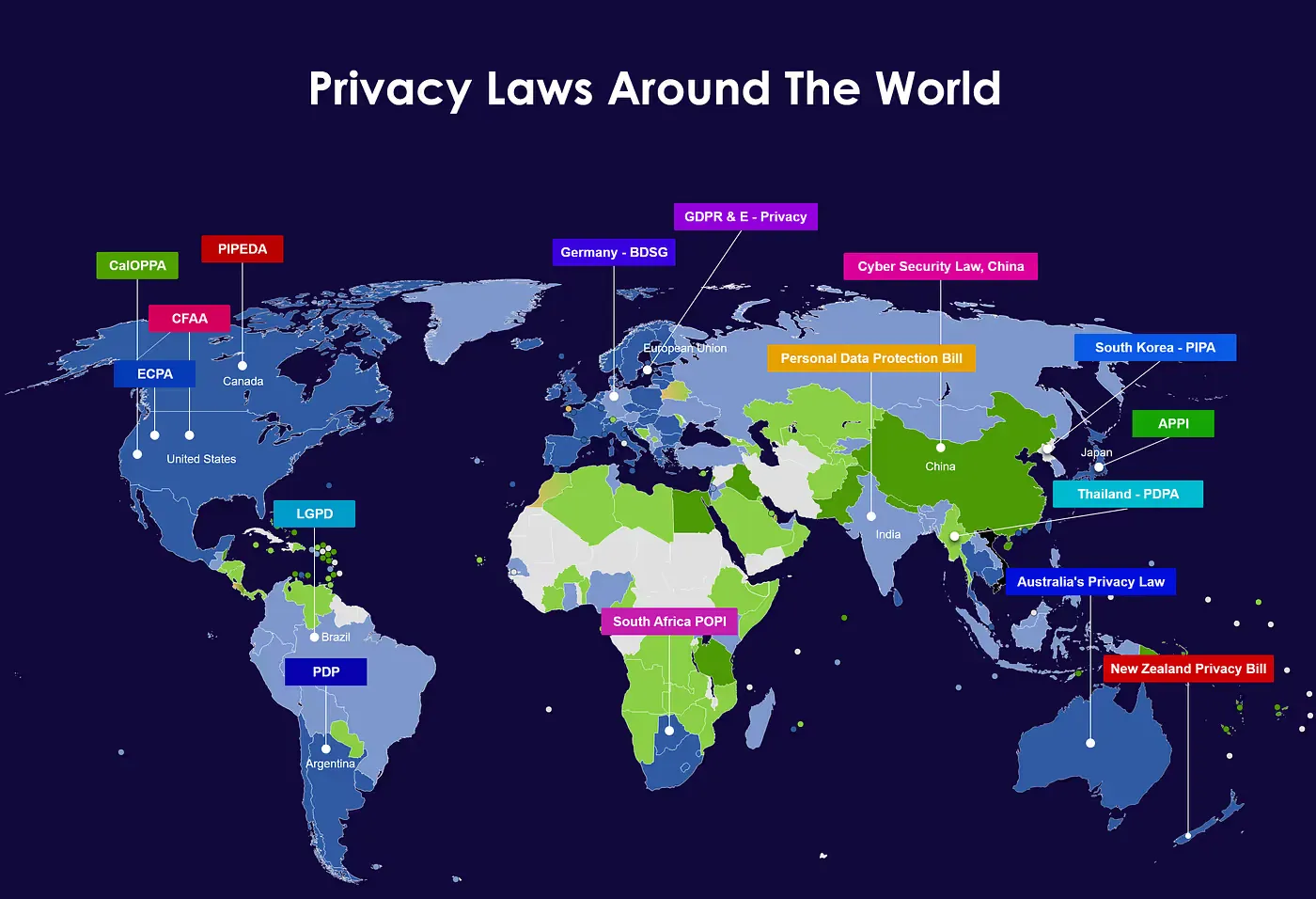
LeadGenius' guide covers data privacy regulations, compliance frameworks, audits, training & tech safeguards to enhance global strategies & build consumer trust.

Get precise, compliant, and on-demand contact data—tailored to your business needs.