Guide
The Attribution Illusion
Why your paid media data doesn't add up... and who's actually solving it.
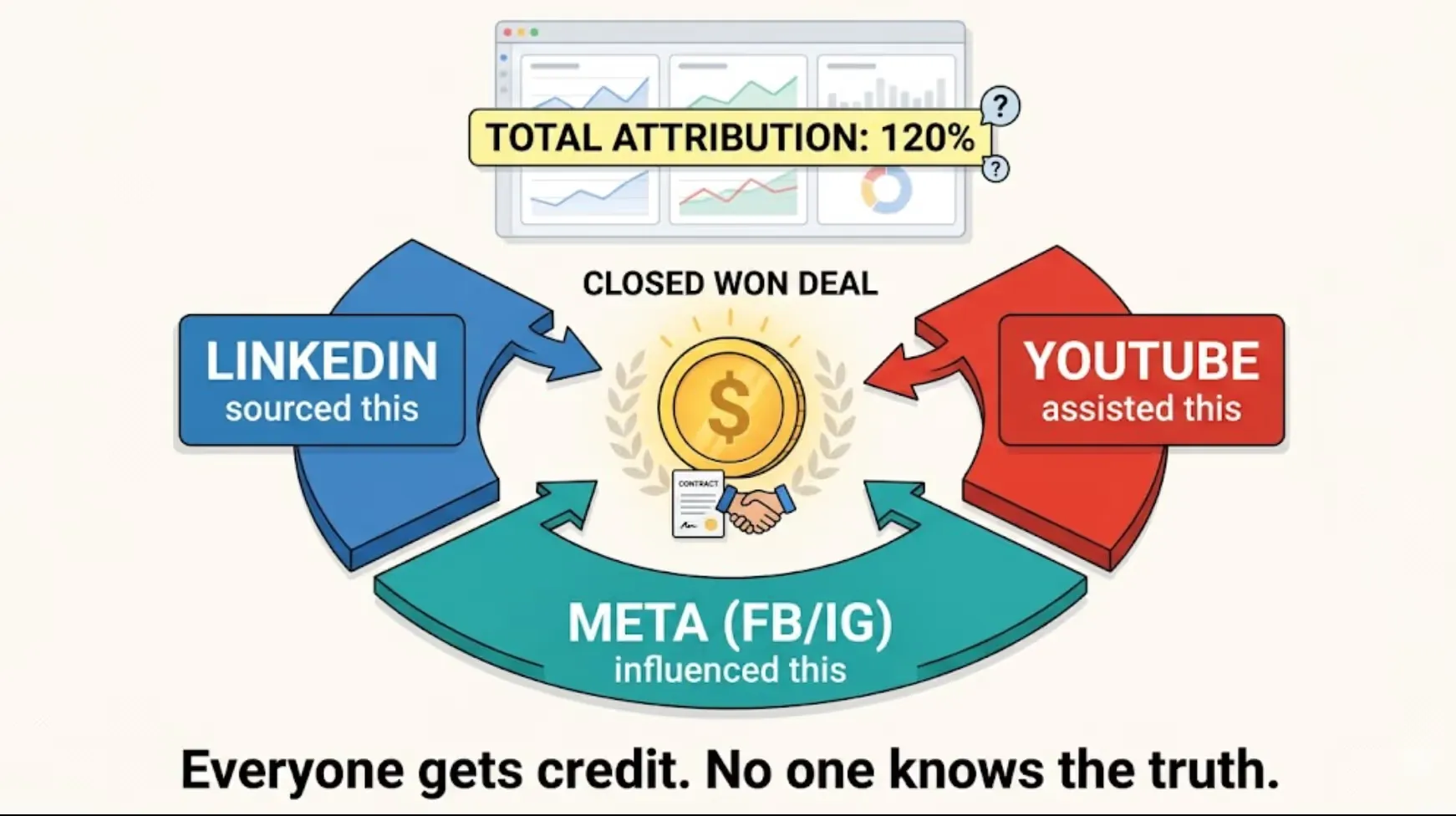
Attribution has become marketing’s modern-day illusion — every ad platform tells a different version of reality. Google, Meta, and LinkedIn each measure conversions through their own biased models, leaving digital teams frustrated by massive discrepancies and data they can’t trust.

Attribution has become marketing’s modern-day hallucination.
Open Google Ads and you’ll see one version of reality — clean, confident, full of conversions.
Open Meta Ads Manager? Another story entirely.
LinkedIn? A third, usually more expensive, one.
Meanwhile, Google Analytics 4 quietly tells you that none of them are right.
Every platform is lying — not maliciously, but mechanically. Each uses its own model, its own lookback windows, and its own logic about who “deserves” credit. The result? Marketing teams stuck in a philosophical debate masquerading as a data problem: What is truth?
When 80% discrepancies between platforms are now considered “normal,” you know something’s broken.
The short answer: because they have to.
The long answer: because privacy killed the pixel.
Over the past few years, the perfect storm of iOS14 tracking restrictions, cookie deprecation, and GA4’s simplified attribution framework has shattered the fragile illusion of measurement consistency. Each platform — Google, Meta, LinkedIn, TikTok — now operates within its own walled garden of partial data.
Let’s break down what’s happening:
Each of these “truths” is technically valid — within its own system. But for a marketer trying to unify reporting, it’s like getting three eyewitness accounts of the same event… and all three contradict each other.
Here’s the paradox: the more data we have, the less we trust it.
GA4 was supposed to make analytics cleaner and more modern. Instead, it introduced a data drought — fewer visible conversions, more “unassigned” traffic, and limited access to multi-touch modeling.
In the name of privacy and compliance, platforms have closed off visibility. We’re left measuring performance with partial instruments — half-blind, half-automated, and wholly frustrated.
The marketing forums are full of despair:
“Meta says 200+ purchases, GA4 shows two.”
“Attribution is broken.”
“No one believes ROAS anymore.”
Attribution used to be a science. Now it’s more like theology. Everyone has faith in their preferred model — and spends meetings defending it.
For years, marketers worshiped the click.
Last-touch attribution ruled the dashboard.
But in today’s world of dark social, long B2B sales cycles, and multi-device journeys, that model collapses. Your buyer might see an ad on LinkedIn, read a post shared in Slack, get retargeted on Meta, and finally convert after searching your brand on Google.
And guess who takes all the credit? Google. Every time.
Clicks tell only a fraction of the story. They miss influence, sequence, and nuance — everything that actually drives conversion in a multi-touch world.
If you’re optimizing solely on last-click data, you’re rewarding the final handshake, not the entire conversation that led to it.
So how do you fight back against the mirage?
By rethinking what “truth” means in marketing measurement.
The next generation of performance analytics isn’t about choosing an attribution model. It’s about building a source of truth — one that unifies, deduplicates, and validates signals across every channel.
Instead of relying on each platform’s proprietary math, marketers are beginning to embrace signal-based validation — server-side tracking, CRM integrations, and unified event IDs that let them see what really happened, not just what the platforms think happened.
This approach replaces faith with forensics.
It’s not about who gets the credit — it’s about what’s actually true.
This is exactly where AdGenius comes in.
AdGenius isn’t another analytics dashboard — it’s the reality engine that reconciles all those competing versions of the truth.
By capturing server-side signals directly from verified sources (web, CRM, conversion APIs), AdGenius creates a transparent, de-duplicated record of every meaningful marketing event.
Here’s what that means for digital teams:
AdGenius doesn’t care who claims credit — it shows who deserves it.
It turns attribution into alignment, finally bridging the gap between ad spend and actual outcomes.
Attribution will always be messy — but your data doesn’t have to be.
The future of marketing measurement isn’t about trusting platforms more; it’s about trusting your own signals most.
Because every ad platform lies differently.
Your job is to find out who’s telling the smallest one.
With AdGenius, you finally can.
Guide
Why your paid media data doesn't add up... and who's actually solving it.
Guide
The power of opportunity attribution: Step-by-step guide on Precision Data Platform by LeadGenius. Optimize sales and marketing efforts with actionable insights
Guide
Do you want to learn how to create an attribution report to boost your marketing? Our essential guide right here is packed with helpful tips.

Get precise, compliant, and on‑demand contact data—tailored to your business needs.