
THE CONTRARIAN TAKE
The GTM engineer trend is a trap
Every RevOps feed is telling you to hire one. Job postings for the role tripled in about a year. That's exactly why you should slow down before you post the req.
Quick version, in case you don't read past the first paragraph: a GTM engineer is someone who wires your sales tools together so leads show up cleaner and outreach happens without a human copying and pasting all day. That's a genuinely useful skill. It is not, for most companies, a genuinely useful hire.
Here's the thing about hiring trends that move this fast: they stop being a strategy and start being a reflex. Someone posts a screenshot of their automated pipeline, it gets 4,000 likes, and by Monday three people on your team are asking why you don't have one of those yet. Nobody in that chain asked whether your company actually needs custom infrastructure, or whether you just watched a really good demo.
Where we actually are
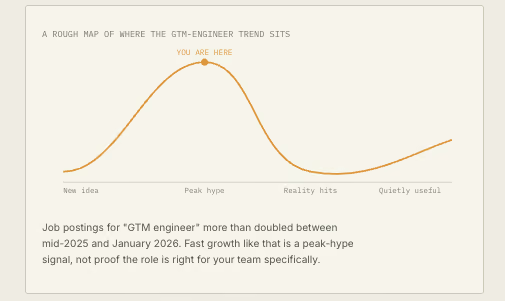
There's an old idea in tech called the hype cycle: a new thing shows up, expectations shoot up faster than the thing can deliver, reality sets in hard, and then, eventually, the thing settles into being quietly useful. Simple shape. Worth drawing, because most of us are standing on it right now without noticing.
Job postings for "GTM engineer" more than doubled between mid-2025 and January 2026. Fast growth like that is a peak-hype signal, not proof the role is right for your team specifically.
Five reasons this is a worse bet than it looks
You're hiring for a story, not a job description
The posts you see are survivorship bias. You hear about the one team whose enrichment pipeline runs like a Swiss watch. You don't hear about the ten teams whose "system" is a half-finished Clay table, a Slack channel of broken workflows, and a founder quietly Googling how to fix it at 11pm.
One person becomes your single point of failure
The whole point of a GTM engineer is that they wire everything together themselves. That's also the risk: if they leave, get sick, or just get busy, the pipeline that runs your entire top of funnel goes quiet, and nobody else knows which button not to press.
The real cost shows up after the build, not during it
APIs change. Prompts drift. Data goes stale. Someone has to babysit the thing forever, and "forever maintenance" is a full second job nobody put a line item next to when they approved the headcount.
You're bidding for scarce talent in an overheated market
Median pay for the role sits around $145K to $190K, and demand has roughly doubled year over year for two years running. You're not just paying a salary. You're competing in a hiring market that's gotten measurably tighter every quarter.
Your GTM stack usually isn't your differentiator
Building your own infrastructure makes sense when your workflow is genuinely unique to your business. For most companies, the thing that actually wins deals is who you're targeting and what you say to them, not how cleverly the spreadsheet was enriched.
Build vs. buy, without the sales pitch
This isn't "building is always wrong." It's "know which one you're actually doing before you commit a year of headcount to it."
BUILDING MAKES SENSE WHEN
- Your data sources or workflow are genuinely unusual, not a standard enrichment-and-outbound motion
- You already have engineering capacity sitting idle
- You're building a product, not just running a sales motion
- You can tolerate the pipeline breaking sometimes while someone fixes it
BUYING MAKES MORE SENSE WHEN
- You want the outcome (qualified pipeline) more than you want to own the plumbing
- You can't afford a single point of failure on lead generation
- You'd rather your best people spend time on strategy than on API maintenance
- The math on salary plus five tools already makes you wince
So here's the honest question worth sitting with: are you hiring a GTM engineer because your business genuinely needs custom infrastructure, or because it's the thing everyone on LinkedIn says to do this quarter?
Disagree? Good. That's the point of writing it this way. Drop a comment and tell us where this take is wrong.
.avif)