
THE ORIGIN STORY
We were the GTM engineering team before the title existed
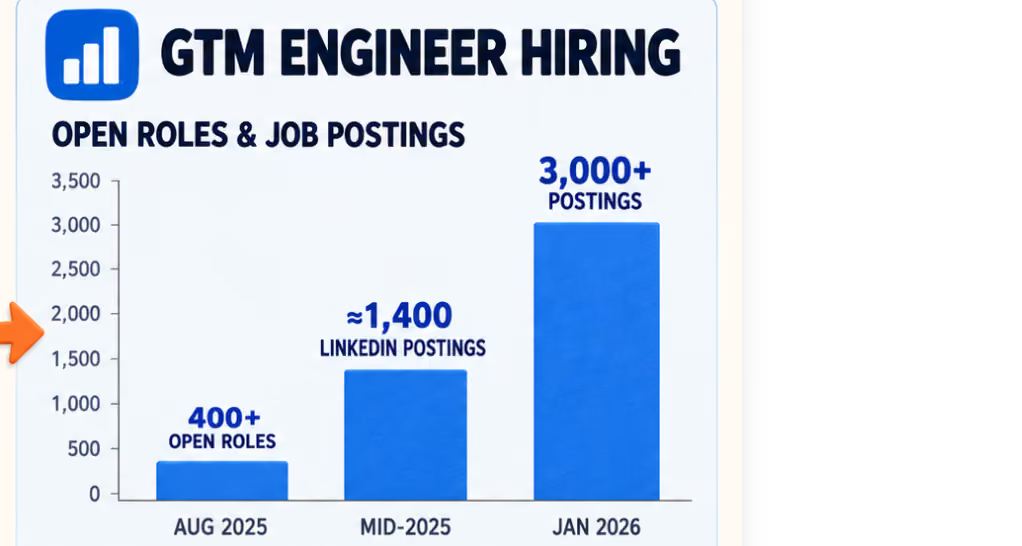
Job postings for "GTM engineer" have tripled since last year. We watched that happen from a strange vantage point: we've been building bespoke go-to-market systems for other people's companies since before the term was coined.
Every trend looks new to the people discovering it. For us, watching "GTM engineer" become the hottest job title in RevOps has felt less like watching a trend arrive and more like watching a room slowly catch up to a conversation we've been having since 2014.
We're not saying that to be smug about it. We're saying it because it's useful context. When something suddenly becomes a hiring trend, it's worth asking who was doing the actual work before it had a name, and what they learned that a fresh job posting can't replicate. That's the whole point of this piece.
How we got here
LeadGenius started in Berkeley in 2011, and within a few years the model had settled into something specific: pair AI-driven research with a global team of skilled human researchers, and use that combination to build custom, verified go-to-market data and campaigns for companies who needed leads a database alone couldn't find. That combination, part machine, part human judgment, is basically what a GTM engineer does today with a single laptop and five tool subscriptions. We were doing it as a service, at scale, for other companies, years before "GTM engineer" showed up in a job posting.
Founded in Berkeley, California
Started with a simple bet: the best B2B data comes from combining machine research with real human researchers, not from a static database that goes stale the day it's purchased.
The model becomes "GTM engineering," years before the phrase existed
Custom TAM, SAM, and SOM definitions. Built personas. Campaigns designed around a client's actual buyers, not a generic template. This is the work the industry now calls GTM engineering. We just called it Tuesday.
A decade of doing it for hundreds of companies
Every industry has different lies hiding in its data: different bounce patterns, different ways titles get misrepresented, different quirks in how contact info decays over time. A decade across hundreds of clients is where you actually learn what breaks, and how to keep it from breaking.
"GTM engineer" becomes a job title
A wave of companies starts hiring individuals to rebuild, in-house, a version of what we'd already spent over a decade refining as a service.
Watching the trend catch up
Postings for the role have more than doubled in a year. Companies are learning, often the hard way, what it actually takes to keep a system like this running.
What twelve years actually teaches you
A new hire, however sharp, is starting from zero on all of this. Not because they lack talent, but because some things are only learned by doing the work, at scale, across enough different companies to see the patterns repeat. Here's what that actually looks like in practice.
Which data sources quietly lie, and how
Every provider's data goes stale differently. Job titles, in particular, are wrong more often than people expect. You only learn which sources to trust, for which industries, by watching thousands of campaigns land or bounce over years, not weeks.
How bounce rates actually behave across regions and industries
A "good" bounce rate in one country or vertical is a bad one in another. That's not a fact you find in a tool's documentation. It's a pattern you notice after running enough campaigns to see it repeat.
Where integration fidelity actually breaks
Every system that connects a data source to a CRM to a sequencer has a weak point where data quietly degrades in transit. Finding those weak points once is luck. Finding them consistently, before they cost you a campaign, is experience.
How to build a TAM, SAM, and SOM that isn't just a slide
Anyone can draw three circles in a deck. Building market sizing that actually holds up when campaigns run against it, and adjusting it as the market shifts, is a different skill, and it's one you only sharpen by doing it for a living.
We're not against the GTM engineer trend
To be clear: we think the underlying instinct is right. Companies should want tighter, more automated, more intelligent go-to-market systems. That instinct is exactly what built our business in the first place. What we'd gently push back on is the assumption that the fastest way there is reinventing, from scratch, inside your own company, something that's already been refined for over a decade elsewhere.
We've watched a lot of companies learn this the expensive way: hire the person, buy the five tools, spend the first year finding the same landmines we mapped years ago. We'd rather hand you the map.
We've been the OG in this room for a while now. Before it was a trend, it was just how we built companies' pipelines: bespoke market sizing, real personas, campaigns tuned to the buyer instead of a template. That's still what we do. We've just had twelve years to get good at it.
.avif)