
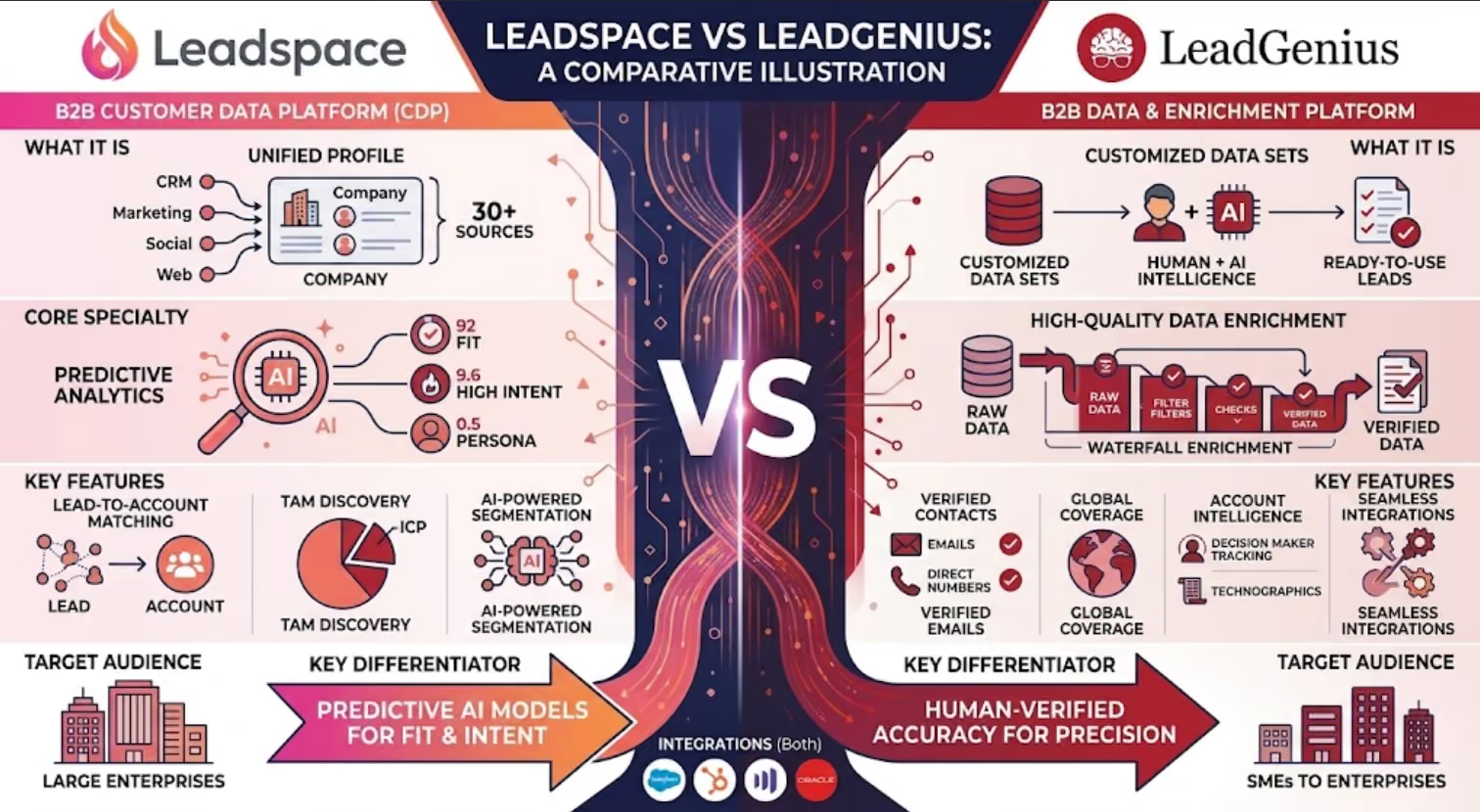
LeadGenius vs. Leadspace: A Plain-English Guide to Picking Your GTM Data Partner
Not all B2B data is built the same. Here's what actually separates the two platforms — no jargon required.
Imagine you asked two people to find you a great apartment in a city you've never visited.
One of them skims a big spreadsheet of listings, some of them years old, and emails you the ones that roughly match your budget. The other actually walks the neighborhood, knocks on doors, checks which buildings are still standing, and calls you back with three places that are exactly what you asked for — even the one that isn't listed anywhere online yet.
That's the difference between a lot of B2B data platforms and LeadGenius. And it's a big part of the difference between LeadGenius and Leadspace.
Leadspace is a real, well-regarded platform. It stitches together data from 30+ outside providers plus whatever you already have in your CRM, and it's good at that job — think of it as a very smart filing cabinet that keeps your existing records tidy. But "tidy" and "true" aren't the same thing. Below is a plain-English look at where the two actually differ.
1. Quality: A librarian vs. a robot skimming the shelves
Most B2B data platforms, Leadspace included, work like a robot skimming library shelves: pull data from a bunch of outside sources, blend it together, and hope the blend is accurate. It's fast, and it scales, but nobody's actually checking each book before it goes on your shelf.
LeadGenius does it more like a librarian who's actually read the books. Every record that matters gets a human researcher's eyes on it — someone who checks that the company, the title, and the contact info are real and current, not just statistically likely to be real. That's slower than pure automation. It's also why LeadGenius data tends to hold up when you actually use it, instead of quietly rotting in your CRM.
2. Beyond "job title" and "industry": the harder GTM engineering problems
Almost any data vendor can hand you a list filtered by job title and industry. That's the easy 80%. The interesting, valuable 20% — the stuff that actually moves pipeline — is harder, and it's where LeadGenius has spent years building muscle that off-the-shelf platforms don't have.
Entity resolution. Companies don't go by one name. "Cisco Systems Inc.," "Cisco," and "the WebEx team" might all be the same account wearing different hats. Entity resolution is the work of figuring out that they're all one entity, so you're not chasing three "different" companies that are actually one. Think of it like realizing your contact's nickname, maiden name, and old work email all belong to the same person — you just have to actually check.
Anonymous and generic email matching. A shocking number of real decision-makers hide behind info@, contact@, or a personal Gmail address instead of a tidy firstname.lastname@company.com. Most platforms simply skip these — they don't fit the pattern-matching formula. LeadGenius treats them as a puzzle worth solving instead of noise worth ignoring, which matters enormously once you leave the neat, English-speaking, enterprise-software part of the market.
Company hierarchy and parent-child relationships. Big companies are basically family trees — a parent company, subsidiaries, divisions that got acquired and renamed twice. If you don't understand that structure, you might sell into three "different" companies that all report up to the same CFO, or miss a much bigger deal sitting one branch up the tree. Mapping that tree accurately is a genuinely hard, ongoing research problem — not a checkbox feature.
Custom data work and one-of-a-kind signals. This is the big one. Off-the-shelf platforms sell you the same database everyone else buys. LeadGenius builds datasets that don't exist anywhere else, built specifically around your ideal customer definition — a niche certification, a regulatory filing, a very specific technology footprint. If your competitors are all buying from the same generic warehouse, the only way to find something they can't see is to go get it built.
3. Intent data with real global reach
Buyer intent data — the signals that tell you a company is actively researching a solution like yours — is only as useful as its coverage. A tool that only "sees" intent signals from U.S. and English-language sources leaves you blind everywhere else.
LeadGenius's intent data is built to travel: coverage spans 30+ countries, with sourcing designed to stay GDPR- and CCPA-compliant along the way. That matters if your total addressable market doesn't stop at the U.S. border — which, for most serious B2B companies today, it doesn't.
4. The SMB long tail: an underserved market LeadGenius was built for
Here's a quiet truth about the B2B data industry: almost every platform is optimized for finding big, well-documented enterprise accounts, because that's where the data is easy to find. Small and mid-sized businesses are messier — inconsistent names, no LinkedIn presence for the owner, filings buried in a Secretary of State database instead of a tidy corporate website.
LeadGenius has spent years building the unglamorous infrastructure this requires: pulling directly from primary sources like state business registries across dozens of jurisdictions, resolving the mess of legal names, DBAs, and owners into one clean identity, and keeping it current instead of letting it go stale. That's the difference between a data provider that can find "Acme Corp" and one that can find the plumbing company two towns over that legally operates under four different names.
If your ideal customer lives anywhere in that long tail — franchises, local service businesses, e-commerce sellers, SMB software buyers — this is exactly the gap LeadGenius was built to close.
The bottom line
Leadspace is a capable data unification layer, especially if your world is mid-market-to-enterprise accounts that already have clean digital footprints. LeadGenius is built for the harder, messier problems next to that world: verifying quality at the record level, resolving entities and hierarchies that automated tools miss, matching the anonymous inboxes everyone else ignores, building data that exists nowhere else, and reaching deep into global and SMB markets that generic databases were never designed to cover.
If your GTM motion depends on precision, not just volume, that difference shows up fast — usually the first time a list actually converts instead of bouncing.
Want to see the difference on your own target accounts? Connect with a strategist about a sample dataset built around your specific ICP.
Connect with a strategist →.avif)