
THE FRAMEWORK
Build vs. buy: what you're actually paying for
Hiring a GTM engineer and buying an outsourced GTM partner aren't two prices for the same thing. They're two different things. Here's how to tell which one your team needs.
When you hire a GTM engineer, you're buying a person plus a set of raw tools, and you assemble the system yourself. When you outsource, you're buying a finished, already-tuned system: defined market, built personas, running campaigns. Neither is automatically right. The rest of this piece is the checklist for figuring out which one fits you.
"Build vs. buy" gets thrown around like it's one decision. It isn't. It's really two separate questions stacked on top of each other: what does each option actually hand you on day one, and which set of tradeoffs can your team live with. Answer those honestly and the decision mostly makes itself.
01What you're really buying, either way
Start with the plainest possible version of each option, stripped of the sales language on both sides.
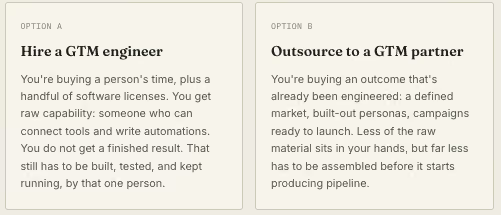
Hire a GTM engineer
You're buying a person's time, plus a handful of software licenses. You get raw capability: someone who can connect tools and write automations. You do not get a finished result. That still has to be built, tested, and kept running, by that one person.
Outsource to a GTM partner
You're buying an outcome that's already been engineered: a defined market, built-out personas, campaigns ready to launch. Less of the raw material sits in your hands, but far less has to be assembled before it starts producing pipeline.
Neither description is a criticism. They're just different products. The mistake is comparing a monthly software bill to a finished system, when the honest comparison is a finished system against a person plus a pile of parts.
02The variables that actually decide it
Most "build vs. buy" debates get stuck on price. Price matters, but it's not where the real difference shows up. These are the variables worth checking first.
| Criterion | Build (hire + stack) | Buy (outsourced system) |
|---|---|---|
| Data quality | You're responsible for sourcing, cleaning, and deduplicating contacts across whichever providers you've wired in. | Pre-vetted and continuously refreshed by the vendor, as part of what you're paying for. |
| Bounce rates | Inherited from whatever data providers your stack happens to pull from. Wide variance, and it's on you to monitor it. | Contractually the vendor's problem. Deliverability is part of what you're buying, not a side effect. |
| Connectivity & fidelity | You build and maintain every integration. When a field maps wrong or an API changes, it breaks quietly and you find out late. | Already integrated and tested. Fidelity between systems is the vendor's ongoing job, not yours. |
| Time to first campaign | Weeks to months: hire, onboard, build the pipeline, then start testing it. | Days to weeks: the system already exists and gets configured to you. |
| Cost structure | Fixed: salary plus five-ish tool subscriptions, whether or not pipeline shows up that quarter. | Tied to the contract, and scales with what you're actually asking for. |
| Risk if it breaks | One person is the whole system. If they leave, the engine stops until someone rebuilds their knowledge. | A team and a process stand behind it. No single departure takes the system down. |
| Control & customization | Full control. You can rebuild anything, at any time, as long as someone has the hours to do it. | Less granular control, in exchange for someone else carrying the operational weight. |
03A short self-check
Before you write the job req or sign the contract, run through this list honestly. It won't hand you a verdict, but it will tell you which way you're actually leaning.
Mostly answering "we'd have to trust it" or "we don't know yet"? That's usually a signal you're closer to buying a finished system than building one. Mostly answering with confidence, and with in-house capacity to back it up? Building may genuinely be the right call for you.
This isn't a framework designed to arrive at one answer. Some teams have a workflow strange enough, or engineering capacity idle enough, that building is the right move. Most teams are buying raw tools and hoping the assembly works out. The point of running the checklist first is making sure you know which one you're actually doing, before a year of budget and headcount is already spent finding out.
.avif)