
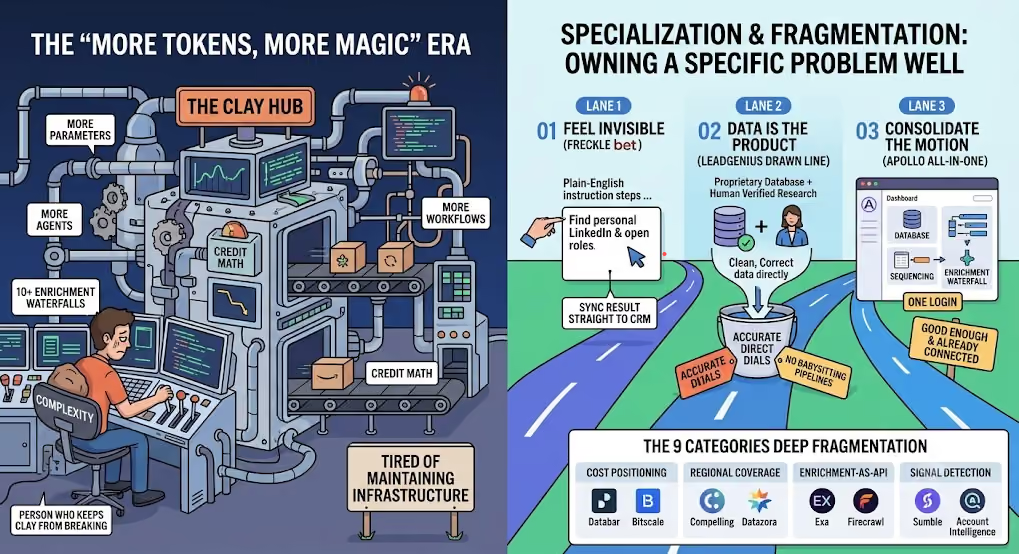
The AI Market Is Getting Over "More Tokens, More Magic." Clay Is Feeling It First.
For two years, the winning pitch in GTM tooling was maximalism: more workflows, more waterfalls, more AI stitched into more steps. That era is cooling — and the fragmentation of the Clay ecosystem is the clearest signal yet.
Every AI product cycle has a phase where "more" is the whole pitch. More parameters, more agents, more steps chained together, more tokens burned per task, on the theory that stacking capability is the same thing as solving the problem. We're watching that phase turn over right now — not because the underlying models got worse, but because buyers got tired of paying, in time and complexity, for capability they weren't actually using.
Clay built its category leadership on exactly that maximalist promise: one workspace that could out-orchestrate anything, an AI research agent that could chain ten enrichment providers into a single waterfall, a spreadsheet that could, in theory, do almost anything a GTM engineer could imagine. It's a genuinely impressive piece of engineering. It's also, per dozens of conversations with GTM leaders over the past few months, the thing a lot of teams have quietly grown tired of maintaining.
Not tired of what it does. Tired of what it takes — the learning curve, the credit math, the reality that someone on the team now has a job that is effectively "person who keeps Clay from breaking." That's the same fatigue showing up across the AI tooling landscape as the token-maxing era gives way to something more specialized. The market isn't asking for a bigger version of the do-everything tool anymore. It's asking for the piece that actually solves its problem, done well.
Freckle bets against the GTM engineer role entirely
Instead of building multi-step workflows in a spreadsheet interface, Freckle takes plain-English instructions — find the personal LinkedIn, count the open roles — and syncs the result straight back into the CRM. It's deliberately narrower than Clay: fewer levers, less configurability, and that's the trade being made on purpose. For a lean team that just wants clean, current records without a dedicated owner, invisibility is the entire value proposition.
Where LeadGenius draws the line
Clay's own pricing changes have made this case for us — a lot of what teams are actually paying for when they run a Clay waterfall — accurate direct dials, freshness, coverage on the accounts standard databases miss — doesn't have to be assembled by hand from ten providers. It can be delivered directly, by a team that pairs a proprietary database with human-verified research. "Enrichment" doesn't have to mean building and babysitting a pipeline. Sometimes it can just mean the data shows up correct the first time.
In a recent head-to-head, a global cloud storage leader ran LeadGenius against ZoomInfo across the same multi-touch cadence in EMEA — and saw connect rates nearly triple. It's the same head-to-head math we walked through in Clay, ZoomInfo, and the question no one wants to answer.
Apollo's all-in-one answer
Apollo isn't trying to out-orchestrate Clay — it's arguing you don't need to. Database, sequencing, and increasingly waterfall-style enrichment, all under one login. It won't match Clay's orchestration depth any time soon, but for a team that finds stitching together five specialized tools exhausting on its own, "good enough, and already connected" is a legitimate answer.
Why the fragmentation is the actual opportunity
The fragmentation runs nine categories deep
Freckle, LeadGenius, and Apollo are the three lanes that show up most often in conversation, but they're not the whole map. Talk to enough operators and the same category keeps splitting into sub-categories, each one narrow enough that a founder somewhere decided it was worth building a company around.
Budget-conscious teams are peeling off toward lighter, cheaper builders rather than paying for Clay's full workflow engine. Teams selling on timing — the "why now" of an outreach — are leaning on contact-decay detection that flags a stale record and, in some cases, refreshes it automatically, or on champion-tracking tools that watch for a known buyer changing jobs. Regional coverage gaps are opening room for data providers built for a single geography — the EU, Japan — instead of the whole world at once. CRM-native players are going after the enrichment budget directly inside HubSpot or Salesforce rather than a separate workspace. Data hygiene has become its own lane, distinct from enrichment: cleaning what's already in the CRM and keeping it clean as records decay. And underneath all of it, the raw materials of a Clay workflow — the AI-native web search, the crawling, the waterfall itself — are getting unbundled into API-first products for teams that would rather build their own thin layer than adopt anyone's opinionated workspace. On the opposite end, pure orchestration tools skip the data model entirely and just move information between systems, agnostic to what any of it means.
One more lane worth naming: account intelligence built from signal, not static records. That's where Sumble sits — constructing its picture of a company from hiring activity and job-post language rather than a database that goes stale the moment it's compiled. It's a different answer to the same underlying complaint: a record that's technically in the system but no longer true isn't data, it's debt.
| Company | Lane | HQ | Founded |
|---|---|---|---|
| Databar.ai | Cost positioning | United States | 2020 |
| Bitscale | Cost positioning | India | 2023 |
| Dealmatching | Contact decay / champion tracking / CRM hygiene | France | 2025 |
| Compelling | Regional coverage (EU) | Germany | 2022 |
| Datazora | Regional coverage (JP) | Japan | 2020 |
| UserGems | Champion tracking | United States | 2020 |
| Champify | Champion tracking (Salesforce-only) | United States | 2021 |
| Floqer | CRM-native enrichment | Canada | 2024 |
| Fluar | CRM-native enrichment | Poland | 2017 |
| Insycle | CRM data hygiene | United States | 2016 |
| Pipe0 | Enrichment-as-API | Germany | 2025 |
| Exa | Enrichment-as-API | United States | 2021 |
| Firecrawl | Enrichment-as-API | United States | 2024 |
| FullEnrich | Email waterfall | United States | 2024 |
| n8n | Pure orchestration | Germany | 2019 |
| Cargo | Pure orchestration | France | 2023 |
| Sumble | Account intelligence / signal detection | United States | 2022 |
None of that list is exhaustive, and it won't stay accurate for long — that's rather the point. The rate at which new lanes keep opening is itself evidence for the argument: this isn't a market waiting for one winner. It's a market that rewards owning a specific problem well.
None of these three tools are trying to be Clay, and that's the point. Clay earned its reputation by being everything at once — part database, part workflow engine, part philosophy about how GTM data should work. But "everything at once" is exactly the kind of product that creates room for someone to come in and be very good at one piece of it, the same pattern now playing out across AI tooling broadly as the market pivots away from raw capability stacking and toward tools that solve one job precisely.
So the useful question isn't "which tool wins." It's which problem is actually yours. A team where nobody wants to own a Clay instance has a different problem than a team whose contact data keeps going stale, which is a different problem again from a team quietly paying for four overlapping enrichment tools. Clay solves all three at once, at the cost of complexity. The alternatives are betting that most teams would rather solve their real problem well than solve every problem adequately.
Given how many operators describe feeling behind on their own tool rather than in command of it, that's not a bad bet to be on — as a buyer, at least. And if the problem you're solving for is contact data you can actually trust without building a pipeline to get there, that's exactly where we'd point you.
Not sure which fault line is yours
Talk through your GTM data stack with someone who's seen this pattern before
Connect with a Strategist →Built with HITL + AI for Ops & Marketing pros driving revenue.
© 2026 LeadGenius · Berkeley, California
.avif)