Guide
The Ultimate Guide to GDPR-Compliant Sales Outreach
How to Find and Activate Customers Without Breaking the Law
Country-by-country rules for compliant B2B outreach in 21 countries: consent models, Do-Not-Contact registries, vendor obligations and LeadGenius consent services.
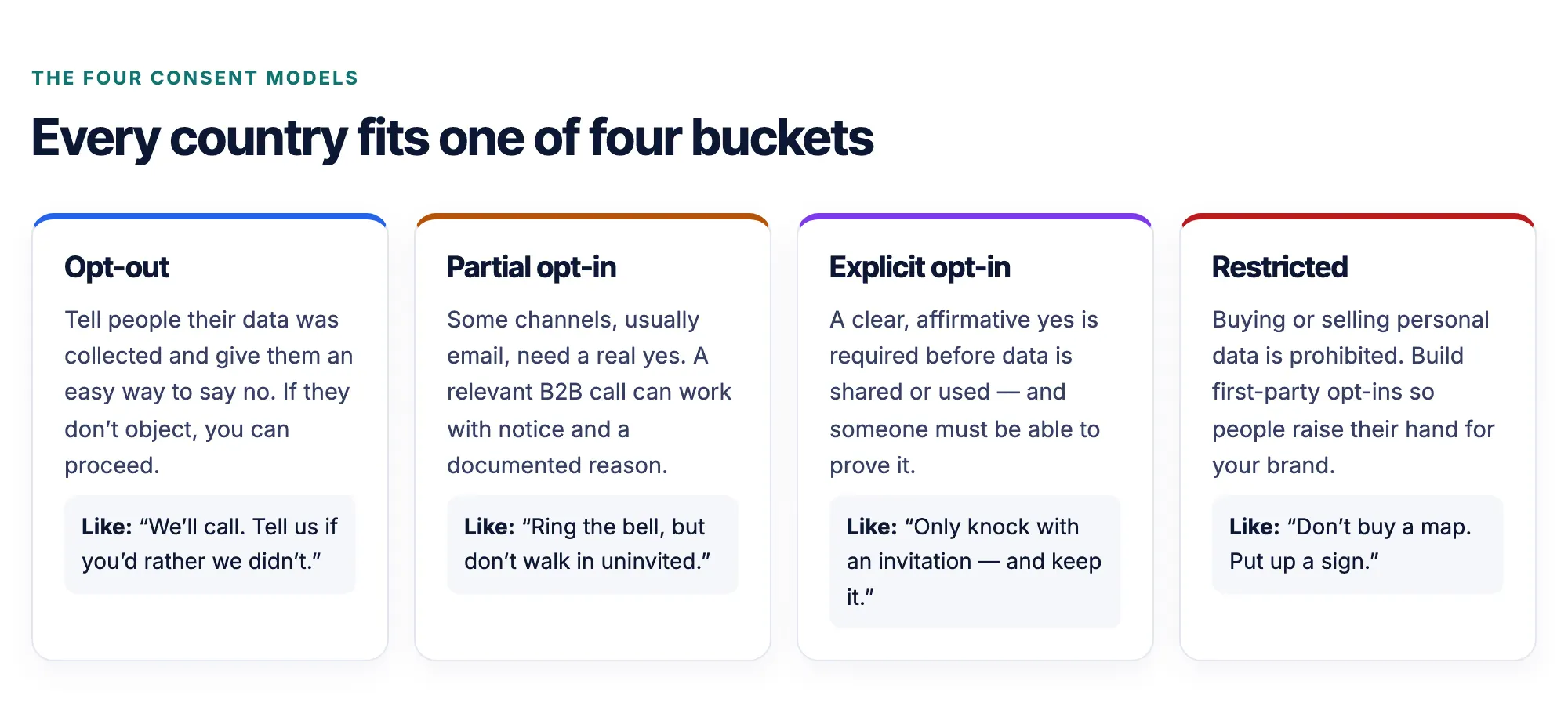
Think of every prospect as a house. Every country has its own rules for knocking on the door. Some say “knock, but leave if they ask you to.” Some say “only knock if you were invited.” One says “don’t buy a map of who lives here at all.”
You don’t need to memorize 21 rulebooks. Before you reach out, know three things: which rule applies, which channel is open, and whether you can prove it. This playbook gives you all three for every country, and shows how LeadGenius makes the proof automatic.
Tell people their data was collected and give them an easy way to say no. If they don’t object, you can proceed.
Like: “We’ll call. Tell us if you’d rather we didn’t.”
Some channels, usually email, need a real yes. A relevant B2B call can work with notice and a documented reason.
Like: “Ring the bell, but don’t walk in uninvited.”
A clear, affirmative yes is required before data is shared or used — and someone must be able to prove it.
Like: “Only knock with an invitation — and keep it.”
Buying or selling personal data is prohibited. Build first-party opt-ins so people raise their hand for your brand.
Like: “Don’t buy a map. Put up a sign.”
Find your country below, then go to its full playbook.
| Country | Consent model | Do-Not-Contact | All sourced | Opt-out notice | Explicit opt-in | Content syndication | Hygiene & signals |
|---|---|---|---|---|---|---|---|
| Argentina | Opt-out | National “No Llame” (Do Not Call) Registry | Included | Included | Not used | Not used | Included |
| Brazil | Explicit opt-in | Your internal suppression lists | Included | Not used | Included | Included | Included |
| Chile | Opt-out | SERNAC “No Molestar” registry | Included | Included | Not used | Not used | Included |
| Colombia | Explicit opt-in | Your internal suppression lists | Included | Not used | Included | Included | Included |
| Peru | Opt-out | “Gracias… No Insista” registry (INDECOPI) | Included | Included | Not used | Not used | Included |
| Austria | Explicit opt-in | Robinson List (maintained under GewO §151) | Included | Not used | Included | Included | Included |
| Germany | Partial opt-in | Your internal suppression lists | Included | Not used | Included | Optional | Included |
| Ireland | Partial opt-in | National Directory Database (NDD) marketing opt-out | Included | Not used | Included | Optional | Included |
| Spain | Explicit opt-in | Advertising exclusion systems published by the AEPD (Lista Robinson) | Included | Not used | Included | Included | Included |
| Switzerland | Partial opt-in | Your internal suppression lists | Included | Not used | Included | Optional | Included |
| United Kingdom | Partial opt-in | Telephone Preference Service (TPS) and Corporate TPS (CTPS) | Included | Not used | Included | Optional | Included |
| Australia | Partial opt-in | Do Not Call Register (DNCR) | Included | Not used | Included | Optional | Included |
| India | Partial opt-in | Your internal suppression lists | Included | Not used | Included | Optional | Included |
| Indonesia | Opt-out | Your internal suppression lists | Included | Included | Not used | Not used | Included |
| Malaysia | Explicit opt-in | Your internal suppression lists | Included | Not used | Included | Included | Included |
| New Zealand | Partial opt-in | Marketing Association Do Not Call / Name Removal services (industry-run) | Included | Not used | Included | Optional | Included |
| Philippines | Opt-out | Opt-out suppression lists and any applicable Do Not Call list | Included | Included | Not used | Not used | Included |
| Singapore | Opt-out | Do Not Call (DNC) Register | Included | Included | Not used | Not used | Included |
| South Korea | Explicit opt-in | Your internal suppression lists | Included | Not used | Included | Included | Included |
| Thailand | Explicit opt-in | Your internal suppression lists | Included | Not used | Included | Included | Included |
| Vietnam | Restricted | Your internal suppression lists | Not used | Not used | Included | Included | Included |
Each playbook answers what privacy teams actually ask: not just whether a vendor can comply, but how.
Opt-out · Standard risk
In Argentina you can reach out as long as people were told their details were collected and were given an easy way to say no. Before you call, check the “No Llame” list.
Laws: Personal Data Protection Law 25.326 and Regulatory Decree 1558/2001; AAIP (Agency for Access to Public Information); Consumer Protection Act; Fair Trade Act
Do-Not-Contact: National “No Llame” (Do Not Call) Registry
How LeadGenius delivers it:
Explicit opt-in · High risk
Brazil wants a clear “yes” before anyone passes a person’s details along — and proof that the yes really happened. No yes, no hand-off.
Jan 2026: The EU and Brazil adopted mutual adequacy decisions, so personal data can now move between the EEA and Brazil without extra transfer clauses. The ANPD’s 2026–2027 priority map signals more active sanctioning; fines reach 2% of Brazil revenue, capped at R$50M per infraction.
Laws: LGPD — Lei Geral de Proteção de Dados (Law 13.709/2018); Enforced by the ANPD
Do-Not-Contact: Your internal suppression lists, plus any registry you ask us to apply
How LeadGenius delivers it:
Opt-out · Elevated risk
Today Chile works like Argentina: tell people, let them say no, and check the do-not-call list. But on 1 December 2026 a much stricter, GDPR-style law switches on — so plan for tighter rules now.
1 Dec 2026: Law 21.719 takes full effect — extraterritorial reach, new data subject rights including portability, a new Data Protection Agency, and revenue-based sanctions (roughly 2–4% of revenue for serious cases).
Laws: Law 19.628 on the Protection of Private Life (in force until 30 Nov 2026); Law 21.719 — new Personal Data Protection Law (in force 1 Dec 2026)
Do-Not-Contact: SERNAC “No Molestar” registry
How LeadGenius delivers it:
Explicit opt-in · High risk
Like Brazil: before a person’s details can be shared with you, they need to have said yes — and someone needs to be able to prove it.
Laws: Statutory Law 1581 of 2012 and Decree 1377 of 2013; Enforced by the SIC (Superintendence of Industry and Commerce)
Do-Not-Contact: Your internal suppression lists, plus any registry you ask us to apply
How LeadGenius delivers it:
Opt-out · Elevated risk
Peru lets you knock on the door once to ask if it’s okay to talk. If they don’t say yes, you don’t knock again. And if a vendor gets it wrong, the law assumes you — the company benefiting — are responsible.
Mar 2025: Peru’s new regulation confirms a single first contact to obtain consent is allowed — but if consent isn’t given, further contact is unlawful. Liability for commercial prospecting is presumed to sit with the beneficiary. Qualifying incidents must be reported to the authority within 48 hours.
Laws: Personal Data Protection Law 29733; New Regulation — Supreme Decree 016-2024-JUS (in force 30 March 2025)
Do-Not-Contact: “Gracias… No Insista” registry (INDECOPI)
How LeadGenius delivers it:
Explicit opt-in · High risk
Austria wants the person’s yes before their data is processed and sold — and anyone on the Robinson List is off-limits.
Laws: GDPR + Austrian Data Protection Act (DSG); Telecommunications Act 2021 (TKG) §174 — electronic marketing; Trade Regulation Act (GewO) §151 — address publishers and direct-marketing companies
Do-Not-Contact: Robinson List (maintained under GewO §151)
How LeadGenius delivers it:
Partial opt-in · High risk
Germany has two gatekeepers. GDPR decides whether you may hold someone’s data. The UWG decides whether you may contact them. For business calls, a good, documented reason they’d care is enough. For email, you need a real “yes” first.
Watch: Automated or AI-voiced calls need prior express consent even in B2B. Unlawful advertising calls can draw fines of up to €300,000, and competitors can sue directly under the UWG.
Laws: GDPR + Federal Data Protection Act (BDSG); Act Against Unfair Competition (UWG) — §7 governs email and phone advertising
Do-Not-Contact: Your internal suppression lists, plus any registry you ask us to apply
Your options:
How LeadGenius delivers it:
Partial opt-in · Elevated risk
Ireland asks for consent to share with a vendor’s customers — it doesn’t have to name you — and you skip anyone who opted out on the National Directory Database.
Laws: GDPR + Data Protection Act 2018; ePrivacy Regulations 2011 (S.I. 336/2011)
Do-Not-Contact: National Directory Database (NDD) marketing opt-out
How LeadGenius delivers it:
Explicit opt-in · High risk
Spain says no marketing email unless the person asked for it or is already your customer. And before any campaign, check the Robinson exclusion list — Spain’s regulator fines people who skip it.
Enforcement: Spain’s Supreme Court upheld a €40,000 AEPD fine against an insurer for marketing to a person on the Robinson List.
Laws: GDPR + Organic Law 3/2018 (LOPDGDD); Law 34/2002 on Information Society Services and E-Commerce (LSSI-CE), Art. 21
Do-Not-Contact: Advertising exclusion systems published by the AEPD (Lista Robinson)
How LeadGenius delivers it:
Partial opt-in · Elevated risk
Switzerland gives you two paths: either the vendor gets permission up front, or you ask for it in your very first message. Either way, people must know who has their data and why.
Laws: Revised Federal Act on Data Protection (revFADP / nDSG, in force 1 Sep 2023); Federal Act against Unfair Competition of 19 Dec 1986 (UWG; SR 241)
Do-Not-Contact: Your internal suppression lists; respect the “no advertising” star (*) in phone directories
Your options:
How LeadGenius delivers it:
Partial opt-in · Elevated risk
In the UK, our playbook standard is simple: the person agreed to share their details with you by name, and anyone on the TPS or CTPS phone lists gets skipped.
DUAA 2025: Maximum PECR fines rose from £500,000 to £17.5M or 4% of global turnover, whichever is higher — direct-marketing mistakes now carry GDPR-level risk.
Laws: UK GDPR + Data Protection Act 2018 (regulator: ICO); PECR — Privacy and Electronic Communications Regulations 2003; Data (Use and Access) Act 2025
Do-Not-Contact: Telephone Preference Service (TPS) and Corporate TPS (CTPS)
How LeadGenius delivers it:
Partial opt-in · Elevated risk
Australia wants the person’s okay, a simple way to stop hearing from you, and no calls to numbers on the Do Not Call Register. Subject to change.
10 Jun 2025: A new statutory tort for serious invasions of privacy commenced. 10 Dec 2026: Privacy policies must disclose automated decision-making that uses personal information.
Laws: Privacy Act 1988 (Cth), as amended by the Privacy and Other Legislation Amendment Act 2024; Spam Act 2003 — email and SMS; Do Not Call Register Act 2006 — telephone
Do-Not-Contact: Do Not Call Register (DNCR)
How LeadGenius delivers it:
Partial opt-in · Elevated risk
India is switching on a brand-new privacy law in stages. If the data came from places the person made public themselves, a notice with a way to opt out works. If not, the person needs to have said yes. Subject to change.
Timeline: Consent-manager registration opens 14 Nov 2026. The core notice, consent and breach obligations apply from May 2027. Consent must be free, specific, informed and as easy to withdraw as to give.
Laws: Digital Personal Data Protection Act 2023 (DPDP Act); DPDP Rules 2025 (notified 13 Nov 2025, phased to May 2027)
Do-Not-Contact: Your internal suppression lists; TRAI commercial-communication preferences for telecom
Your options:
How LeadGenius delivers it:
Opt-out · Elevated risk
Indonesia wants people told the whole story — why their data is used, what kind, for how long, and their rights — plus an easy way to opt out. Subject to change.
Watch: The PDP Law has been fully enforceable since Oct 2024, but the dedicated PDP Agency was still being set up as of 2026. Expect enforcement to rise once it’s operational.
Laws: Personal Data Protection Law No. 27 of 2022 (PDP Law), fully effective 17 Oct 2024
Do-Not-Contact: Your internal suppression lists
How LeadGenius delivers it:
Explicit opt-in · High risk
Malaysia needs the person’s yes to sell their data, plus a written notice in both English and Bahasa Malaysia.
2025: Amendments phased in — data processors directly bound by the security principle (Apr 2025); mandatory DPO appointment and breach notification (Jun 2025); higher maximum penalties.
Laws: Personal Data Protection Act 2010 (PDPA), as amended by the PDP (Amendment) Act 2024
Do-Not-Contact: Your internal suppression lists
How LeadGenius delivers it:
Partial opt-in · Elevated risk
New Zealand now says: if you got someone’s details from somebody else, you have to tell them — what you have, why, and who it goes to. Subject to change.
1 May 2026: New IPP3A requires notifying people when their information is collected indirectly (from a third party). Generic privacy-policy wording isn’t enough on its own.
Laws: Privacy Act 2020, as amended by the Privacy Amendment Act 2025; Unsolicited Electronic Messages Act 2007 — email and SMS
Do-Not-Contact: Marketing Association Do Not Call / Name Removal services (industry-run)
How LeadGenius delivers it:
Opt-out · Standard risk
Tell people their details were collected, give them an easy way to say no, and leave out numbers that asked not to be called.
Laws: Data Privacy Act of 2012 (Republic Act 10173); Enforced by the National Privacy Commission (NPC)
Do-Not-Contact: Opt-out suppression lists and any applicable Do Not Call list
How LeadGenius delivers it:
Opt-out · Standard risk
Singapore treats work contact details differently from personal ones. Keep proof the data was public when collected, give an opt-out, and check the DNC Register before calling.
Laws: Personal Data Protection Act 2012 (PDPA); Spam Control Act 2007
Do-Not-Contact: Do Not Call (DNC) Register
How LeadGenius delivers it:
Explicit opt-in · Very high risk
Buying and selling personal data is a very sensitive topic in Korea. The safest move is to not buy lists — and if you do, every person must have clearly agreed first.
11 Sep 2026: PIPA amendments took effect — penalties can reach up to 10% of total revenue for repeated, intentional or large-scale violations, and the CEO is designated as ultimately responsible for data protection.
Laws: Personal Information Protection Act (PIPA), amended 2026; Act on Promotion of Information and Communications Network Utilization (Network Act)
Do-Not-Contact: Your internal suppression lists
How LeadGenius delivers it:
Explicit opt-in · High risk
Thailand wants a clear yes before a person’s details are sold — and evidence of that yes you can show the regulator.
Aug 2025: The PDPC announced eight new administrative fines across five cases, taking cumulative PDPA fines past THB 21 million — and processors were fined alongside controllers.
Laws: Personal Data Protection Act B.E. 2562 (2019), fully enforced since 1 Jun 2022; Enforced by the Personal Data Protection Committee (PDPC)
Do-Not-Contact: Your internal suppression lists
How LeadGenius delivers it:
Restricted · Restricted risk
Since January 2026, Vietnam’s law says personal data can’t be bought or sold. So don’t buy contact lists — get people to raise their hand for you instead.
1 Jan 2026: The PDPL bans the purchase and sale of personal data. Unlawful trading draws fines of at least VND 3 billion, up to 10× the illegal revenue.
Laws: Law on Personal Data Protection No. 91/2025/QH15 (PDPL), effective 1 Jan 2026; Decree 356/2025/ND-CP (implementing decree), effective 1 Jan 2026; Replaces Decree 13/2023/ND-CP (PDPD)
Do-Not-Contact: Your internal suppression lists
How LeadGenius delivers it:
Most vendors act as data controllers and resell the same records to everyone. LeadGenius works as a data processor: we source uniquely for you, never resell, and match the consent model to each country.
A clear opt-in / opt-out email in the contact’s language before they reach your reps, with every reply logged as evidence.
Every delivery flags exactly who gave an affirmative yes, so reps know who is cleared for email.
Required transparency notices sent at collection, opt-outs honored before delivery, proof kept for every notice.
Content syndication through our global publisher network turns engagement into first-party, opted-in contacts.
TPS/CTPS, Robinson Lists, NDD, DNCR, No Llame and your own suppression lists, applied by country.
URL-level sourcing, consent records per contact, a configurable compliance matrix, and indemnification.
Observed explicit opt-in rates run about 3% in Brazil and 5% in an Indonesia campaign — which is why we pair Permission Pass with Contact Activation to grow the consented pool.
| Requirement | How LeadGenius meets it |
|---|---|
| Comply with the PDPA (as amended 2024) | PDPA obligations mapped into our sourcing workflow, backed by indemnification. |
| Explicit consent to sell personal data | Permission Pass with an affirmative opt-in; only the consented subset is cleared. |
| Section 7 notice in English and Bahasa Malaysia | Bilingual notice approved by your team before launch, logged per record. |
| Requirement | How LeadGenius meets it |
|---|---|
| Consent to process and sell personal data | German-language Permission Pass with explicit opt-in; consent kept per contact. |
| GewO §151 requirements | §151 obligations built into Austrian sourcing and documented for your review. |
| Robinson List check | Robinson List scrubbing is standard in our Austrian process. |
A short email sent to sourced contacts before they reach your reps, with opt-in and opt-out buttons. After a 5-day window we deliver opted-in contacts, suppress opt-outs, and flag non-responders for your legal policy.
We recommend against it. Vietnam has banned buying and selling personal data since January 2026, and South Korea’s amended PIPA allows penalties up to 10% of total revenue. Use Contact Activation so people opt in to your brand directly.
Compliant, on-demand contact data with the consent model each country requires. Connect with a Strategist or explore Contact Activation.
This playbook is general guidance for revenue teams, not legal advice. Privacy laws change often and apply differently to each organization; confirm your program with your own counsel. Last reviewed October 16, 2026.
Guide
How to Find and Activate Customers Without Breaking the Law
Guide
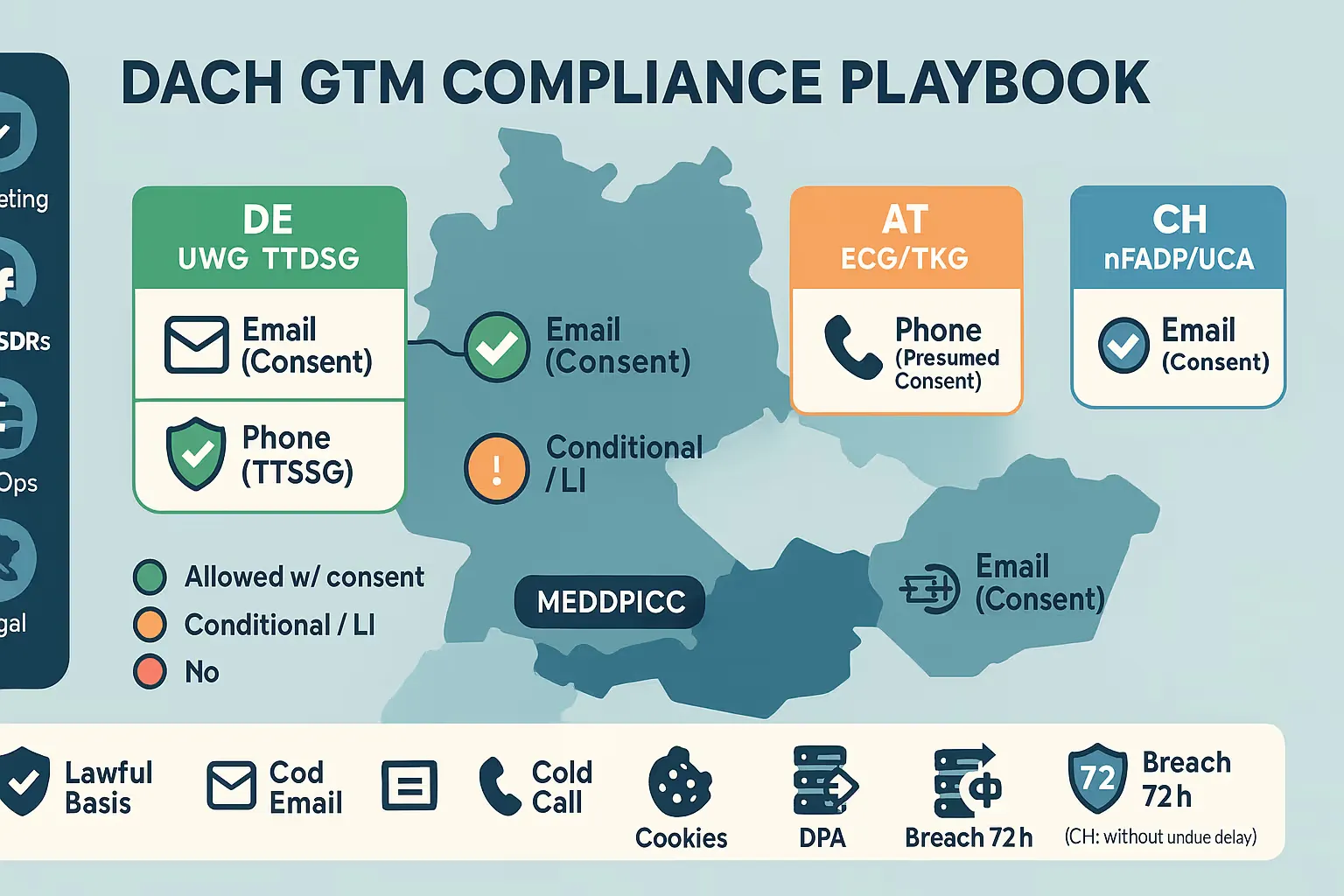
The DACH GTM Compliance Playbook visualizes data privacy expectations across Germany (DE), Austria (AT), and Switzerland (CH), clarifying where consent or legitimate interest applies for outreach and cookies. It helps GTM teams quickly understand what’s allowed—showing at a glance that email marketing requires consent everywhere, while B2B calling remains conditional under German and Austrian law.
Article
LeadGenius' guide covers data privacy regulations, compliance frameworks, audits, training & tech safeguards to enhance global strategies & build consumer trust.

Get precise, compliant, and on-demand contact data—tailored to your business needs.